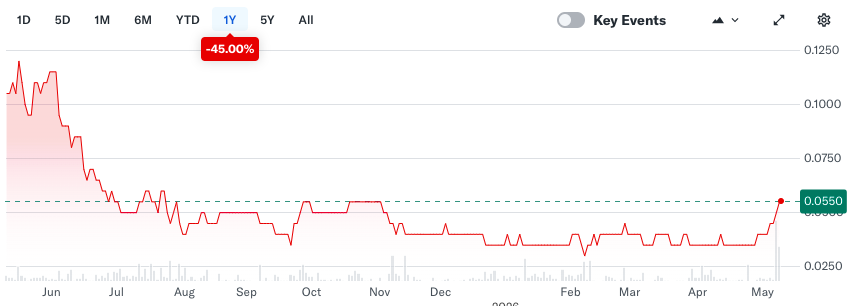
- AIML focus: AI/ML Innovations Inc. (CSE: AIML / OTCQB: AIMLF) trades around US$0.037–US$0.040 on the OTC market, with a micro-cap valuation around US$7M–US$10M.
- Main catalyst: AIML subsidiary NeuralCloud is building around AI-powered ECG signal processing, Holter analysis, and cardiovascular data workflows.
- Investor angle: AIML is much earlier and riskier than SOPH, RXRX, SDGR, and BFLY, but its valuation gives it more torque if NeuralCloud can convert pilots and research agreements into commercial traction.
AI healthcare is becoming one of the more interesting corners of the small-cap market because the addressable markets are large and still fragmented. Grand View Research estimated the global AI healthcare market at about US$26.6B in 2024 and projected it could grow at a roughly 38% CAGR from 2025 to 2030, while other industry forecasts point to healthcare AI becoming a US$100B-plus market over time. That creates room for companies using artificial intelligence to analyze ECG data, genomic data, drug-discovery data, ultrasound images, and patient workflows.
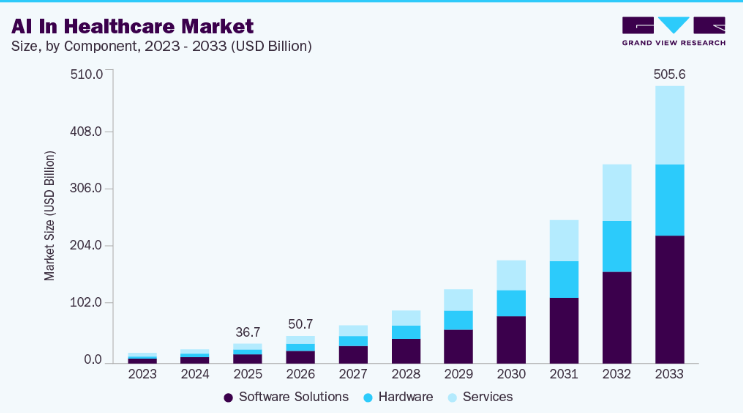
For investors, the opportunity is not just “AI in healthcare.” The real question is which companies have a focused product, a clear market problem, enough capital to execute, and early signs of customer adoption. That is why this watchlist combines one micro-cap name, AI/ML Innovations, with four larger small-cap or small/mid-cap comparables: SOPHiA GENETICS, Recursion Pharmaceuticals, Schrödinger, and Butterfly Network.
Market Catalyst: AI Is Moving Into Clinical Workflows
Healthcare AI is no longer limited to big promises about future medicine. It is starting to show up in real workflows: ECG interpretation, precision oncology, clinical trial design, imaging, hospital decision support, and drug discovery. The investment case is supported by hard numbers: cardiovascular disease is the world’s leading cause of death, responsible for roughly 17.9M deaths per year, while hospitals and clinics generate huge volumes of ECG, Holter, imaging, genomic, and patient-monitoring data that still require human review.
Two numbers show why this matters for investors:
- Holter monitoring can generate 24 hours to 14 days of continuous heart-rhythm data per patient, creating a labor-heavy review process where automation, signal cleaning, beat labeling, and interval measurement could improve workflow efficiency.
- Commercial AI healthcare adoption is already visible in adjacent markets: SOPHiA GENETICS processed 108,000 genomic analyses in Q1 2026, while Butterfly Network generated US$26.5M of Q1 2026 revenue, up 25% year over year.
That matters for AIML because its NeuralCloud platform is focused on ECG signal processing and cardiovascular-data workflows. The risk is that healthcare adoption is slow. Medical AI companies still face regulatory review, clinical validation, reimbursement questions, hospital procurement cycles, and cash burn. That makes the investable metrics clear: revenue growth, gross margin, customer count, cash runway, FDA or regulatory progress, commercial contracts, and recurring revenue matter more than buzzwords.
1. AI/ML Innovations: The Micro-Cap ECG AI Angle
AI/ML Innovations Inc. (CSE: AIML / OTCQB: AIMLF / FWB: 42FB) is the smallest and most speculative stock in this basket. The company is focused on digital health and artificial intelligence, with its NeuralCloud subsidiary building around AI-driven ECG processing and cardiovascular analytics.
The key product angle is MaxYield™, NeuralCloud’s ECG signal-processing platform. AIML says the system can convert raw or legacy ECG data into structured, machine-readable formats, isolate and label ECG waveform components, and generate beat-level data and interval measurements for downstream analysis.
- Investor data point: AIMLF trades around US$0.037–US$0.040, with a micro-cap valuation near US$7M–US$10M and roughly 271.1M shares outstanding.
The latest catalyst came from NeuralCloud’s research services agreement with the Baker Heart and Diabetes Institute. Under that agreement, NeuralCloud is applying MaxYield™ to existing ECG recordings for a cardiovascular research study evaluating heart rate variability in healthy control subjects compared with individuals experiencing post-exertional malaise.
For investors, the important part is not that this is already a huge revenue event. It is not. The important part is that AIML is trying to prove MaxYield™ in real research workflows with credible cardiovascular institutions. If those relationships lead to recurring research services, clinical partnerships, hospital workflow integrations, or Holter-reporting commercialization, AIMLF could start to look more like a focused medical-AI platform rather than a concept-stage micro-cap.
2. SOPHiA GENETICS: Precision Medicine at Scale
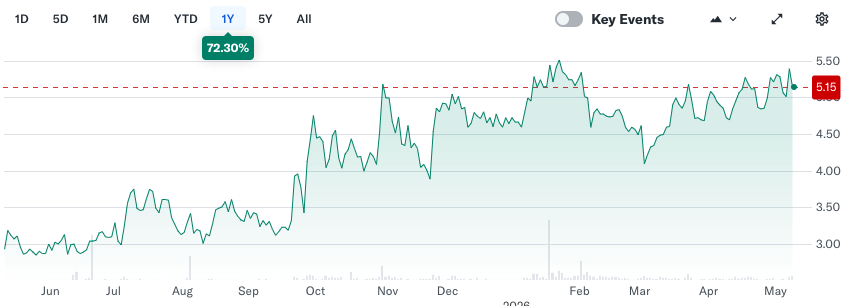
SOPHiA GENETICS (NASDAQ: SOPH) is a more mature AI healthcare name focused on data-driven medicine, especially genomic analysis and precision oncology. Recent market data showed SOPH trading around US$5, with a market cap around US$370M–US$380M.
Its latest Q1 2026 results showed US$21.7M in revenue, up 22% year over year, and a record 108,000 genomic analyses on the SOPHiA DDM™ platform. The company also reported 537 core genomics customers, up from 490 a year earlier, and guided for full-year 2026 revenue of US$92M–US$94M, implying roughly 20%–22% growth.
- Investor data point: SOPH is already proving commercial adoption, with 108,000 analyses in one quarter and more than 500 core genomics customers.
SOPH is useful as a comparison for AIML because it shows what healthcare AI can look like once a platform starts getting adopted by hospitals and labs. The risk is that SOPH remains loss-making, so investors still need to watch cash burn and the path toward EBITDA breakeven.
3. Recursion Pharmaceuticals: AI Drug Discovery Scale
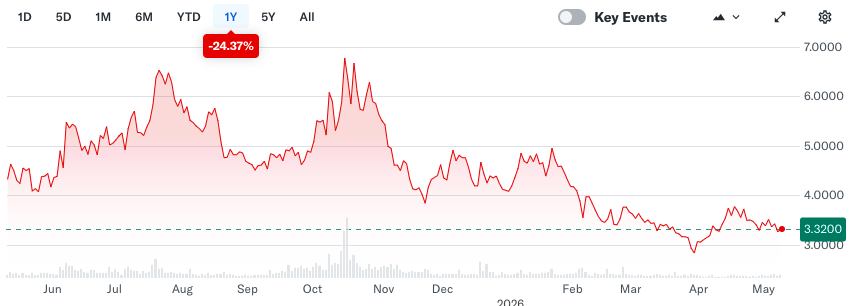
Recursion Pharmaceuticals (NASDAQ: RXRX) is one of the better-known AI drug discovery names. Recent market data showed RXRX trading around US$3.30, with a market cap around US$1.7B–US$1.8B.
The company’s platform is built around using large biological datasets, automation, and machine learning to discover and develop medicines. For investors, RXRX offers exposure to the idea that AI can make drug discovery faster, more systematic, and more scalable.
- Investor data point: RXRX carries a much larger valuation than AIML, around US$1.7B–US$1.8B, showing how much premium the market can assign to scaled AI drug-discovery platforms.
The opportunity is large, but the stock also shows the risk of the sector. Even with a much larger valuation than AIML, RXRX still depends on clinical progress, partnership economics, and investor confidence in long-term platform value. Revenue can be uneven, and biotech sentiment can move sharply with trial updates or funding conditions.
4. Schrödinger: Computational Drug Discovery and Software
Schrödinger (NASDAQ: SDGR) is another AI and computational drug-discovery company, but with a different profile. Recent market data showed SDGR trading around US$13, with a market cap around US$950M–US$1.0B.
Schrödinger combines a software business with a drug-discovery pipeline. That gives investors two angles: recurring software revenue from life-sciences customers and longer-term upside from internally discovered or partnered drug candidates.
- Investor data point: SDGR’s market cap near US$950M–US$1.0B shows investors are still assigning meaningful value to computational drug-discovery platforms, even before large-scale profitability.
The attraction is that SDGR has an established computational platform used across pharmaceutical research. The risk is that the company is still loss-making, and drug-discovery upside can take years to show up in revenue or earnings. For AIML investors, SDGR is a reminder that strong technology still needs commercial scale and disciplined capital allocation.
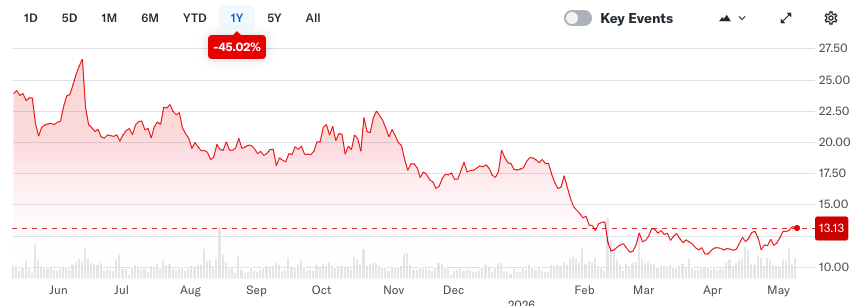
5. Butterfly Network: AI-Enabled Medical Imaging
Butterfly Network (NYSE: BFLY) gives investors exposure to AI-enabled medical imaging and portable ultrasound. Recent market data showed BFLY trading around US$4.20–US$4.30, with a market cap around US$1.1B–US$1.3B.
The company reported Q1 2026 revenue of US$26.5M, up 25% year over year, with gross margin improving to 68.9% from 63.0% a year earlier. Butterfly also reaffirmed full-year 2026 revenue guidance of US$117M–US$121M.
- Investor data point: BFLY combines revenue growth with improving gross margin, which is important because AI medical-device companies still need to prove they can scale efficiently.
The AI angle became more visible after Butterfly received FDA clearance for an AI-powered ultrasound tool that estimates gestational age. For investors, BFLY is a useful example of how AI can move into medical devices and workflow automation, not just software dashboards.
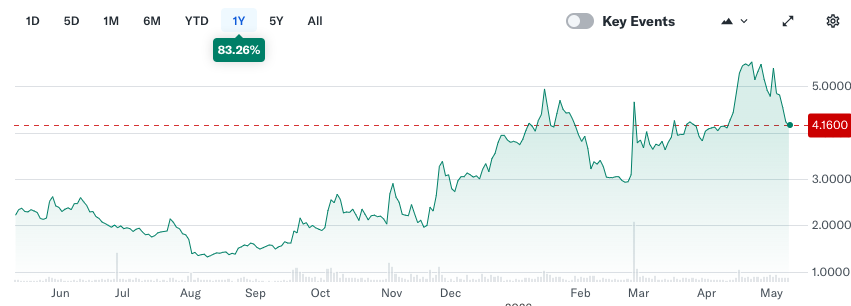
Stock Snapshot
| Company | Ticker | Recent Price | Market Cap | Latest Key Number | Main AI Healthcare Angle |
|---|---|---|---|---|---|
| AI/ML Innovations | CSE: AIML / OTCQB: AIMLF | ~US$0.037–US$0.040 | ~US$7M–US$10M | 271.1M shares outstanding on CSE | ECG AI, Holter analytics, NeuralCloud MaxYield™ |
| SOPHiA GENETICS | NASDAQ: SOPH | ~US$5 | ~US$370M–US$380M | Q1 revenue +22% YoY to US$21.7M | AI precision medicine and genomics |
| Recursion Pharmaceuticals | NASDAQ: RXRX | ~US$3.30 | ~US$1.7B–US$1.8B | 52-week range around US$2.80–US$7.18 | AI drug discovery platform |
| Schrödinger | NASDAQ: SDGR | ~US$13 | ~US$950M–US$1.0B | Computational platform plus drug pipeline | Molecular modeling and drug discovery software |
| Butterfly Network | NYSE: BFLY | ~US$4.20–US$4.30 | ~US$1.1B–US$1.3B | Q1 revenue +25% YoY to US$26.5M | AI-enabled portable ultrasound |
Bottom Line
AI/ML Innovations is the speculative micro-cap in this AI healthcare basket. AIMLF has a focused ECG-AI angle, exposure to Holter and cardiovascular-data workflows, and a real research services agreement that could help validate NeuralCloud’s MaxYield™ platform.
The key watch items are simple: more research agreements, hospital or clinic pilots, Holter-reporting commercialization, recurring revenue, and funding discipline. If those pieces start to appear, AIMLF could begin looking less like a concept stock and more like an early-stage AI healthcare platform.
This is sponsored content. Investors should conduct their own due diligence and consult a qualified financial advisor before making any investment decisions.

Marc has been involved in the Stock Market Media Industry for the last +5 years. After obtaining a college degree in engineering in France, he moved to Canada, where he created Money,eh?, a personal finance website.