This article has been prepared on behalf of AIML Innovations Inc. and is for informational purposes only. It does not constitute financial advice or a recommendation to buy or sell securities.
- AI transforms Holter workflows from labor-limited to software-scalable systems
- Throughput potential increases from ~3–5 to 20–30+ reports per day per technician
- Clear wedge in a multi-billion dollar monitoring market with strong demand tailwinds
A fundamental challenge to Holter ECG analysis today exists in terms of human input. Cardiac monitoring has increased dramatically, but so too have the number of manual reviews of signals, removal of artifacts, and clinician readings. In essence, a structural barrier has been created that limits production to the amount of personnel available versus the demand for these services.
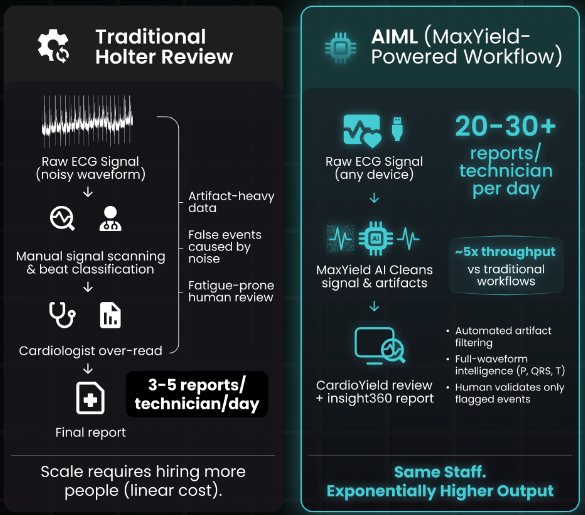
To counteract this limitation, AIML Innovations has chosen to directly address this limitation. Instead of creating new values in each test; the company is attempting to create additional tests within the exact same system. Through utilizing an artificial intelligence component in their workflow, AIML believes they can turn a linear, labor-intensive method of processing tests into a software based high-throughput engine.
Technology & Workflow: Creating AI Driven Efficiency Versus Human Based Labor Intensive Review Process
Traditionally, Holter analysis involves a technician scanning a raw ECG signal looking at all the beats in the signal and passing them along to a cardiologist for final reading. There are numerous limitations associated with this type of process including excessive amounts of time being consumed performing each task, fatigue related errors and ultimately producing 3 – 5 reports per technician per day. To grow the volume of tests would require hiring more staff which will increase cost in a linear fashion.
AIML’s MaxYield powered workflow takes advantage of the automation of removing noise and artifacts from ECG signals and the initial analysis before providing clinicians with prioritized data that contains only the most important information. Therefore, clinicians no longer need to review large sets of data in order to find clinically relevant events. Ultimately, clinicians are able to focus on what is clinically relevant. Therefore, a clinic/hospital can generate significantly more reports per day (up to 20 – 30 + reports per day), which equates to a minimum of a 5x increase in reports compared to other workflows using traditional methods. Additionally, the increased report volume is generated with little to no additional staff, essentially converting operational efficiency into financial leverage.
Market Impact & Economic Model
Holter monitoring is a multibillion-dollar global market. Millions of tests are conducted annually throughout North America. Each test has a defined payment schedule or reimbursement rate therefore an increase in test volume is a direct correlation to an increase in revenue potential for clinics and hospitals.
As previously stated, AIML’s business model is structured to benefit from an increase in revenue potential. The business model utilizes SaaS based pricing, per-report fees, and enterprise agreements. Therefore, when there is an increase in throughput, AIML benefits from the increase in volume. Modest increases in efficiency such as 25-50% will provide incremental revenue for providers whereas larger increases (i.e., 2-4x throughput) will provide step-change economics.
Competitive Positioning: Identifying a Unique Space Within a Competitive Industry
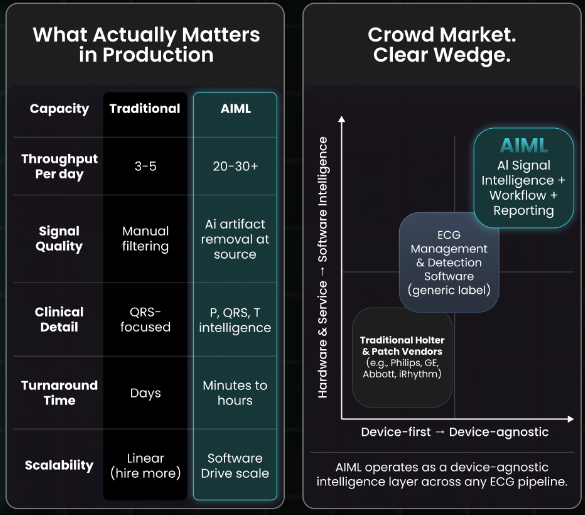
The ECG/cardiac monitoring industry consists of well-established medical device manufacturers and software companies. Most existing solutions focus either on detecting conditions or improving the function of devices.
However, by positioning itself as an intelligence layer that interfaces with an ECG across all segments of the ECG flow stream, AIML is creating a unique competitive wedge. Instead of competing on who provides better hardware, AIML is enhancing existing systems through AI based analysis and reporting. When AIML focuses on workflow intelligence and does not compete for device ownership it can potentially interface with multiple systems and scale faster.
Valuation: Applying Software Economics to Healthcare Workflows
- Scaling from linear (labor) to scalable (software)
- Tying revenue directly to volume expansion and workflow integration
- Positioning micro-cap valuation against multi-billion dollar monitoring market
- Creating upside through adoption, integration and enterprise deployments
Why Now: Intersecting Drivers
- Increasing numbers of individuals requiring cardiac monitoring as the population ages
- Pressure on healthcare systems to operate more efficiently
- Growing use of AI in clinical workflows
- AIML is beginning commercialization with expanding partnerships
Conclusion: Scalable Version of What Currently Exits
AIML is not re-inventing cardiac diagnostics, it is re-inventing how the current diagnostic systems produce reports. By identifying the primary bottleneck in Holter analysis, AIML is combining the clinical requirement with the financial incentive. If successful, AIML could become a major contributor to scaling cardiac monitoring — converting a labor limited process into a software driven growth engine.

Marc has been involved in the Stock Market Media Industry for the last +5 years. After obtaining a college degree in engineering in France, he moved to Canada, where he created Money,eh?, a personal finance website.