AI/ML Innovations Inc. (CSE: AIML | OTCQB: AIMLF), is a Healthcare company operating in a space where there is large demand, yet still limited by cost of human labor. Globally, more than 300 million ECGs are produced every year, in various environments, including hospitals, cardiology clinics, diagnostic labs and an increasingly large universe of wearable and patch based devices. That is >1 billion ECGs over 10 years.
In traditional clinical environments alone, ECG and Holter monitoring represent an estimated $6 – $11 billion annual market, while the broader ECG capable device ecosystem represents an estimated >$80 billion when considering the growth of consumer wearable and telemedicine applications. This is not about the level of adoption; it is about the amount of volume.
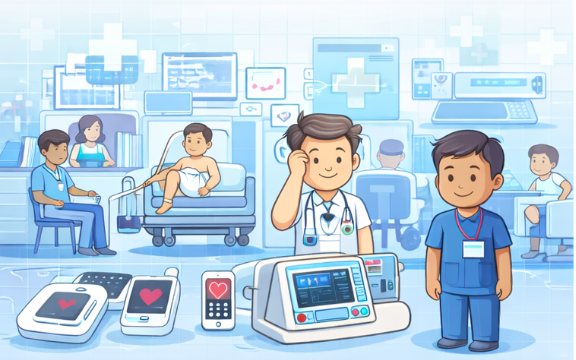
What Does One ECG Represent?
- Standard ECG: approximately $20 per report (large volumes, simple processing)
- Holter Monitoring (24 – 48 hours): approximately $200 – $300 per report (smaller volumes, larger values)
- Extended / Patch ECG: >$300 per report (fastest growing segment)
- Constant Factor: payment for reimbursement does NOT change as a result of using AI
- Economic Lever: Amount of reports processed each day
The Structural Bottleneck
ECG and Holter workflows today are fundamentally labor bound. Technicians manually have to scan each beat of each report, resulting in approximately 3 – 5 reports per technician per day. Reports commonly take one to three days to complete and sometimes longer to get back to clients for Holter studies. The labor shortage of skilled cardiac technicians further exacerbates the bottleneck in the ability to scale the workflow.
Incremental automation has made some improvements to the workflow margins, however, the majority of legacy systems continue to depend on the technician to clean up and review the remaining issues.
Why Does AI Change the Economics
- AI does not change pricing, it changes capacity
- Cleaning the Signal Before Review: Reduces the noise and makes it easier for humans to review
- Increased Throughput: ~ 5x compared to traditional workflows
- Productivity: 15 – 30+ reports per technician per day
- Turnaround Time: Reduced from Days to Minutes/Hours
- Results: Same Staff, Significantly Higher Output
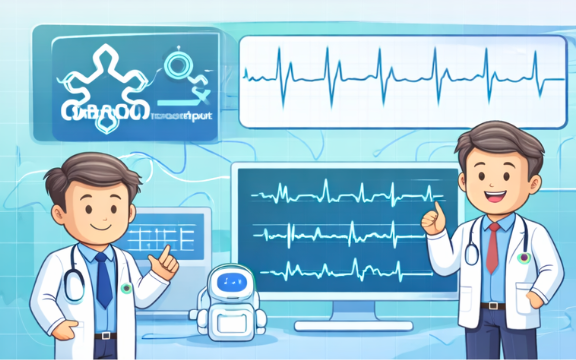
Signal Intelligence vs. Status Quo
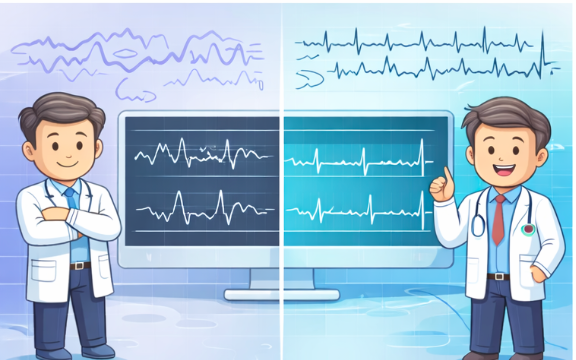
Most competitors use AI to improve detection rates on already noisy ECG data and leave the artifacts present in the data. However, AIML uses signal intelligence, which cleanses the signal prior to classification rather than cleansing the signal after classification.
This distinction is significant in production environments. Traditional manual review is linear and fatiguing. Rule-based automation is more efficient but still dependent upon human labor. AI applied to noisy data improves speed but plateaus at accuracy. AIML’s signal first approach allows for 25–30+ reports per technician per day and better waveform fidelity in the P, QRS, and T segments.
An Example Using Holter Monitoring
The Holter segment is a prime example of how AIML is able to leverage the economics. In the U.S., Holter tests generate $100–$140 under Medicare equivalent reimbursement, $120–$180 under private insurance and $200–$400 per test for cash pay clinics. In Canada, both public and private reimbursement is common for between CA$120–$300 per Holter.
Volume compounds very quickly. For example, a mid-sized clinic processes 3,000–8,000 Holters per year, while a hospital system can easily surpass 20,000–100,000 Holters annually. However, a cardiologist is only able to read 15–25 Holters per day, thus leading to chronic backlog and burnout.
Where AIML Fits
AIML is not replacing the clinician. AIML is multiplying the clinician. AIML is taking all of the clinically irrelevant information out of the ECG and only presenting the clinician with clinically relevant information. Thus, the clinician focuses on exception reporting, rather than raw data. Therefore, the same staff can handle 2–4 times the volume with no loss in clinical quality.
Reality of Monetizing Revenue Streams
- Revenue Models: Per report Software-as-a-Service, Per Clinic Licensing, Per Contract Enterprise Based on Volume
- Example Pricing: $5–15 per Holter software fee
- Example Clinic: 5,000 Holters per year = $25k–75k Annual Recurring Revenue (ARR)
- Enterprise Systems: Potential Six Figure ARR per deployment
- Primary Driver: Volume, Not Unit Price
Commercial Advancement
In December, AIML announced a commercial Term Sheet through their NeuralCloud Subsidiary with Culminate H Labs, to integrate MaxYield™ and Insight360™ into the INTRINSICA DNA-guided BioFeedback Platform. Although the term sheet is non-binding, the agreement indicates platform level integration as opposed to isolated experiments and opens the door to a quicker path to commercialization in the areas of Wellness and Personalized Health Channels.
Conclusion
AI/ML Innovations Inc. (CSE: AIML | OTCQB: AIMLF) is not trying to change the price of ECG analysis. AI/ML Innovations Inc. (CSE: AIML | OTCQB: AIMLF) is trying to remove the labor bottleneck that limits the volume. There are currently 300+ Million ECGs generated every year, therefore, throughput is the economic lever. If AIML is able to successfully convert the integration of their technology to contractually obligated use cases, software style economics will likely emerge from a marketplace that has traditionally relied on labor.
AI/ML Innovations Inc. (CSE: AIML | OTCQB: AIMLF) is not wagering on changing the price of ECG analysis. AI/ML Innovations Inc. (CSE: AIML | OTCQB: AIMLF) is wagering on changing how many ECGs are processed by one technician. With 300M+ ECGs per year being generated, volume is the lever. If AIML is successful in executing commercially, volume economics — not hype are what drives the upside.
Posted on behalf of Guerilla Capital for the issuer.

Marc has been involved in the Stock Market Media Industry for the last +5 years. After obtaining a college degree in engineering in France, he moved to Canada, where he created Money,eh?, a personal finance website.