AIML Innovations Inc. (CNSX: AIML) today announced a collaborative effort with Movesense to provide expanded, bundled ECG solutions consisting of wearable ECG capable devices paired with AIML’s AI-based signal intelligence and workflow software.
This new relationship is targeted at addressing a major bottleneck in cardiac diagnosis: ECG analysis is limited by the human processing capacity of technicians and physicians despite the ongoing expansion of test volumes.
This new development follows AIML’s position in the ECG and Holter monitoring space, where AIML is focused on transitioning ECG analysis from a labor-intensive process to a scalable software-driven economic model.

The News — AIML and Movesense Collaboration
The collaboration with Movesense was established to provide bundled ECG solutions, which would combine wearable ECG devices with AIML’s ECG analysis stack, including end-to-end ECG workflows that encompass the acquisition, cleaning and review of ECG data, and offer these as a bundle to clinics, diagnostic providers and healthcare systems.
The key aspects of the announcement include:
- Integration of Movesense wearable ECG devices with AIML’s ECG analysis stack
- Creation of end-to-end ECG workflows that include acquisition, signal cleaning, and clinical review of ECG data
- Bundled solutions for clinics, diagnostic providers, and healthcare systems
Integration of Movesense wearable ECG devices with AIML’s ECG analysis stack
Creation of end-to-end ECG workflows that include acquisition, signal cleaning, and clinical review of ECG data
Bundled solutions for clinics, diagnostic providers, and healthcare systems
By providing bundled hardware and software solutions, AIML lowers barriers for its customers to implement ECG monitoring at scale.
Industry Context — ECG Is A High-Volume Market
ECG and Holter monitoring represents a large-scale, repetitive-use market; millions of ECGs and Holter tests are performed each year in hospitals, clinics and diagnostic laboratories.
However, the current ECG analysis economics are limited by:
- Low per-test revenues associated with standard ECGs, but very high volumes of tests
- Higher-value Holter and extended ECG reports require more time and labor to analyze
- There is a limit to how many reports a technician and/or cardiologist can process per day due to staffing constraints
Low per-test revenues associated with standard ECGs, but very high volumes of tests
Higher-value Holter and extended ECG reports require more time and labor to analyze
There is a limit to how many reports a technician and/or cardiologist can process per day due to staffing constraints
Therefore, it takes many hours to days to complete the reporting process and increasing volume generally requires additional staff.

How AI Can Improve Productivity
AIML’s focus on signal intelligence, rather than AI-classification layered upon poor-quality data, enables much greater throughput per technician with cleaned ECG signals and structured data before clinical review.
In accordance with AIML’s statements and supporting materials:
- Traditional work flows allow 3 – 5 reports per technician per day
- Workflows enabled with AI can increase report production to 20 – 30 + reports per technician per day
- Turn-around time is reduced from days to minutes or hours
Traditional work flows allow 3 – 5 reports per technician per day
Workflows enabled with AI can increase report production to 20 – 30 + reports per technician per day
Turn-around time is reduced from days to minutes or hours
Most importantly, while the reimbursement rate per ECG test does not change, the increased number of reports processed per technician allows for the leveraging of software and increases the opportunities for software revenue generation.
Market Opportunity — From Volume to Value
The global ECG and Holter monitoring market consists of hundreds of millions of tests performed each year, supported by an installed base of millions of ECG capable devices. The application of even modest amounts of software monetization at scale provides a tremendous revenue opportunity.
AIML’s business model includes:
- Software charges per report layered on top of existing reimbursement rates
- License agreements based on clinic or enterprise volume
- Long-term contract agreements with diagnostic providers and health systems
- Software charges per report layered on top of existing reimbursement rates
- License agreements based on clinic or enterprise volume
- Long-term contract agreements with diagnostic providers and health systems
At scale, even low single-digit dollar increments in revenue per ECG test, compounded over multiple years, create large, recurring revenue streams.

Performance of AIML — Building Positioning in AI-Driven ECG Analysis
AIML Innovations is in an early stage of commercialization, so its performance should be evaluated based on strategic progress versus short term financial scale. To date, AIML has been focused on developing signal-intelligence capabilities, validating improved workflows, and adding partners like Movesense to its network.
Some key performance metrics are discussed in AIML’s public-facing documents, including:
- Demonstrating throughput improvements of 5x+ in ECG analysis work flows
- Establishing a presence in a large-volume clinical market with a high volume of repeat use-cases
- Creating an ecosystem to provide integrated hardware, software and clinical workflows
- Demonstrating throughput improvements of 5x+ in ECG analysis work flows
- Establishing a presence in a large-volume clinical market with a high volume of repeat use-cases
- Creating an ecosystem to provide integrated hardware, software and clinical workflows
Unlike AIML’s competitors who focus on device manufacturing or changing reimbursement levels, AIML’s competitive strategy is centered on software leverage — increasing output using the same clinical labor base.
Strategic Implications
The Movesense collaboration adds to AIML’s strategic positioning:
- Expanding AIML’s reach through bundles of hardware and software
- Lowering barriers to entry for customers who wish to adopt AI-enabled ECG analysis
- Strengthening AIML’s role as an intelligence layer for ECG analysis that is independent of devices used to collect ECG data
- Expanding AIML’s reach through bundles of hardware and software
- Lowering barriers to entry for customers who wish to adopt AI-enabled ECG analysis
- Strengthening AIML’s role as an intelligence layer for ECG analysis that is independent of devices used to collect ECG data
Instead of eliminating clinical personnel, AIML’s strategy is to enable clinical personnel to process significantly larger volumes of ECG tests.
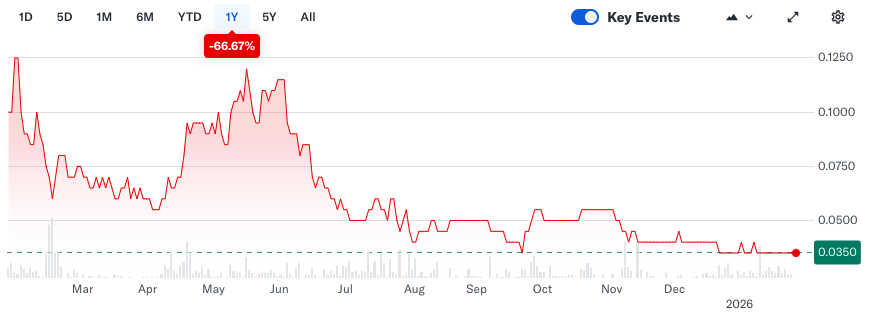
Trading Performance — Valuation, Volatility, and AI-Optionality
AIML Innovations’ stock price has fluctuated greatly over the last year, primarily as a function of the uncertainty of the early-stage execution of the company’s business plan, as well as the general volatility of small cap stocks. As of late January 2026, AIML’s shares are trading around C$0.035, representing a market capitalization of approximately C$6.6 million.
Recent data related to AIML’s stock trading activity includes:
- Year-over-year declines of ~65%
- A 52-week trading range of approximately C$0.03 to C$0.14
AIML is a microcap technology company, and therefore, there is limited liquidity available to support buying/selling activity.
It is worth noting that AIML operates within a broader theme of AI-enabled healthcare and workflow automation, which has historically caused dramatic re-rating of companies in this space when their execution matches the expectations of investors. Historically, companies such as NVIDIA, Palantir and C3.ai have experienced significant appreciation in their share prices as the adoption of AI has accelerated in various industries. However, while there is always some degree of uncertainty associated with executing an early-stage business plan, the optionality provided by AIML’s exposure to applied-AI in healthcare may also present the potential for significant long-term appreciation if investor interest in AI-enabled productivity solutions continues to build.
Risks and Considerations
While the potential is significant, there are a number of risks and considerations to be aware of:
- Adoption of AIML’s product by clinics and diagnostic providers
- Deployment timelines for AIML’s products with its customers
- Potential competition from traditional ECG platforms, as well as emerging AI-based vendors
- Adoption of AIML’s product by clinics and diagnostic providers
- Deployment timelines for AIML’s products with its customers
- Potential competition from traditional ECG platforms, as well as emerging AI-based vendors
Success of AIML’s commercial efforts, customer validation and repeat sales will be important measures of successful execution.
Conclusion
The collaboration between AIML and Movesense aligns with a larger trend in the cardiac diagnostics industry toward using software to improve operational efficiencies. By integrating wearable ECG capable devices with AIML’s AI-based signal intelligence, AIML is targeting the central bottleneck in ECG analysis: the ability of humans to process ECG data. If the expected level of adoption occurs, AIML’s model demonstrates how volume in healthcare can be converted to value through software.
Posted on behalf of Guerilla Capital for the issuer.

Marc has been involved in the Stock Market Media Industry for the last +5 years. After obtaining a college degree in engineering in France, he moved to Canada, where he created Money,eh?, a personal finance website.