Copper Quest Exploration Inc. (CSE: CQX), is expanding its Kitimat Copper-Gold Project in British Columbia using a combination of land acquisition and AI-driven geological identification.
In addition to greatly enlarging the project’s land base, Copper Quest has created a high-priority porphyry target, based on both past work and current analytical techniques.
The progression of events indicates that Copper Quest has established a clearly defined strategy: expand land holdings around high conviction targets and utilize artificial intelligence to identify concealed large-scale systems.
Land Acquisition and Growth
Copper Quest (CSE: CQX) recently filed an application to increase the Company’s interest in an additional 3,847 hectares of land. This represents an approximate 130% increase to the total size of the project.
The expanded land position now totals approximately 6,801 hectares. It also encompasses the historic Bowbyes target area.
Acquiring this additional land provides Copper Quest (CSE: CQX) with greater control over a larger portion of the mineralized system and provides adequate coverage of several important geological characteristics.
AI Generated Porphyry Target
The largest focus point of recent advancements at the Kitimat Copper-Gold Project is a large conductive anomaly identified utilizing AI-based modeling.
Approximately 1.5 kilometers x 1.5 kilometers in horizontal extent; demonstrates vertical continuity to at least 1 kilometer depth; begins approximately 50 meters below surface beneath a layer of sediments.
The location of the anomaly is situated within a magnetic corridor which suggests possible intrusive contact(s). Such contact(s) are common in porphyry systems.
Geological Setting Supports Large-Scale System
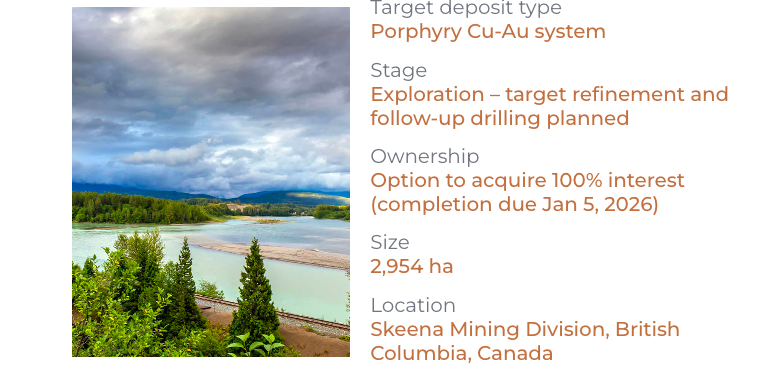
The target sits within a geologically favorable environment that is typical of large-scale copper-gold systems.
• Situated adjacent to areas demonstrating magnetic gradient and conductive structure;
• Located proximal to volcanic hosted sulfide mineralization;
• Interpreted as a potential concealed intrusive porphyry center;
• Provides evidence that mineralization encountered during previous drilling may be part of a larger system that extends beyond the immediate drill hole locations.
Previous Drilling Validates Exploration Model
Drilling completed at the Jeannette target area provides strong historical validation for the exploration model utilized at the Kitimat Copper-Gold Project.
• Included intercepts of 117.07m @ 0.54% Cu and 1.03 g/t Au;
• Additional results included numerous 100 meter plus intervals with consistent Cu-Au grades;
• Mineralization remains open and untested at depth;
These results provide strong evidence supporting the potential magnitude of the system being explored and demonstrate alignment with mineralization patterns commonly associated with porphyry style deposits.
Multiple Target Areas
Two separate, yet related, target areas currently exist within the project.
• Jeannette: epithermal Cu-Au deposit, likely sourced from a porphyry intrusion;
• Bowbyes: Cu-Mo mineralization, exhibiting both vein and disseminated styles;
• Both target areas display alteration patterns characteristic of porphyry environments;
• A multi-target configuration will enhance the likelihood of discovery across the entire property.
Integration of Artificial Intelligence into Exploration Workflow
Copper Quest (CSE: CQX) is incorporating artificial intelligence into its exploration process.
• Partnership agreement with ExploreTech enables creation of probabilistic 3-D models;
• Utilizing AI-generated thousands of different geological models using historical data;
• Identified high probability areas for the presence of intrusive centers and sulfide systems;
• AI will enhance exploration targeting effectiveness and reduce exploration risks.
Market Demand for Copper
Global demand for copper continues to be one of the leading commodities due to growing electrical use, growth of global infrastructure, and continued technological innovation.
- Global copper demand was approximately 28 million tonnes in 2025 and is projected to reach ~42 million tonnes by 2040.
- Demand for copper is expected to continue to grow by >40%-50% over the next two decades and require up to 80 new mines and ~$250 billion in capital expenditure to meet anticipated requirements.
- The global copper market was valued at ~$291 billion in 2025 and is expected to exceed $300 billion in 2026.
- Increasingly apparent supply constraints are developing throughout the industry.
- Global copper demand already exceeds available supply by ~300,000 to 500,000 tonnes each year in recent studies.
- Refined copper deficits of ~330,000 tonnes are predicted for 2026.
- International Energy Agency forecasts a potential supply shortage of up to 30% by 2035 without substantial new development.
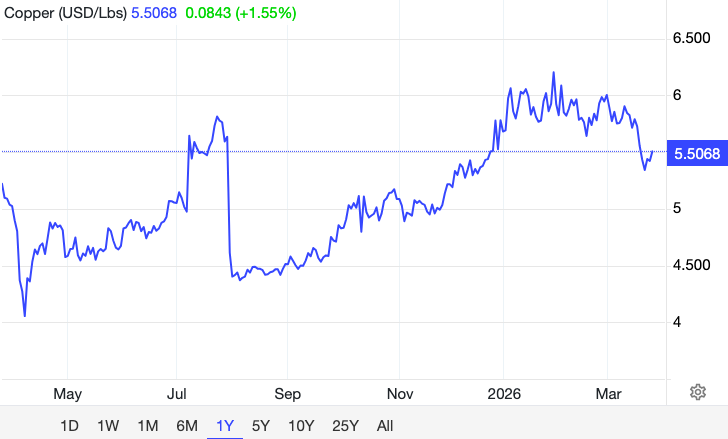
As such, copper prices have trended upwards strongly in response to these conditions.
Price movements have exceeded ~20% in 2025 and are estimated to range from ~$12,000-$12,500 per tonne in 2026.
Long term fundamentals for copper are well-supported by electric vehicles, renewable energy generation, AI-based infrastructure, and continued grid expansion.
Conclusion
Copper Quest (CSE: CQX) is applying land acquisition and advanced AI-based targeting techniques to develop a potentially very large copper-gold system at Kitimat.
With existing historical drilling success, a newly discovered conductive anomaly, and multiple mineralized zones, Copper Quest (CSE: CQX) has set the stage for further exploration and discovery.
Posted on behalf of Guerilla Capital for the issuer.

Marc has been involved in the Stock Market Media Industry for the last +5 years. After obtaining a college degree in engineering in France, he moved to Canada, where he created Money,eh?, a personal finance website.