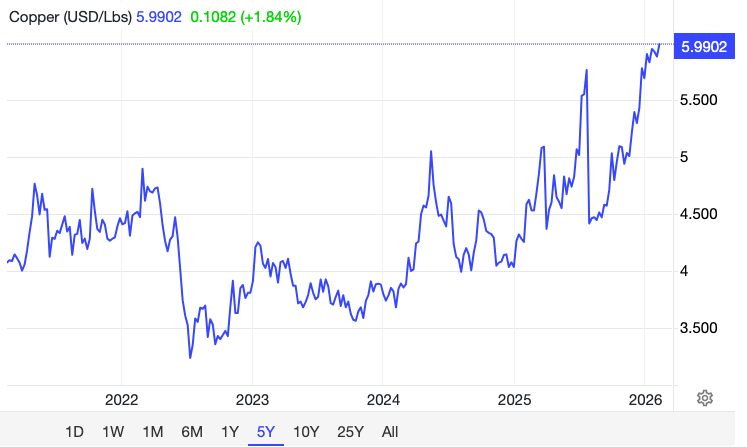
The future of copper is looking bright again. Global demand for copper is expected to grow as a result of increasing electrification, as well as the increasing need for renewable energy and other technologies associated with “the clean-energy revolution.” As such, copper prices have reached historic highs — with spot pricing for copper reaching approximately $5.9 per pound in early February 2026, following a print of a new all time-high at approximately $6.58 per pound in January 2026.
The stage is set for copper to move even further upward in price, thanks to the interaction of three forces: (1) the increasing demand for copper from the growing use of electricity from grids, electric vehicles, data centers and industrial build-out; (2) the ongoing challenges facing suppliers of copper due to declining grades of ore mined and the lengthy permitting process for new mines; and (3) geopolitical factors leading to governments taking steps to develop friendly and secure critical mineral supply chains.
Market / Industry Context
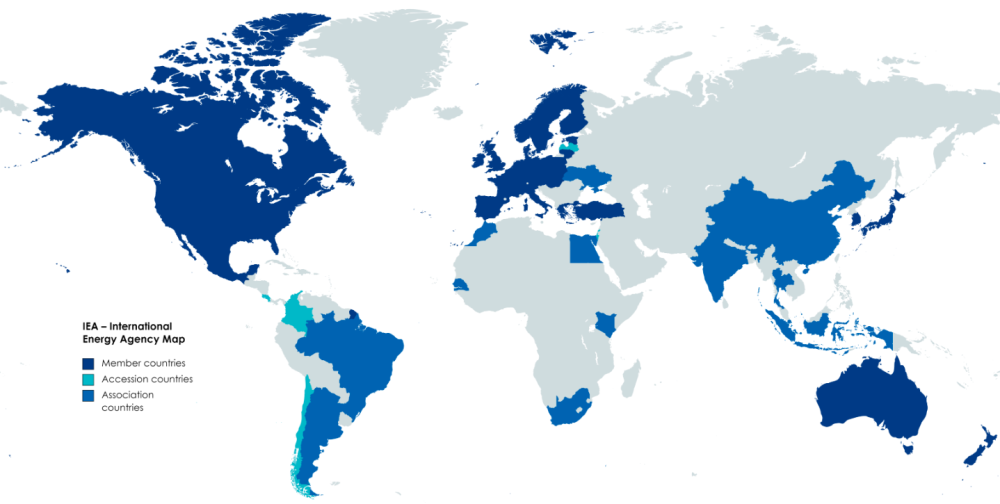
As noted in the previous section, copper is uniquely positioned at the epicenter of the “energy transition” given its difficult-to-substitute nature in wiring, motors, transformers, and grid infrastructure. The International Energy Agency (“IEA”) estimates that annual copper demand for electricity grids will increase from approximately 5 million tons (“Mt”) in 2020 to 7.5 Mt by 2040 in the IEA’s “Stated Policies Scenario,” and 10 Mt by 2040 in the IEA’s “More Ambitious Climate Scenario.”
Independent research has identified multiple vectors driving the long-term growth of copper demand — both on the core-economic demand side and the broader demand side which includes electrification, renewable energy, electric vehicles, and the incremental pull from artificial intelligence (“AI”) and data centers. A recent outlook projected global copper demand to grow approximately 50% to approximately 42 Mt by 2040, with the potential of a 10 Mt supply shortfall absent significant new investments and risk-reducing measures.
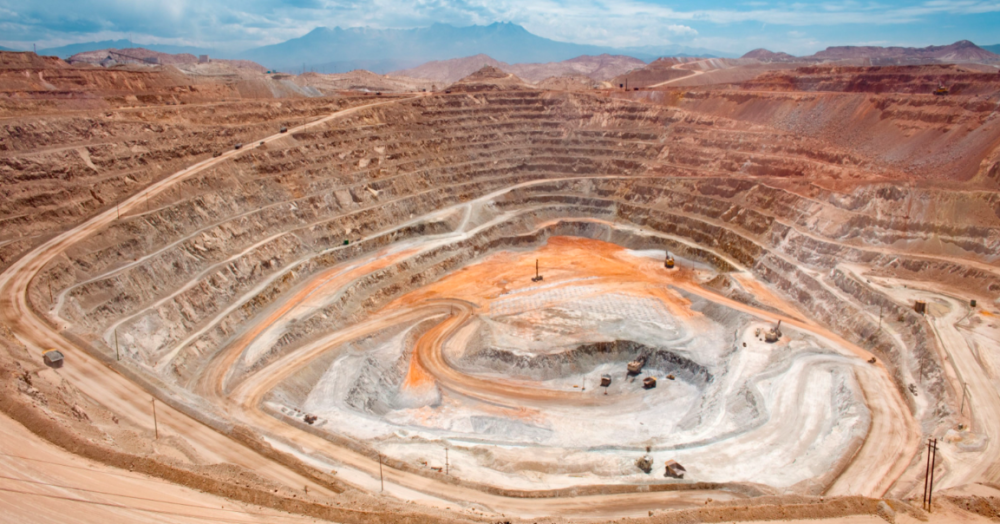
Disruptions to the supply chain and the depletion of reserves also matter. The closure of the Cobre Panamá Mine in Panama eliminated a primary source of new copper production; it produced approximately 330,863 tons in 2023 or approximately 1.5% of global copper supply. The largest producers of copper are also facing lower grades and operational constraints: Anglo-American reported a 10% decline in 2025 copper production and reduced its 2026 production guidance, and Chile’s Codelco continues to face significant reinvestment requirements in order to forecast copper production at approximately $4.90 per pound in its 2026 budget assumptions.
Core Thesis
Yes — copper can plausibly “pace up” from this point forward; however, the path to additional price appreciation may be volatile. The most compelling argument supporting the thesis is structural: copper demand growth is being accelerated by the increasing use of electricity and digital infrastructure, while copper supply growth is constrained by the geological characteristics of the deposits available to be mined (i.e. declining grades of ore), capital intensity of mining operations, and the permitting process required for new mines to come into production.
If copper prices continue to trade at elevated levels, capital typically flows to earlier-stage explorers and developers operating in stable jurisdictions with existing infrastructure — the segment of the copper market where upside potential exists based upon discovery and de-risking events.
Key Drivers & Catalysts
- Electrification & Grid Build-Out: The copper content is high in all types of power networks, and the IEA’s long-range projections of copper demand for the grid indicate a decades-long drawdown.
- AI + Data Centers: Incremental copper demand resulting from the rapid development and deployment of data centers and power delivery systems is a rapidly emerging new driver of copper demand. (spglobal.com)
- Supply Constraint Narrative: Disruptions (such as the Cobre Panamá Mine) combined with declining grades and the long timeframes required for permitting are limiting the rate at which new supply can be added to the market to meet increasing demand.
- Geopolitics & Industrial Policy: Governments are actively seeking to establish friendly and secure critical mineral supply chains. Recent reporting by Reuters highlights recent U.S.-led initiatives and alliance-building aimed at reducing dependence on foreign sources and stabilizing the global critical mineral markets.
- Tariff-related Disruptions: The market has priced-in the potential for tariffs to be imposed by the U.S. government, creating regional premium pricing and incentivizing the movement of metal through the supply chain.
Competitive Landscape
The copper industry includes:
- Majors / Producers that are increasingly copper-weighted (and often supply-constrained)
- Companies developing late-stage or permitted projects
- Exploration companies focused on discovering copper deposits in known copper belts, where a single successful drilling program can re-rate valuation
In the junior category, investors typically seek companies that have:
- Large land holdings in established copper belts
- Clear drilling targets
- Infrastructure access
- Sufficient funding to support meaningful drilling programs.
Risks & Considerations
- Global Macro Sensitivity: Copper is cyclical; a sharp global recession can overwhelm structural narratives in the short-term.
- China Demand Swings: Copper pricing historically responds to China’s property and industrial cycles.
- Execution Risk of Projects: Permitting, Community Engagement, Drilling Success, and Dilution Remain Core Risks to Juniors.
- Price Volatility: Even in Bull Markets, Copper Prices Can Correct Hard and Fast.

Copper Quest — One Paragraph Company Summary
Copper Quest Exploration Inc. (CSE: CQX; OTCQB: IMIMF; FRA: 3MX) is assembling a North American Critical Minerals portfolio that includes several copper properties in British Columbia and the United States. In its Q4 2025 Corporate Presentation, Copper Quest highlighted the Stars Project located in BC’s Bulkley Porphyry Belt as a key asset (100% owned; ~9,694 hectares); prior drilling at the Project returned intersections including 0.466% Cu over 195.07 meters in the Tana Zone. Copper Quest owns the Stellar (100% owned; ~5,389 hectares) and Thane (100% owned; ~20,658 hectares) properties and has the option to earn up to 80% of the Rip (Bulkley Porphyry Belt; ~4,770 hectares) property. The Presentation noted that Stars + Stellar + Rip collectively cover ~19,853 hectares in the Bulkley Porphyry Cu-Mo District.
News Flow — Building the Portfolio and Funding the Work
- Auxer Gold Property Option (Idaho, USA): In February 2026, Copper Quest announced an option agreement to acquire 100% possession of the interest in the Auexer Gold Property in Bonner County, Idaho. Highlights of the property provided by Copper Quest include: a road accessible ~1,087 hectare property with 130 unpatented lode claims, approximately 7 kilometers of reported strike length of mineralization, and approximately 1,000 meters of underground workings. Terms of the transaction include a US$30,000 non-refundable payment and the issuance of 2,000,000 shares at a deemed price of $0.15 per share (plus staged escrow), subject to due diligence and approvals.
- Financing Closed: (Approximately C$2.10 Million): In February 2026, Copper Quest reported that it had increased and closed a non-brokered private placement for total gross proceeds of $2,099,890, issuing 16,513,000 units at $0.13 per unit. Each unit consisted of one common share and one warrant exercisable at $0.165 per share for two years, with an accelerator feature if the common share price meets specified conditions. Proceeds of the financing were to be used for exploration and general corporate purposes, and the Company disclosed finder’s fees totaling $113,405.28 plus 872,348 finder’s warrants.
Summary Conclusion
Copper appears to be in a favorable position — with multi-decade drivers of demand (electricity grids, EVs, data centers, etc.) coming into alignment with a supply base that will likely be slow to respond compared to past cycles. For risk tolerant investors, the junior explorer segment of the copper space provides opportunities to create leverage to the theme — but the appropriate approach is project-by-project, financing-by-financing, with a focus on understanding dilution and catalyst timing.

Marc has been involved in the Stock Market Media Industry for the last +5 years. After obtaining a college degree in engineering in France, he moved to Canada, where he created Money,eh?, a personal finance website.