A major bottleneck exists in the area of healthcare, specifically in analyzing a Holter ECG. AIML Innovations Inc. (CSE: AIML | OTCQB: AIMLF | FWB: 42FB) is operating in a system with fixed reimbursement; limited staff; increasing testing volume. The same reimbursement. The same staff. Increasing volume. The way AIML enhances the value of an ECG is to increase the number of tests that can be processed. That one change transforms a labor constrained business model into a software economics model.
In summary, AIML introduces signal level intelligence prior to human review. Rather than having clinicians struggle with numerous noisy waveforms, clinicians have access to clean, well-structured, high confidence data. The end result is a step change in throughput, rather than just improved efficiency.
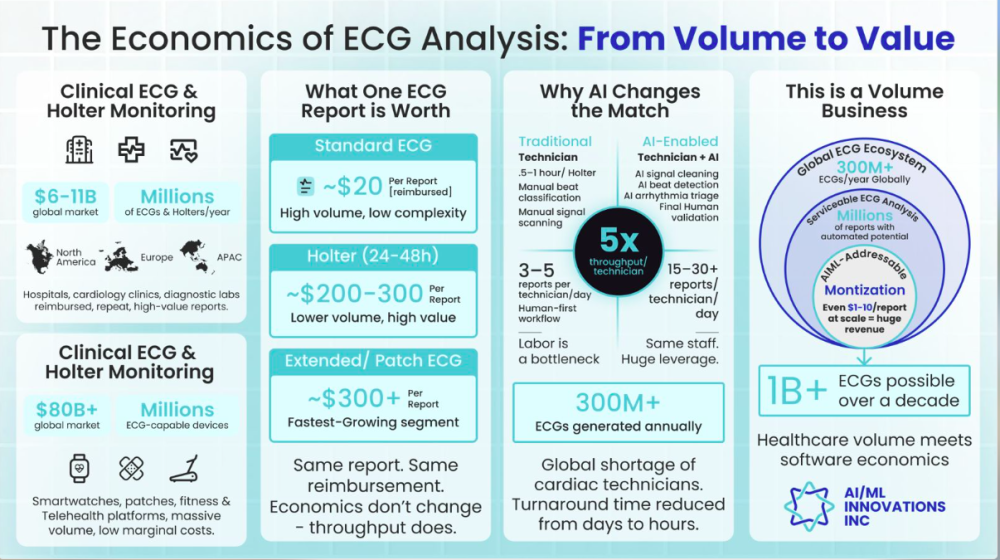
The economics of ECG analysis from volume to value.
This is a volume-based business model, not a price based business model. AIML (CSE: AIML / OTCQB: AIMLF) is attempting to address a throughput constraint, not a reimbursement constraint.
- Annual global ECGs: 300M+
- Holter and extended monitoring reimbursement (US): ~ $100-$300 per report
- Same reimbursement regardless of if review time is 30 minutes or 5 hours.
Traditional economics do not scale because labor does not scale. Throughput is the limiting factor.
Critical point: Throughput will change the economics.
Why AI will change the equation.
Most “ECG AI” today applies AI to noisy data. While it may assist with detection, it does nothing to alleviate the underlying bottleneck.
AIML (CSE: AIML / OTCQB: AIMLF) addresses the problem earlier in the workflow, at the signal level. By cleaning the raw ECG signals and structuring the waveform data before the clinician reviews them, clinicians are no longer overwhelmed with false positives.
- Artifact removal at the source
- Beat-by-beat waveform intelligence (P, QRS, T)
- Only humans confirm flagged events
For this reason, the performance gap manifests as multiples, not percentages.
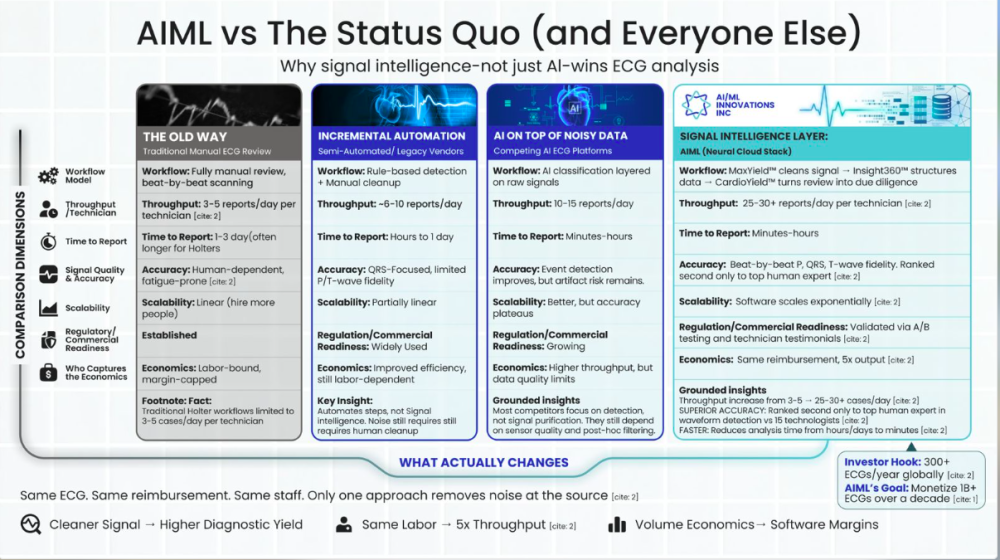
Throughput comparison: status quo versus AIML enabled workflow.
Here’s the math that really counts.
Manual Holter review – traditional workflow
- 3-5 reports/day per technician
- Turnaround: 1-3 days
- Scaling: Hire more people (Linear Cost)
Automated incremental improvements in this space improve throughput marginally, but still leaves technicians cleaning out noise.
AIML enabled workflow (AIML | AIMLF)
- 20-30 + reports/day per technician
- Turnaround: Minutes to Hours
- Scaling: Software
Using the same staff, that is approximately 5-8 times more throughput.
Market bottleneck and structural demand.
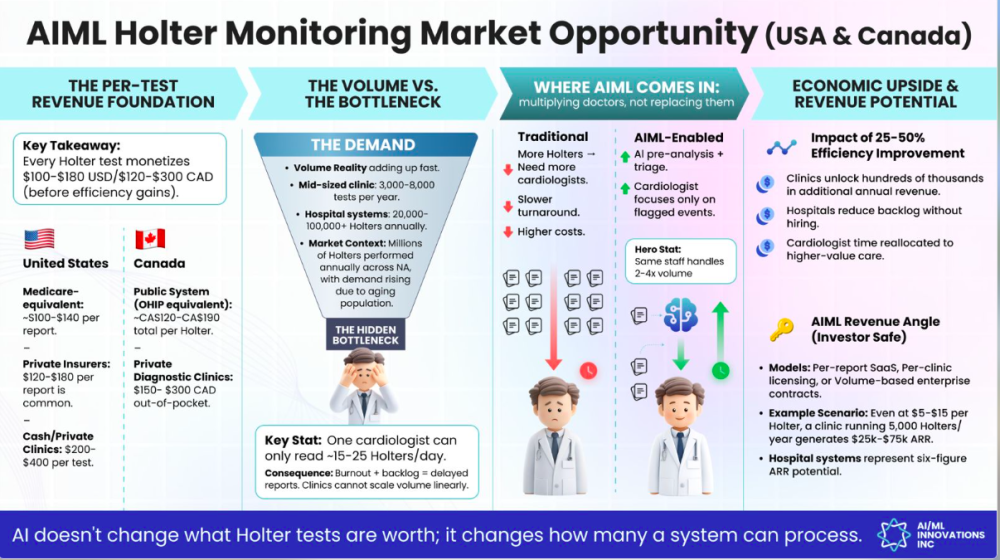
There is plenty of demand, there is little labor.
- One cardiologist typically reads ~ 15-25 Holters/day
- Mid-sized clinics process 3,000 – 8,000 Holters/year
- Hospital systems process over 20,000+ Holters/year
Burnout, backlog, and delayed diagnosis are structural issues, not cyclic issues. This is the exact type of constraint that AIML (CSE: AIML / OTCQB: AIMLF) is designed to overcome.
Where AIML fits in.
AIML functions as a device agnostic intelligence layer. It can integrate with existing ECG devices and platforms, enhancing -not displacing- current architecture. Clinicians are ultimately responsible for validating the results, however AIML enables them to effectively process more volume.
Revenue and monetization framework.
AIML (CSE: AIML / OTCQB: AIMLF) does not alter reimbursement. It increases output.
At its most basic:
- SaaS Pricing: $5-$15 per Holter
- Clinic Volume: ~5,000 Holters/year
- Revenue per clinic: $25K-$75K ARR
When scaled to hospitals, this rapidly becomes 6 figure ARR per system – without hiring additional staff.
Competitive landscape.
Multiple competitors utilize AI atop of noisy data and focus primarily on event detection. AIML differentiates itself by addressing the problem at the signal level which reduces downstream false positive rates and review burdens.
This differentiation enables higher scalability, greater clinical trust and easier to defend workflow integrations.
Why it matters.
Healthcare software rarely changes the reimbursement structures. The winners are those that change throughput. AIML’s approach aligns healthcare economics with software economics and converts a labor-constrained process into a scalable intelligent-driven process.
Major risks.
- Regulatory and validation timetables could affect deployment velocity
- Cycles of integration with healthcare systems can be lengthy
- Clinical adoption is dependent upon demonstrating accuracy and building clinician trust
Conclusion.
This is not an AI story. This is a throughput story.
- Same ECG
- Same Reimbursement
- Same Staff
The difference is how many reports flow through the process.
That is why AIML Innovations Inc. (CSE: AIML | OTCQB: AIMLF | FWB: 42FB) is more akin to traditional healthcare IT, than it is software leveraging a structurally broken workflow – the type of set-up that produces asymmetrical outcomes when successful.
Posted on behalf of Guerilla Capital for the issuer.

Marc has been involved in the Stock Market Media Industry for the last +5 years. After obtaining a college degree in engineering in France, he moved to Canada, where he created Money,eh?, a personal finance website.