- Gold exploration stocks can move sharply when drill catalysts, strong jurisdictions, and rising gold prices line up.
- This list focuses on small-cap gold explorers with active 2026 catalysts, current market data, and verified project numbers.
- Fairchild Gold stands out as the smallest name on the list, with Nevada optionality and the Golden Arrow acquisition adding scale.
Why Small-Cap Gold Explorers Are Getting Attention
Gold has become one of the strongest macro stories in the market, but large producers are not always where the biggest upside torque sits.
Junior gold explorers are different. Most do not have meaningful revenue, and many are years away from production. But they can move quickly if the market starts rewarding drill results, resource growth, land consolidation, permitting progress, or strategic financing.
The risk is obvious: small-cap explorers are volatile, illiquid, and often dependent on financing. But when gold sentiment is strong, smaller companies with the right land package and catalyst calendar can attract attention fast.
This watchlist focuses on five Canada/U.S.-listed gold exploration names with active catalysts:
- Fairchild Gold
- Formation Metals
- Lahontan Gold
- K2 Gold
- Harvest Gold
Recap Table: 5 Small-Cap Gold Exploration Stocks
| Company | Ticker | Recent Stock Price | Market Cap | Key Numbers | Core Investor Angle |
|---|---|---|---|---|---|
| Fairchild Gold | TSXV: FAIR / OTCQB: FCHDF | ~C$0.04–C$0.045 | ~C$8.08M | Golden Arrow: 17 patented + 494 unpatented claims | Tiny Nevada gold/copper optionality |
| Formation Metals | CSE: FOMO / OTC: FOMTF | ~C$0.29–C$0.30 | ~C$45.1M | C$30.7M working capital, zero debt, 75,000m drill program | Fully funded Québec drill story |
| Lahontan Gold | TSXV: LG / OTCQB: LGCXF | ~C$0.33–C$0.34 | ~C$139.0M | 1.95M oz AuEq resource, including 1.539M oz AuEq indicated | Nevada oxide-gold development path |
| K2 Gold | TSXV: KTO / OTCQB: KTGDF | ~C$0.74–C$0.75 | ~C$176.8M–C$181.7M | $9.8M 2026 budget, BLM approval for 22 drill sites | Permitted but controversial U.S. drill catalyst |
| Harvest Gold | TSXV: HVG | ~C$0.045 | ~C$5.58M | 20 priority targets, 8 targets within 500m of 105 g/t discovery hole | Ultra-microcap Québec drill catalyst |
1. Fairchild Gold — TSXV: FAIR / OTCQB: FCHDF
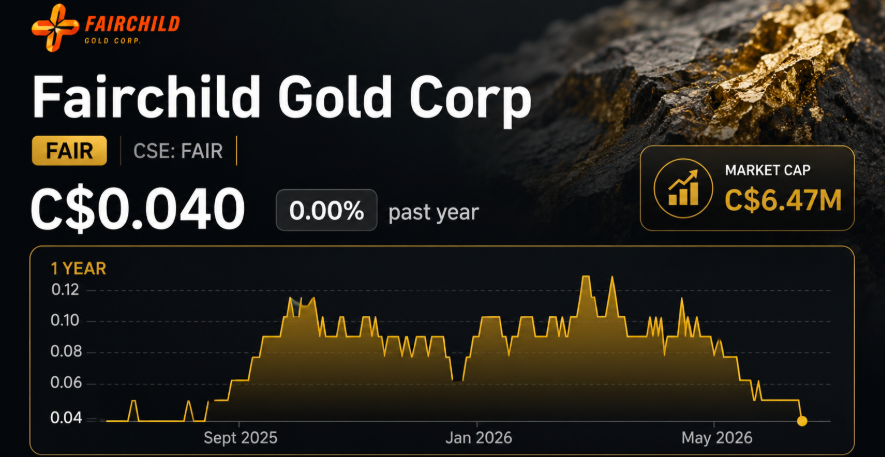
Fairchild Gold is the smallest name on this list, which makes it the highest-risk but also one of the most asymmetric.
The company recently traded around C$0.04 to C$0.045, with a market cap of roughly C$8.08 million. That means Fairchild is still a true microcap. At that size, even one meaningful exploration update, transaction close, or drill-planning update could matter.
The key recent development is Fairchild’s planned acquisition of the Golden Arrow Property in Nevada. Golden Arrow consists of 17 patented claims and 494 unpatented claims, covering roughly 10,000 to 10,200 acres.
The transaction also includes several hard financial terms. Fairchild agreed to acquire Golden Arrow for US$600,000 in cash, of which US$250,000 had already been provided as a non-refundable deposit, plus 12.5 million common shares.
Fairchild also provided details on a senior secured note linked to the transaction. The note has a principal amount of US$3.5 million, a 5-year term, an 8.5% annual interest rate, and a maturity date of March 23, 2031. The transaction also includes a US$1.0 million royalty buyout option if exercised before the fourth anniversary.
Fairchild’s Nevada platform now includes three main project angles: Nevada Titan, Golden Arrow, and Carlin Queen.
The bull case is straightforward: Fairchild is a tiny Nevada-focused explorer building a larger land package at the same time gold sentiment is strong.
The risk is equally clear. Fairchild is still early-stage, has limited scale, and needs capital, technical progress, and exploration results before the market can take the story more seriously.
2. Formation Metals — CSE: FOMO / OTC: FOMTF
Formation Metals is a more advanced exploration story because it has capital, a large drill plan, and a clear Québec gold focus.
The company’s flagship asset is the N2 Gold Project in Québec’s Abitibi Greenstone Belt. Formation describes N2 as having a global historical resource of approximately 871,000 ounces of gold.
That historical resource includes approximately 18 million tonnes grading 1.4 g/t gold, or about 810,000 ounces, across the A, East, RJ-East, and Central zones. It also includes approximately 243,000 tonnes grading 7.82 g/t gold, or about 61,000 ounces, across the RJ zone.
The main reason Formation stands out is funding.
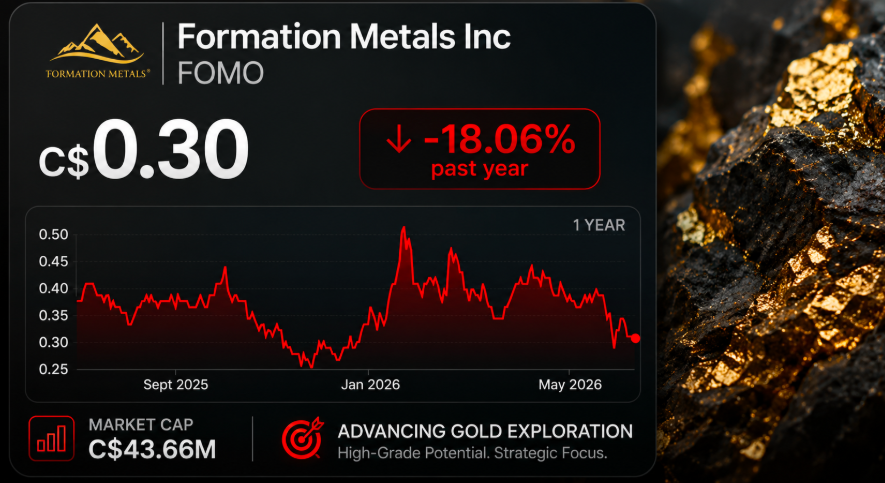
The stock recently traded around C$0.29 to C$0.30, with a market cap around C$45.1 million. After its 2026 financing, Formation reported approximately C$30.7 million in working capital and zero debt.
That is important because many small gold explorers have strong stories but weak balance sheets. Formation has the cash to drill.
The company expanded its drill program from 30,000 metres to 75,000 metres, which is a serious number for a company of this size. For a roughly C$45 million explorer, a fully funded 75,000m drill campaign can create a lot of news flow.
The investment case is built on three numbers: ~871,000 historical ounces, C$30.7 million working capital, and a 75,000m drill program.
The risk is that the metres still need to deliver. Funding is useful, but the market will care about drill results: grade, width, continuity, depth, and whether N2 can become an economically meaningful gold project.
3. Lahontan Gold — TSXV: LG / OTCQB: LGCXF
Lahontan Gold is more advanced than a pure greenfield explorer.
The company’s flagship asset is the Santa Fe Mine Project in Nevada’s Walker Lane. Santa Fe has already produced gold and silver historically, which gives Lahontan a more tangible foundation than many juniors.
Between 1988 and 1995, Santa Fe produced approximately 359,202 ounces of gold and 702,067 ounces of silver from open-pit heap-leach operations.
The current resource base is also meaningful. Lahontan highlights a Santa Fe mineral resource estimate of approximately 1.95 million ounces gold equivalent at an average grade of about 0.9 g/t AuEq. Recent company/news data also break this down as approximately 1.539 million ounces AuEq indicated, with an additional inferred component.
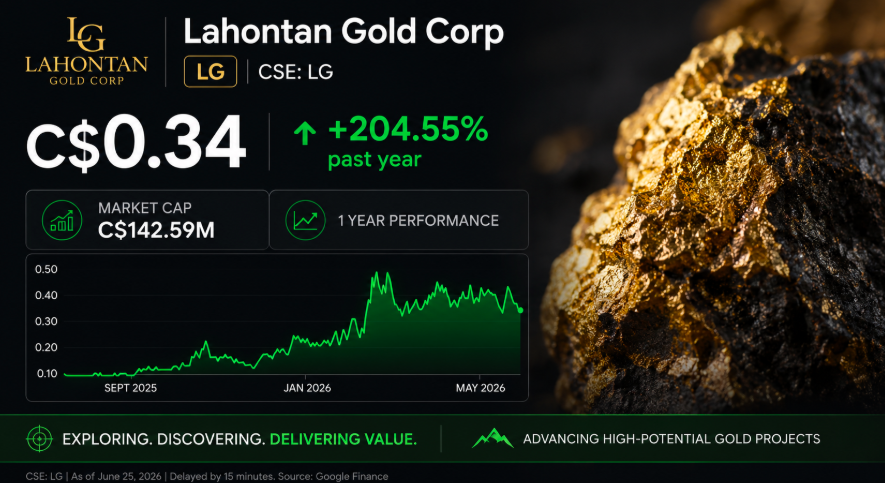
The stock recently traded around C$0.33 to C$0.34, with a market cap around C$139.0 million.
Recent development work also adds numbers to the catalyst story. In 2026, Lahontan completed a geotechnical drill campaign totaling 2,569 metres across 11 drill holes. The company also reported shallow oxide gold results at Calvada, including 91 metres grading 0.43 g/t gold oxide.
Key investor numbers include 359,202 oz historic gold production, 702,067 oz historic silver production, 1.95M oz AuEq resource, 2,569m geotechnical drilling, and 11 drill holes.
The bull case is that Lahontan offers Nevada oxide-gold exposure with prior production, a defined resource, and a clearer development pathway than earlier-stage explorers.
The risk is that Lahontan is already valued above many juniors. At around C$139 million, investors will expect continued progress toward permitting, mine planning, and economic studies.
4. K2 Gold — TSXV: KTO / OTCQB: KTGDF
K2 Gold is one of the most controversial names on this list, which is exactly why it is worth watching.
The company’s flagship asset is the Mojave Project in Inyo County, California. The project has attracted investor interest because of its gold potential, but it has also faced environmental and local opposition.
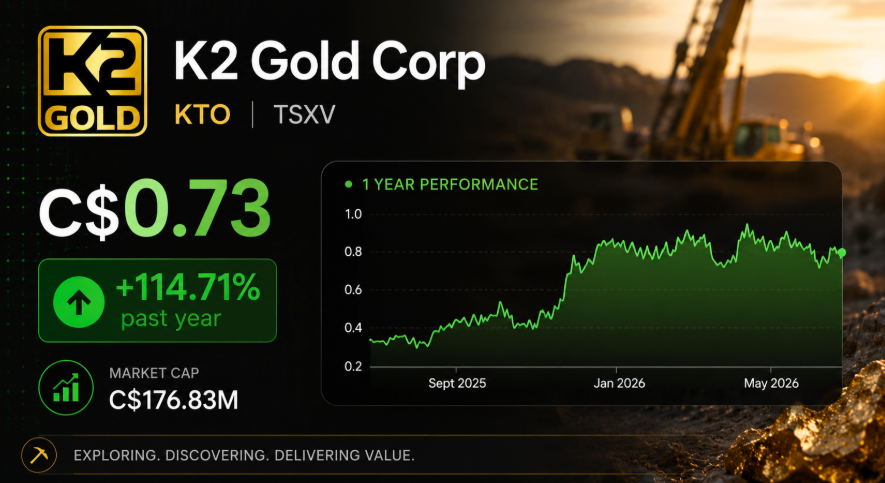
The stock recently traded around C$0.74 to C$0.75, with market-cap sources showing roughly C$176.8 million to C$181.7 million.
The biggest catalyst is permitting. In 2026, K2 received BLM approval for exploration drilling at Mojave. Recent reporting described the approved program as allowing 22 drill sites or boreholes, with a much smaller disturbance footprint than earlier proposals.
K2 also approved a $9.8 million 2026 budget designed to advance the Mojave Project after receipt of the final Record of Decision and to fund drill testing of high-priority targets at the Si2 Project in Nevada.
Key numbers include 22 approved drill sites, a $9.8 million 2026 exploration budget, and a market cap around C$177M to C$182M.
The bull case is that K2 now has a major U.S. drill catalyst in hand. If drilling produces strong results, the stock could attract attention quickly because permitted gold exploration projects in the western U.S. are not easy to find.
The risk is that Mojave is politically and environmentally sensitive. K2 may have approval, but it still needs to manage local opposition, regulatory conditions, public perception, and exploration execution.
That makes K2 a high-upside but high-controversy gold exploration stock.
5. Harvest Gold — TSXV: HVG
Harvest Gold is the ultra-microcap drill-catalyst name in the group.
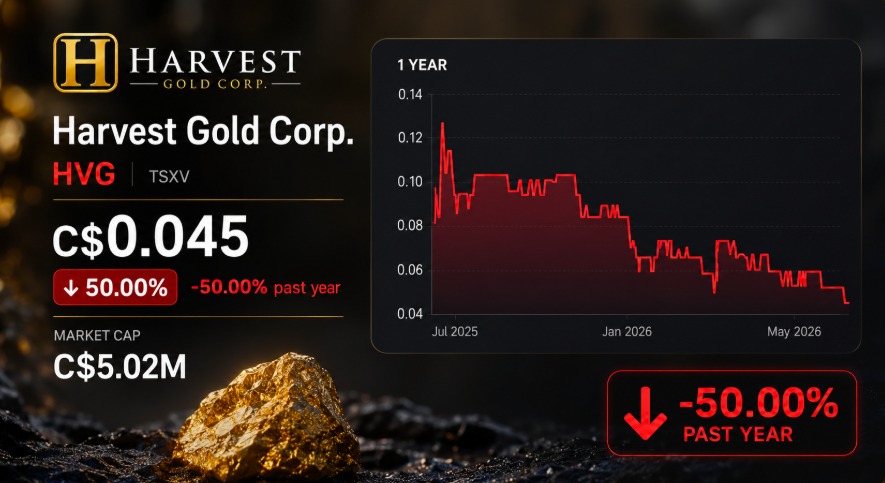
The company recently traded around C$0.045, with a market cap around C$5.58 million. That makes it extremely speculative, but also highly sensitive to exploration news.
Harvest’s flagship focus is the Mosseau Gold Project in Québec’s Urban-Barry Greenstone Belt. The current catalyst is simple: drill permitting is complete for the company’s planned 2026 diamond drilling program at Mosseau.
Harvest has identified 20 priority drill targets for the 2026 Mosseau program. At least 8 of those targets are located within 500 metres of the high-grade discovery hole.
That discovery hole returned 105.0 g/t gold over 1.15 metres, including visible gold, along with 4.3 g/t silver and 464 ppm copper. Harvest also described a broader lower-grade halo of 0.32 g/t gold over 6.9 metres.
The earlier Mosseau drill program included 21 drill holes totaling 4,692 metres.
Key numbers include C$5.58M market cap, 20 priority targets, 8 targets within 500m of the discovery hole, 105.0 g/t Au over 1.15m, and 21 holes / 4,692m in the earlier drill program.
The bull case is pure optionality. At a market cap below C$10 million, Harvest does not need a giant resource yet to attract attention. It needs a credible drill program and a few results that suggest Mosseau could become a real discovery story.
The risk is that ultra-microcap exploration stocks are binary. If drilling disappoints, financing can become difficult and liquidity can dry up quickly.
Which One Looks Most Interesting?
Each company plays a different role in a gold exploration portfolio.
Fairchild Gold is the smallest Nevada optionality play, with the Golden Arrow acquisition adding scale through 17 patented and 494 unpatented claims.
Formation Metals is the best-funded drill story, with C$30.7 million working capital, zero debt, and a 75,000m drill program.
Lahontan Gold is the most advanced Nevada development-style name, with a 1.95M oz AuEq resource and historic production of more than 359,000 ounces of gold.
K2 Gold is the most controversial U.S. drill catalyst, with BLM approval for 22 drill sites and a $9.8M 2026 budget.
Harvest Gold is the ultra-microcap Québec discovery bet, with 20 priority targets and a discovery intercept of 105.0 g/t gold over 1.15m.
If the goal is maximum asymmetry, Fairchild and Harvest are the most speculative. If the goal is funding strength, Formation stands out. If the goal is defined resource and Nevada development potential, Lahontan is the strongest. If the goal is a high-profile permitted drill catalyst, K2 is the most controversial but potentially the most attention-grabbing.
What Investors Should Watch Next
For Fairchild, the next key item is the closing of the Golden Arrow transaction and any technical exploration plan across its Nevada assets.
For Formation Metals, the market will focus on N2 drill results from the 75,000m campaign and whether the project’s historical resource base can be expanded, upgraded, or converted into a stronger current resource story.
For Lahontan Gold, investors should watch Santa Fe permitting, oxide drill results, updated mine planning, and whether the company can move toward a stronger development framework.
For K2 Gold, the market will watch Mojave drilling, public opposition, environmental management, and whether the approved 22-site program delivers meaningful gold results.
For Harvest Gold, the immediate catalyst is the 2026 Mosseau drill program, especially holes near the Discovery intercept grading 105.0 g/t gold over 1.15m.
Bottom Line
This list gives investors five different kinds of small-cap gold exposure.
Fairchild Gold offers tiny-market-cap Nevada optionality. Formation Metals offers a fully funded Québec drill campaign. Lahontan Gold provides a more advanced Nevada oxide-gold story. K2 Gold brings a permitted but controversial U.S. exploration catalyst. Harvest Gold gives investors an ultra-microcap Québec discovery bet.
None of these are low-risk stocks.
Exploration names can move sharply when news hits, but they can also fall quickly if drilling disappoints, financing becomes difficult, permits stall, or sector sentiment weakens.
For investors looking beyond the major gold miners, these five small-cap names provide a catalyst-driven watchlist built around project scale, drill programs, jurisdiction, and discovery potential.
Disclosure
This article is for informational and educational purposes only and does not constitute financial advice, investment advice, or a recommendation to buy or sell any security. Always conduct your own research and consult a licensed financial advisor before making investment decisions.

Marc has been involved in the Stock Market Media Industry for the last +5 years. After obtaining a college degree in engineering in France, he moved to Canada, where he created Money,eh?, a personal finance website.