- MindBio is developing AI-powered drug and alcohol intoxication detection using voice.
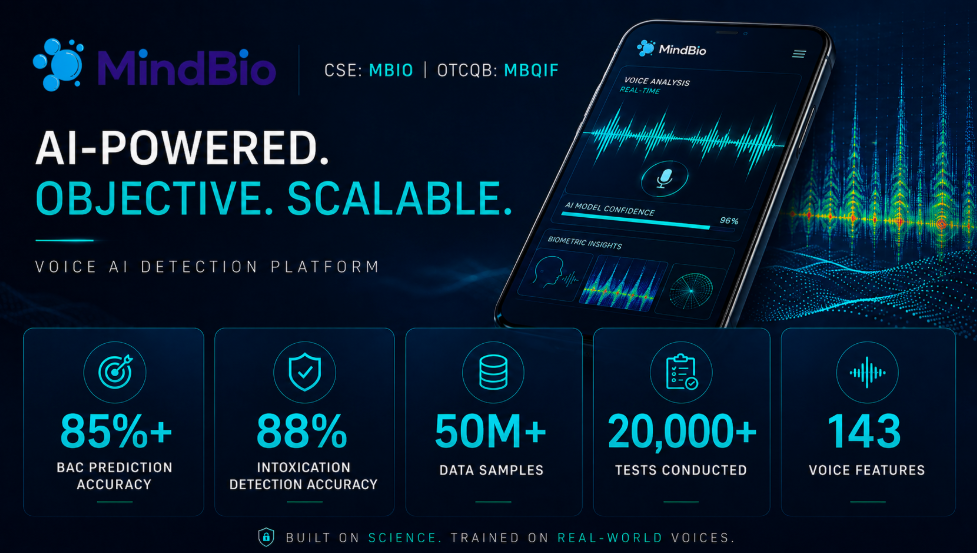
- The platform reports 85%+ BAC prediction accuracy, 88% intoxication detection accuracy, 50M+ data samples analyzed, and 20,000+ tests conducted.
- At a microcap valuation, even modest commercial traction could create meaningful upside if the technology converts into paid deployments.
Why MindBio Is Worth Watching
MindBio is building around one simple but potentially powerful idea: voice can become a biomarker for health and safety screening.
The company’s technology is focused on using voice, AI, machine learning, and speech analytics to detect drug and alcohol intoxication. That gives MindBio a potential place in markets where impairment detection matters: workplaces, transportation, mining, aviation, construction, law enforcement, insurance, telehealth, and consumer safety.
Current drug and alcohol testing methods can be slow, invasive, expensive, and difficult to scale. MindBio’s opportunity is to create a faster, lower-friction screening layer that can be deployed through smartphones, kiosks, or enterprise software.
• The upside case is that MindBio may be building a scalable detection platform for industries where impairment risk is expensive, dangerous, and hard to monitor.
The Core Technology
MindBio’s platform uses voice analysis to estimate intoxication risk.
The company has reported several important validation metrics:
- 85%+ BAC prediction accuracy
- 88% binary intoxication detection accuracy
- 50M+ data samples analyzed
- 20,000+ tests conducted
- 143 engineered voice features
- mel spectrogram analysis
- real-time early-warning predictions
These numbers are central to the story.
If the platform continues to perform in real-world commercial environments, MindBio could offer a tool that helps employers, insurers, public-safety agencies, and consumers identify impairment faster than traditional testing workflows.
• The commercial opportunity is not only detecting alcohol. It is turning voice into a low-friction, scalable health and safety screening tool.
Why the Market Opportunity Is Bigger Than One App
MindBio’s first commercial angle is intoxication detection, but the broader platform opportunity is larger.
Voice-based screening could potentially expand into workplace fatigue, cognitive impairment, mental-health monitoring, insurance triage, call-center risk detection, telehealth, suicide-prevention workflows, and other early-warning health applications.
That is what makes the company interesting from an investor perspective.
MindBio does not need to win every vertical immediately. It only needs one or two markets to validate the model and create recurring revenue.
• The biggest upside comes from platform potential: if voice can detect intoxication today, it may support broader health prediction use cases tomorrow.
Revenue Path 1: Booze AI Consumer App
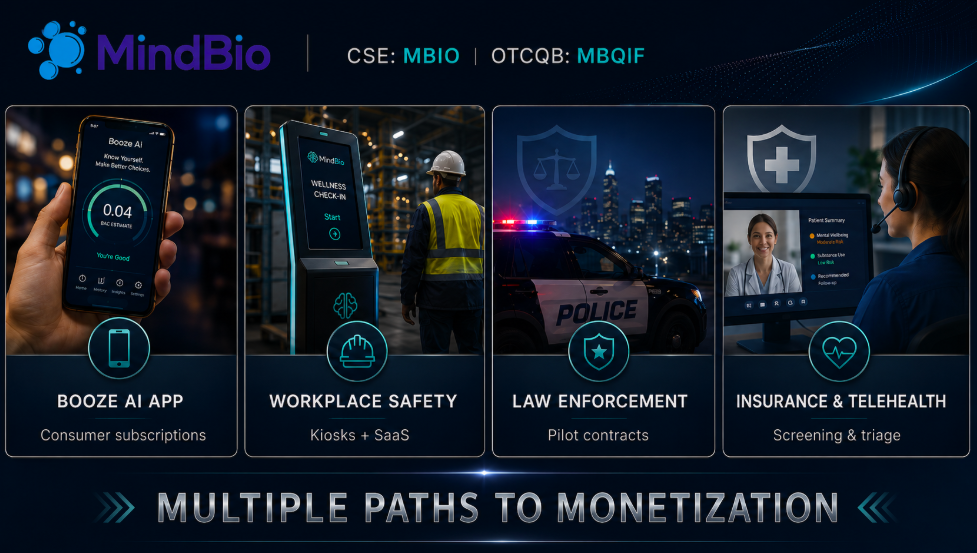
MindBio’s consumer-facing product is Booze AI, a voice-activated AI blood-alcohol estimator using a smartphone.
The app gives the company a direct-to-consumer entry point. It can help build brand awareness, gather usage data, test pricing models, and prove that users are willing to interact with voice-based intoxication detection.
Potential revenue models include:
- paid tests
- monthly subscriptions
- annual subscriptions
- premium safety features
- university partnerships
- insurer partnerships
- driving-safety campaigns
- event and nightlife integrations
Illustrative scenarios:
- 25,000 users at CA$5/month = CA$1.5M annual revenue
- 50,000 users at CA$5/month = CA$3.0M annual revenue
- 100,000 users at CA$5/month = CA$6.0M annual revenue
These are not forecasts. They show how quickly recurring revenue could become relevant relative to MindBio’s current size.
• The consumer app can become both a revenue product and a data engine for broader commercial validation.
Revenue Path 2: Enterprise Workplace Safety
The most attractive near-term opportunity may be enterprise workplace safety.
Mining, aviation, construction, logistics, manufacturing, and transportation are industries where impairment risk can be costly, dangerous, and heavily regulated. Even one major workplace accident can create large financial, legal, and reputational consequences.
That creates a clear business case for faster, more scalable impairment screening.
MindBio could commercialize through:
- workplace screening kiosks
- per-site monthly fees
- per-employee pricing
- SaaS dashboard subscriptions
- compliance reporting tools
- onboarding and training fees
- multi-year workplace safety contracts
Illustrative enterprise scenarios:
- 50 worksites at CA$1,000/month = CA$600K ARR
- 100 worksites at CA$1,500/month = CA$1.8M ARR
- 250 worksites at CA$2,000/month = CA$6.0M ARR
- 500 worksites at CA$2,000/month = CA$12.0M ARR
This is where the upside becomes more compelling.
A consumer app can validate the technology, but enterprise safety contracts could create stickier, higher-value recurring revenue.
• If MindBio lands enterprise customers, the valuation story could shift from speculative app launch to recurring B2B safety-tech platform.
Revenue Path 3: Law Enforcement and Public Safety
Law enforcement and public safety could become another high-value market.
This market may take longer to develop because it requires validation, privacy safeguards, legal defensibility, procurement approval, and strong accuracy standards. But if MindBio can secure even small pilots, the credibility impact could be significant.
Potential revenue paths include:
- municipal pilots
- public-safety software licenses
- mobile screening subscriptions
- field-testing tools
- agency-level contracts
- recurring analytics and compliance tools
• Law enforcement would not only represent revenue. It could act as external validation for the technology.
Revenue Path 4: Insurance, Call Centers, and Telehealth
The broader voice-AI opportunity could extend into insurance, call centers, telehealth, suicide prevention, and clinical triage.
These markets already rely heavily on voice interactions. That makes them logical expansion areas if MindBio can prove that voice patterns contain commercially useful health and impairment signals.
Potential use cases include:
- insurance fraud screening
- telehealth risk triage
- call-center safety alerts
- mental-health monitoring
- suicide-risk escalation
- remote patient screening
- workplace fatigue and impairment detection
• The long-term upside is that MindBio may become a voice-based risk-detection platform across multiple health and safety verticals.
Why the Valuation Setup Is Interesting
MindBio’s current market valuation remains very small relative to the commercial scenarios.
The company has approximately 7.28M shares on issue. At a microcap market value, the stock does not need massive revenue to look different to investors.
Using the current share count, every CA$7.28M of equity value equals roughly CA$1.00 per current share, before considering future dilution.
That makes the valuation highly sensitive to commercial traction.
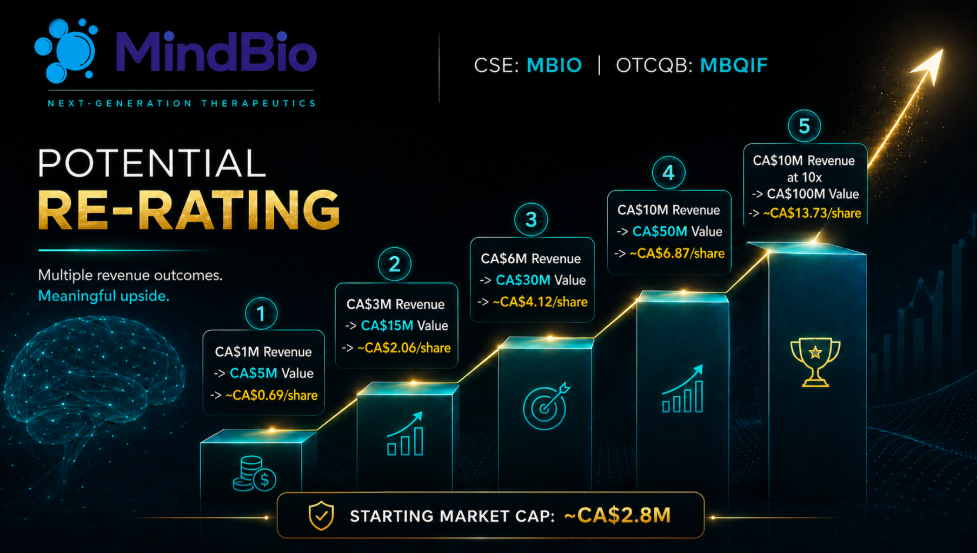
| Scenario | Revenue / ARR | Revenue Multiple | Implied Value | Approx. Value Per Current Share |
|---|---|---|---|---|
| Early proof | CA$1M | 5x | CA$5M | ~CA$0.69 |
| Small traction | CA$3M | 5x | CA$15M | ~CA$2.06 |
| Strong niche traction | CA$6M | 5x | CA$30M | ~CA$4.12 |
| Platform re-rating | CA$10M | 5x | CA$50M | ~CA$6.87 |
| AI-health upside case | CA$10M | 10x | CA$100M | ~CA$13.73 |
These are not price targets.
They are scenario math showing how meaningful even modest revenue could be if MindBio proves commercialization.
• The upside is driven by starting valuation. A small amount of credible recurring revenue could have an outsized impact.
Why the Current Setup Could Be Attractive
MindBio’s share price has pulled back sharply from prior highs, but that should be treated as context rather than the whole story.
For investors, the more important question is whether the market is underpricing the company’s current technology opportunity.
A stock decline can happen for many reasons: liquidity, financing concerns, weak sector sentiment, lack of near-term revenue, or microcap volatility. But none of those automatically invalidate the detection platform.
The technology thesis depends on commercial execution, not the past chart.
• A lower share price can create a more attractive entry point if the company begins proving paid adoption.
What Could Drive a Re-Rating
MindBio does not need vague AI headlines. It needs measurable commercial progress.
The most important catalysts would be:
- first paid enterprise deployment
- kiosk launch confirmation
- mining, aviation, construction, or transportation customer wins
- recurring revenue disclosure
- app usage and paid conversion data
- law-enforcement pilot
- insurance or telehealth partnership
- monthly test-volume growth
- third-party validation in commercial settings
- clear pricing and margin disclosure
The strongest catalyst would be recurring revenue.
That is what could move the stock from “interesting technology” to “commercial AI health-tech platform.”
• The market will likely reward proof: paid customers, real deployments, ARR, and repeat usage.
Bottom Line
MindBio’s upside story is now centered on AI-powered voice detection.
The company is targeting a real problem: intoxication and impairment screening across consumer safety, workplace safety, law enforcement, insurance, call centers, telehealth, and broader health prediction.
With reported metrics including 85%+ BAC prediction accuracy, 88% intoxication detection accuracy, 50M+ data samples, and 20,000+ tests, the platform has a clear technology narrative.
The next step is commercialization.
If MindBio can turn Booze AI, enterprise kiosks, workplace safety tools, or public-safety deployments into paid recurring revenue, the company’s current microcap valuation could leave significant room for a re-rating.
The upside case is simple: MindBio does not need to become a giant overnight. It needs to prove that voice-AI detection can generate revenue. If that proof arrives, the stock could become much more interesting.
Disclaimer: This content is for informational and marketing purposes only and is not financial advice. MindBio is a microcap company and may involve high volatility, low liquidity, dilution risk, and possible loss of capital. This may be sponsored content, and the publisher or related parties may receive compensation or hold securities mentioned. Always do your own research and consult a licensed advisor before investing.

Marc has been involved in the Stock Market Media Industry for the last +5 years. After obtaining a college degree in engineering in France, he moved to Canada, where he created Money,eh?, a personal finance website.