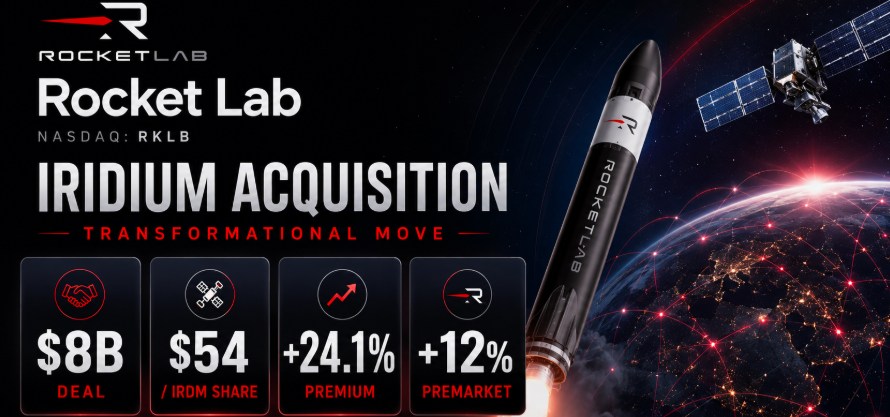
- Rocket Lab has agreed to acquire Iridium Communications in a cash-and-stock deal valued at about $8 billion, marking its largest acquisition to date.
- The deal combines Rocket Lab’s launch and spacecraft manufacturing capabilities with Iridium’s global satellite communications network, licensed spectrum, and 2.5 million subscribers.
- For RKLB investors, the acquisition accelerates Rocket Lab’s shift into a vertically integrated, multi-billion-dollar space infrastructure and communications platform.
Rocket Lab Makes Its Biggest Move Yet
Rocket Lab has made a major strategic leap — and this one changes the entire story.
The company announced it will acquire Iridium Communications in a cash-and-stock deal valued at approximately $8 billion, marking one of the largest consolidation moves in the commercial space industry.
Under the terms of the deal, Iridium shareholders will receive $27 in cash plus Rocket Lab shares, bringing the total value to $54 per Iridium share. This represents a 24.1% premium to Iridium’s last closing price, with the deal expected to close in mid-2027.
Markets reacted immediately. Rocket Lab shares jumped roughly 12% in premarket trading, while Iridium shares surged about 22%.
This is Rocket Lab’s first acquisition of a publicly traded company — and by far its largest.
What Iridium Brings to Rocket Lab
Iridium is not just another satellite company — it is a fully operational global communications network.
The acquisition gives Rocket Lab:
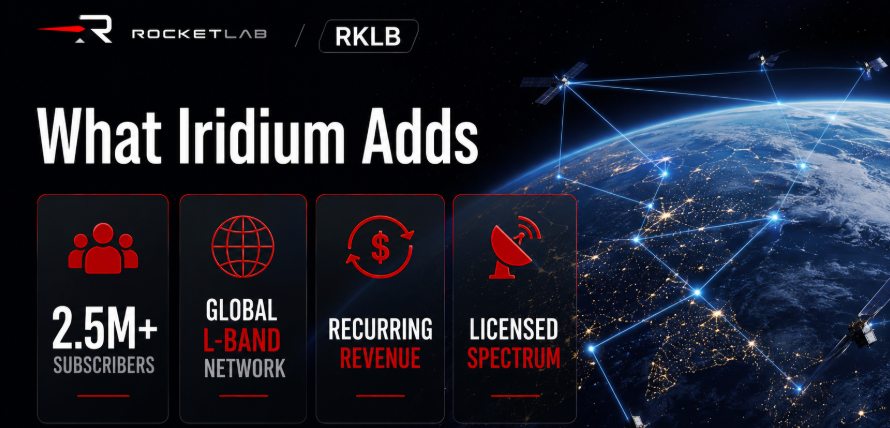
- a global L-band satellite constellation
- licensed spectrum
- more than 2.5 million subscribers
It also brings an established presence across government and defense, aviation, maritime, and commercial markets.
Rocket Lab moves from building and launching satellites to owning and operating a global communications service with recurring revenue. That is a completely different business model — and a much larger one.
Why Rocket Lab Acquired Iridium
Rocket Lab made it clear this deal is about solving three major barriers to entering satellite communications:
- access to spectrum
- long infrastructure deployment timelines
- building a customer base and recurring revenue
Instead of spending years building a network from scratch, Rocket Lab effectively bought a shortcut.
That shortcut includes an already deployed constellation, an established global customer base, immediate recurring revenue streams, and regulatory approvals already secured.
This dramatically accelerates Rocket Lab’s entry into one of the most valuable segments of the space economy.
The Strategy Mirrors SpaceX — But With a Twist
The move puts Rocket Lab on a path similar to SpaceX and Starlink.
SpaceX built its own vertically integrated model, combining launch, satellite manufacturing, and a global communications network.
Rocket Lab is now pursuing a similar structure — but instead of building from scratch, it is entering the market instantly through acquisition.
This approach trades capital for speed, which can be critical in a fast-moving industry.
Financing the Deal
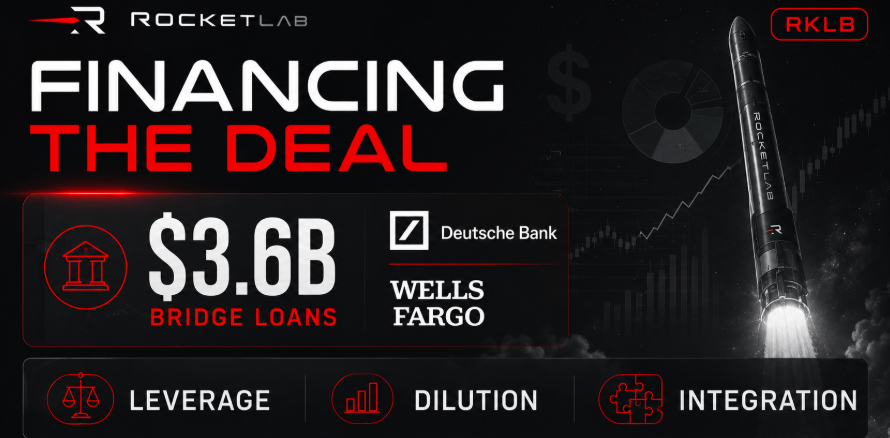
Rocket Lab has lined up significant financing to support the acquisition. The company secured $3.6 billion in bridge loan commitments from Deutsche Bank and Wells Fargo and plans to use a mix of cash, debt, and equity issuance. This is a large and complex transaction that will reshape Rocket Lab’s balance sheet.
Investors should expect:
- increased leverage
- potential dilution
- integration costs
In exchange, Rocket Lab gains a fully operational communications business.
Why This Changes the Rocket Lab Story
Before this deal, Rocket Lab was evolving into a vertically integrated space systems company.
After this deal, it becomes something bigger: a space infrastructure and communications platform.
The combined company will span launch services, spacecraft manufacturing, satellite components, defense systems, and global satellite communications.
That last piece is critical.
Satellite communications is one of the largest and fastest-growing segments of the space economy, driven by global connectivity needs, defense demand, and underserved regions.
Iridium gives Rocket Lab immediate exposure to all of it.
The Revenue Model Shift
This acquisition fundamentally changes Rocket Lab’s revenue profile.
Previously, revenue came primarily from launch services and spacecraft or component contracts.
With Iridium, Rocket Lab adds:
- recurring subscription revenue
- long-term service contracts
- more predictable cash flow
That is a major upgrade from an investor perspective.
Recurring revenue businesses are often valued at higher multiples than project-based revenue streams.
Why RKLB Investors Should Care
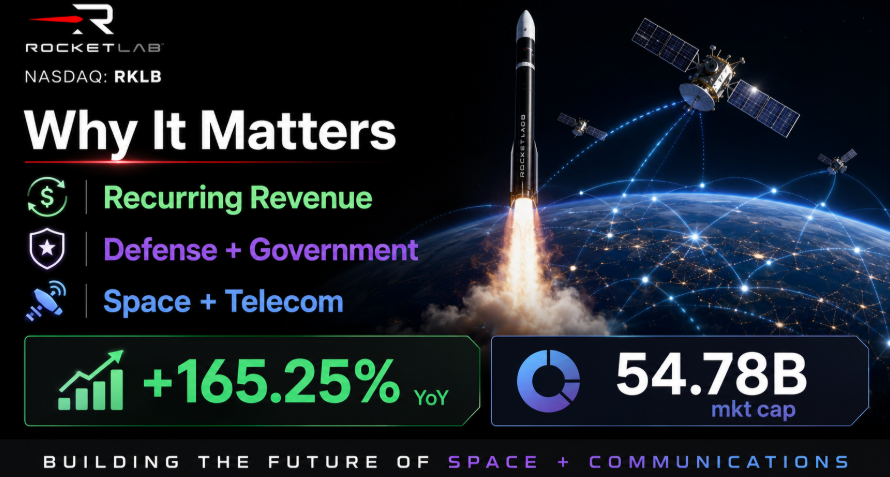
For Rocket Lab (NASDAQ: RKLB), the Iridium acquisition strengthens the investment case in three major ways:
- accelerates vertical integration
- expands the addressable market
- introduces recurring revenue
These factors could improve valuation multiples and reduce reliance on launch cadence.
The Bigger Picture: From Launch Company to Space Platform
Rocket Lab’s long-term strategy is now much clearer.
The company is building a full-stack space platform that includes launch, spacecraft manufacturing, satellite components, solar systems, defense payloads, laser communications, robotics, and now global satellite communications.
This is no longer a niche launch company.
It is becoming a diversified space infrastructure provider competing across multiple layers of the space economy.
The Upside Case
The upside case is that Rocket Lab successfully integrates Iridium and becomes a vertically integrated space and communications powerhouse.
If executed well, the company could benefit from:
- strong demand for global connectivity
- defense and government contracts
- recurring subscription revenue growth
In this scenario, Rocket Lab could be valued more like a hybrid of a space company and a telecom infrastructure provider.
The Risk
The risk is execution — and scale.
This is Rocket Lab’s largest deal by far, and it introduces significant complexity. The company will need to manage integration, operate a global communications network, and handle increased debt.
There is also the challenge of maintaining Iridium’s customer base and service quality, along with the broader risk that the market already prices in significant future growth.
This deal raises the stakes.
What Investors Should Watch Next
After this announcement, investors should monitor:
- regulatory approvals and deal progress
- financing structure and capital raises
- subscriber growth and retention
- integration execution and margins
The biggest confirmation will be whether Rocket Lab can turn this acquisition into sustained revenue growth and improved profitability.
Bottom Line
Rocket Lab’s $8 billion acquisition of Iridium Communications is a transformational move.
It combines Rocket Lab’s launch and spacecraft capabilities with Iridium’s global satellite network, licensed spectrum, and millions of subscribers.
For RKLB investors, the implication is clear: Rocket Lab is no longer just building space hardware — it is moving into operating global space-based services.
That expands the company’s opportunity, increases its scale, and introduces recurring revenue — but also raises execution risk.
The strategy is bold.
Now the market will be watching to see if Rocket Lab can deliver.
Disclaimer
This article is for informational purposes only and does not constitute financial, investment, or trading advice. The information presented is based on publicly available sources and company statements, which may be subject to change. Readers should conduct their own due diligence and consult with a qualified financial advisor before making any investment decisions. The author and publisher do not hold any responsibility for any financial losses or decisions made based on this content.

Marc has been involved in the Stock Market Media Industry for the last +5 years. After obtaining a college degree in engineering in France, he moved to Canada, where he created Money,eh?, a personal finance website.