- AI upside is no longer only about mega-caps.
- These five stocks give exposure to very different AI themes.
- MindBio, SoundHound, BigBear.ai, BrainChip, and VERSES AI all have high-risk, high-upside setups into 2027.
The Setup: AI Is Broadening Beyond the Biggest Names
The mega-cap AI trade has already done a lot of the heavy lifting.
Nvidia, Microsoft, Broadcom, and the rest of the large-cap AI complex have attracted most of the market’s attention. That does not mean AI upside is gone. It means investors looking for bigger percentage moves are increasingly forced to look further down the ladder.
That is where smaller AI stocks start to matter.
These names are much riskier than the leaders, but they also offer more asymmetry if they convert narrative into adoption, contracts, product traction, or revenue growth.
This updated watchlist uses the latest stock screenshots you shared and focuses on five different AI angles:
- AI voice diagnostics
- conversational AI
- defense and decision AI
- edge AI hardware
- agentic AI software
Quick Watchlist Table
| Company | Ticker | Recent Price | 6-Month Performance | Market Cap | 52-Week High | 52-Week Low | Core AI Angle |
|---|---|---|---|---|---|---|---|
| MindBio Therapeutics | CNSX: MBIO | C$0.26 | -79.20% | C$1.90M | C$3.99 | C$0.20 | AI voice biomarkers |
| SoundHound AI | NASDAQ: SOUN | US$6.86 | -35.33% | US$2.97B | US$22.17 | US$5.83 | Conversational AI |
| BigBear.ai | NYSE: BBAI | US$3.74 | -36.04% | US$1.79B | US$9.39 | US$3.01 | Defense / decision AI |
| BrainChip Holdings | ASX: BRN | A$0.16 | -11.11% | A$364.13M | A$0.27 | A$0.12 | Edge / neuromorphic AI |
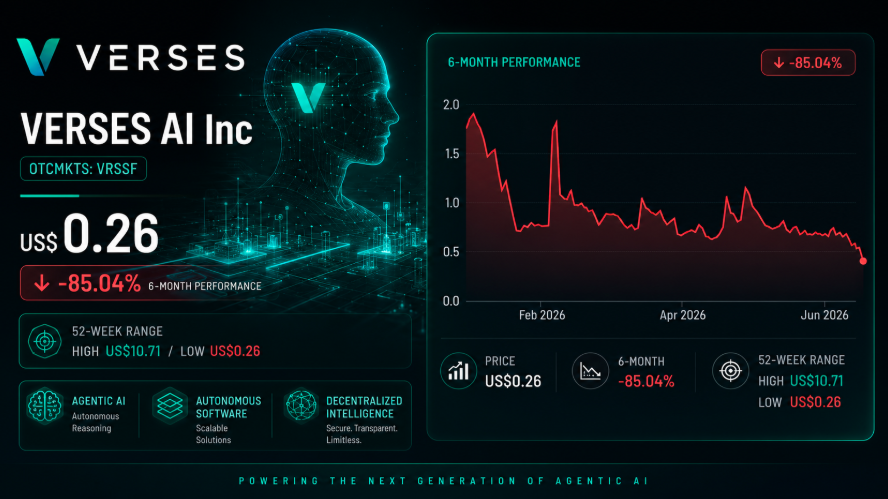
| VERSES AI | OTCMKTS: VRSSF | US$0.26 | -85.04% | Not shown in screenshot | US$10.71 | US$0.26 | Agentic AI |
1. MindBio Therapeutics — CNSX: MBIO
MindBio is easily the smallest and most speculative company in this group, and that is part of what makes it interesting.
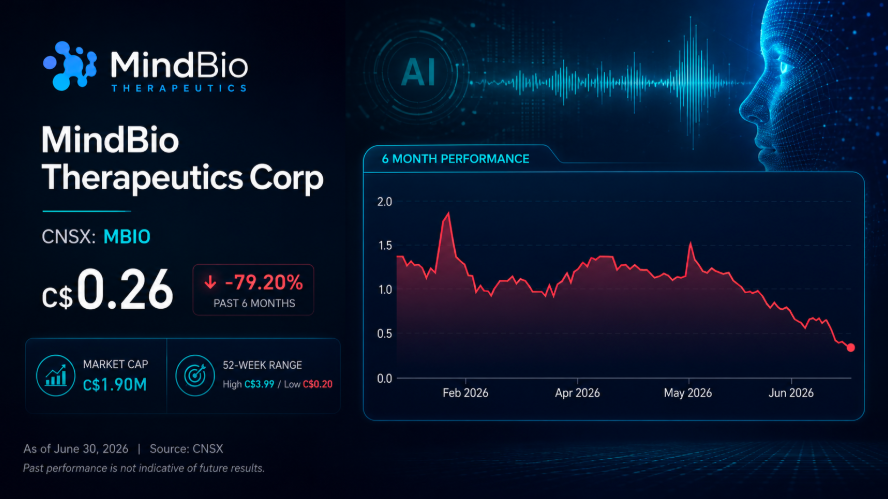
MBIO was trading at C$0.26, down 79.20% over the past 6 months, with a market cap of just C$1.90 million. The stock’s 52-week high is C$3.99 and the 52-week low is C$0.20.
Those numbers tell the story immediately.
This is not a momentum stock right now. It is a deeply beaten-down microcap. That means the company has to prove itself. But it also means the valuation is extremely small if the company starts getting traction.
The key reason MindBio belongs in an AI basket is its voice-based AI angle.
The company is focused on using AI and voice biomarker analysis to develop technology that can help assess sobriety verification, impairment-related signals, and digital-health insights. That is a very different setup from a generic AI software company.
The interesting part is the possible real-world use case.
If voice-based AI can help support safety, screening, or monitoring in sensitive environments, the opportunity could matter in areas such as:
- transport and logistics
- construction
- mining
- safety-critical workplaces
- telehealth and remote monitoring
- employer wellness and compliance workflows
The bull case is that MindBio is so small that even limited commercial proof could reframe the stock.
The bear case is that the company still needs adoption, revenue, and clear execution.
The Reddit-style takeaway: a C$1.90M market cap company with an AI voice-diagnostics angle is exactly the kind of setup that can be ignored for months and then suddenly get attention if the narrative starts working.
2. SoundHound AI — NASDAQ: SOUN
SoundHound is the most established public-market AI name on this list.
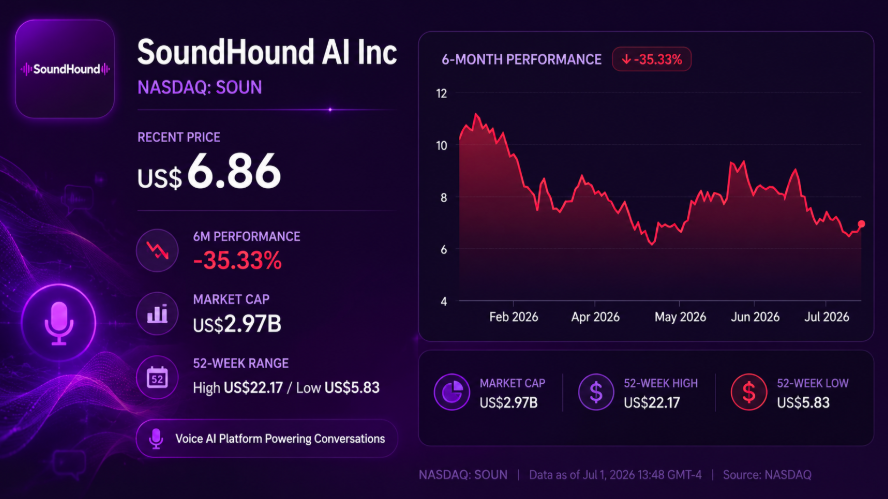
SOUN was trading at US$6.86, down 35.33% over the past 6 months, with a market cap of US$2.97 billion. Its 52-week high is US$22.17 and 52-week low is US$5.83.
That chart says a lot.
SoundHound is well off its highs, but it is still a serious public AI stock with scale and visibility. Unlike the other names here, this is not a tiny unknown microcap.
Its story is also easy to understand: conversational AI.
SoundHound is tied to real-world voice AI applications across:
- restaurants and drive-thrus
- automotive systems
- smart devices
- enterprise customer service
- consumer voice interfaces
This matters because conversational AI is one of the most commercially understandable AI categories in the market.
The bull case is that SoundHound keeps expanding as one of the leading pure-play voice AI names.
The risk is that expectations remain high and competition is intense.
Still, the key point is simple: a stock with a US$2.97B market cap that is still down more than 35% in 6 months will attract investors if sentiment starts shifting back toward voice-AI adoption.
3. BigBear.ai — NYSE: BBAI
BigBear.ai remains one of the more debated AI names in the market.
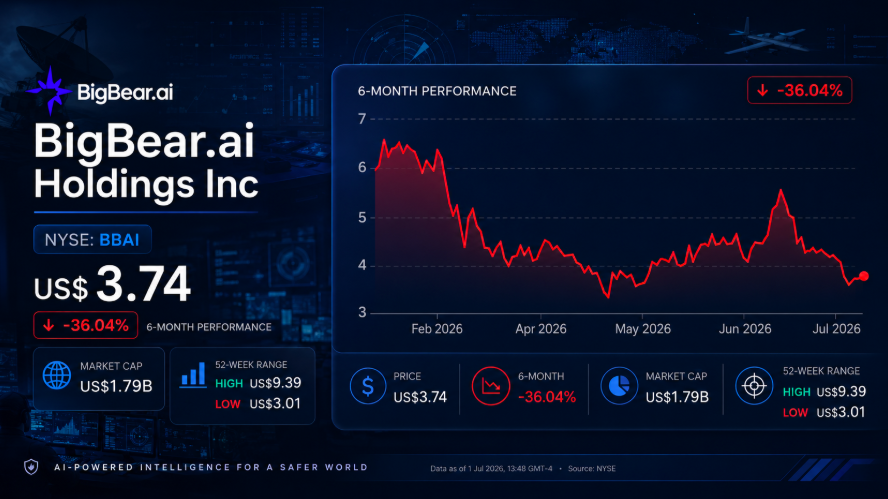
BBAI was trading at US$3.74, down 36.04% over the past 6 months, with a market cap of US$1.79 billion. The 52-week high is US$9.39 and the 52-week low is US$3.01.
That makes the setup interesting.
The stock has pulled back hard, but unlike many tiny speculative names, it still holds a meaningful market value. That means the market still sees relevance in the story, even if sentiment has cooled.
BigBear.ai’s AI angle is different from the usual enterprise-AI narrative.
The company is more closely tied to:
- defense AI
- government analytics
- operational decision intelligence
- mission support tools
- logistics and intelligence workflows
That gives it a differentiated profile.
The bull case is that government and defense become one of the stronger AI spending categories over the next 18 months, and BigBear.ai benefits from that theme.
The risk is execution and valuation swings. Stocks with heavy retail attention can move hard in both directions.
The important point is that a US$1.79B defense-AI company trading not far above its US$3.01 52-week low is the kind of setup investors will keep revisiting if defense-tech momentum strengthens.
4. BrainChip Holdings — ASX: BRN
BrainChip is the most differentiated hardware story in this basket.
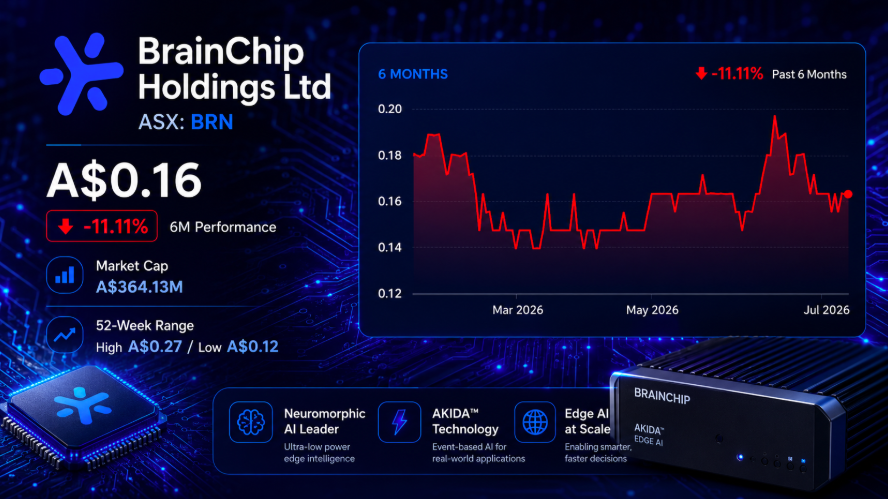
BRN is at A$0.16, down 11.11% over the past 6 months, with a market cap of A$364.13 million. Its 52-week high is A$0.27 and 52-week low is A$0.12.
That is a much less damaged chart than several of the others.
While the stock is down over 6 months, it is not nearly as crushed as MBIO or VERSES. That may suggest the market still gives BrainChip credit for being in a potentially relevant niche.
That niche is neuromorphic and edge AI.
Instead of focusing on giant cloud compute infrastructure, BrainChip’s story is about low-power AI running closer to devices and sensors.
That matters because AI is not only a data-center story. Over time it also needs to operate on:
- robotics
- sensors
- cameras
- industrial devices
- drones
- automotive systems
- wearables
- smart edge devices
This is where BrainChip tries to stand out.
The bull case is that the next phase of AI expands from pure data-center growth into more efficient on-device inference.
The risk is commercial execution. Investors still need to see customer traction, shipments, licensing, and revenue growth.
But from a thematic angle, BrainChip is one of the cleaner “next layer of AI infrastructure” names in the group.
5. VERSES AI — OTCMKTS: VRSSF
VERSES AI is the most controversial stock on this list.
VRSSF is trading at US$0.26, down 85.04% over the past 6 months. The screenshot does not show a market cap, but it does show a 52-week high of US$10.71 and a 52-week low of US$0.26.
That is a brutal collapse.
This is not a stock that the market currently trusts. It is a high-risk speculation. But that is also why it remains interesting for an AI watchlist.
VERSES is tied to the agentic AI theme.
That means AI systems designed to do more than answer prompts. The broader idea is AI that can:
- reason
- plan
- coordinate
- adapt
- support autonomous workflows
- help enterprise decision-making
This is one of the more forward-looking themes in AI.
The bull case is that “agentic AI” becomes one of the most talked-about software categories by 2027, and a heavily punished stock like VERSES gets a second look.
The risk is obvious: after falling from a US$10.71 high to US$0.26, the company has to prove that its story still matters commercially.
The investor takeaway is simple: VERSES is either a broken AI story or an extreme turnaround speculation on a theme that may matter a lot more later.
Why These Five Together Make Sense
These companies do not all represent the same AI trade.
That is actually the point.
Each one gives exposure to a different layer of AI:
- MindBio → AI voice biomarker analysis
- SoundHound → conversational AI
- BigBear.ai → defense and decision intelligence AI
- BrainChip → edge and neuromorphic AI
- VERSES AI → agentic AI software
This makes the basket more interesting than just picking five similar companies.
If AI broadens across healthcare, enterprise interfaces, defense systems, hardware efficiency, and intelligent software agents, smaller public names in these subthemes could become much more visible.
Bottom Line
The large-cap AI trade may be crowded, but smaller AI names still offer plenty of upside if the right subthemes start working.
Using the latest stock screenshots, the setups are now clearer:
- MindBio is a C$1.90M AI microcap tied to voice biomarkers.
- SoundHound is a US$2.97B conversational AI name still well below its highs.
- BigBear.ai is a US$1.79B defense-AI stock with renewed debate around its upside.
- BrainChip is a A$364.13M edge-AI hardware story with a differentiated angle.
- VERSES AI is a highly speculative agentic-AI name down 85.04% in 6 months.
These are not low-risk stocks.
But for investors looking beyond the obvious AI leaders, this is exactly the type of basket that can become more interesting if smaller AI themes start getting market attention again.
Disclaimer
This article is for informational and educational purposes only and does not constitute financial advice, investment advice, or a recommendation to buy or sell any security. Small-cap and emerging technology stocks are highly speculative and may involve substantial volatility and risk, including loss of capital. Investors should conduct their own due diligence and consult a licensed financial advisor before making investment decisions.

Marc has been involved in the Stock Market Media Industry for the last +5 years. After obtaining a college degree in engineering in France, he moved to Canada, where he created Money,eh?, a personal finance website.