- The old Magnificent 7 still dominate the market — but they may no longer tell the full leadership story.
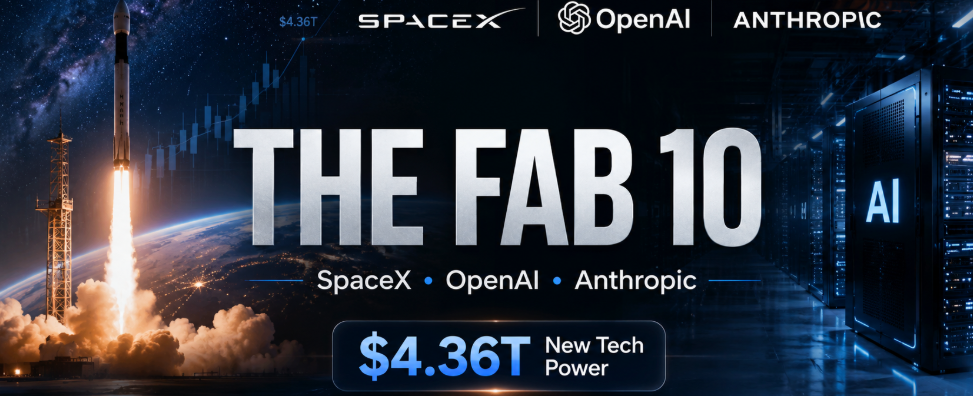
- SpaceX, OpenAI, and Anthropic now represent more than $4 trillion of combined market value / private valuation.
- The new investor question: which public companies benefit from the next AI + space infrastructure spending wave?
Market Snapshot
As of June 16, 2026, the Magnificent 7 remain massive.
| Company | Ticker | Approx. Market Cap |
|---|---|---|
| NVIDIA | NVDA | ~$5.18T |
| Alphabet | GOOGL | ~$4.48T |
| Apple | AAPL | ~$4.37T |
| Microsoft | MSFT | ~$2.98T |
| Amazon | AMZN | ~$2.68T |
| Meta | META | ~$1.52T |
| Tesla | TSLA | ~$1.45T |
Together, the Magnificent 7 represent roughly $22.65 trillion in market value.
But the leadership group is expanding.
| New FAB 10 Name | Status | Latest Market Value / Valuation |
| SpaceX | Public | ~$2.54T market cap |
| Anthropic | Private | ~$965B post-money valuation |
| OpenAI | Private | ~$852B post-money valuation |
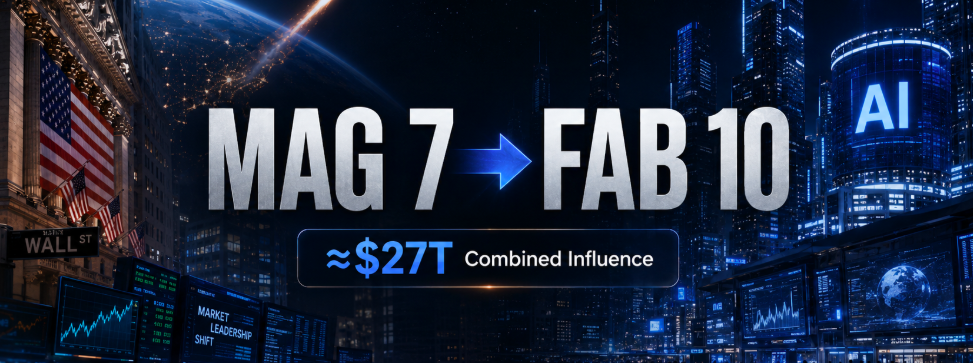
Combined, SpaceX, OpenAI, and Anthropic represent approximately $4.36 trillion of additional market value / private valuation. Add them to the Magnificent 7, and the broader “FAB 10” group approaches $27 trillion.
That is the key shift.
The market is no longer only about the biggest public technology platforms. It is increasingly about the companies building the next layer of AI, compute, space, data-center, and defense infrastructure.
What Changed
For the past two years, the Magnificent 7 carried the market narrative. NVIDIA became the center of the AI chip trade. Microsoft, Amazon, and Google pushed cloud AI infrastructure. Meta leaned into AI-driven advertising and compute. Apple and Tesla remained mega-cap sentiment leaders.
But 2026 is changing the structure of the market.
SpaceX has moved from private-market legend to public-market heavyweight, with shares trading around $192.50 after its record-setting IPO. The company’s market value has reached roughly $2.54 trillion, placing it near the largest public companies in the world.
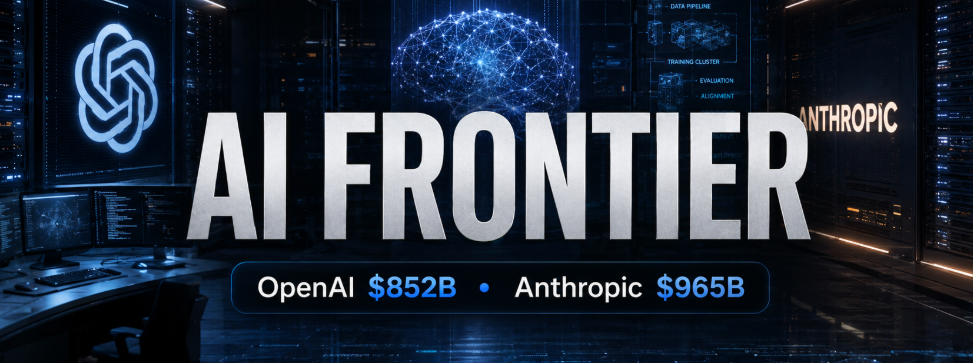
OpenAI closed a massive $122 billion funding round at an $852 billion post-money valuation. Anthropic then surpassed that level, raising $65 billion at a $965 billion post-money valuation.
Those numbers matter because they show that private AI leaders are now being valued on a scale normally reserved for the largest public companies on earth.
Why Investors Should Care
Retail investors cannot easily buy OpenAI or Anthropic directly, and SpaceX is now already being valued like a global mega-cap.
So the opportunity may not be only in the FAB 10 names themselves.
The better question is: who supplies the infrastructure behind them?
AI model growth requires chips, servers, cooling, power, data centers, networking, memory, cloud capacity, cybersecurity, and enterprise deployment. SpaceX’s growth requires launch infrastructure, satellite systems, defense contracts, communications hardware, advanced manufacturing, and space-adjacent suppliers.
That creates second-order opportunities across public markets.
The Real FAB 10 Trade
The FAB 10 theme is not just “buy the biggest names.”
It is a signal that market leadership may be moving into a broader infrastructure cycle.
The key sectors to watch:
AI Compute
The OpenAI and Anthropic numbers show how capital-intensive frontier AI has become. A company valued near $1 trillion needs enormous compute capacity to justify that valuation.
This supports demand for GPUs, custom AI chips, servers, networking, memory, and liquid cooling.
Data Centers and Power
AI models are turning data centers into strategic infrastructure. The next bottleneck may not only be chips — it may be power availability, cooling, grid capacity, and physical data-center construction.
If AI spending continues, power infrastructure could become one of the most important parts of the trade.
Space and Defense
SpaceX’s rise strengthens the broader space economy narrative. Launch, satellite connectivity, defense communications, Earth observation, autonomous systems, and military-grade infrastructure are becoming more strategically important.
This is where public small and mid-cap space names may get investor attention, even if they are not direct SpaceX competitors.
Enterprise AI Software
OpenAI and Anthropic are pushing AI from experimentation into real enterprise workflows. That creates demand for companies that can turn AI models into useful business tools: automation, analytics, cybersecurity, customer service, coding, document processing, and workflow intelligence.
Investor Read-Through
The Magnificent 7 trade was about owning the platforms.
The FAB 10 trade may be about owning the infrastructure.
That means investors should watch companies tied to:
- AI chips and accelerators
- AI servers and rugged edge computing
- data-center cooling and power
- cloud and networking infrastructure
- cybersecurity
- defense technology
- satellite communications
- autonomous systems
- enterprise AI software
The biggest winners may not be the most obvious names. They may be smaller public companies that benefit from rising infrastructure demand before the broader market fully prices it in.
The Risk
The risk is valuation.
When private companies reach $800B, $900B, or even trillion-dollar valuations, expectations become extreme. If growth slows, infrastructure spending gets delayed, or investors start questioning AI monetization, the entire theme could correct.
There is also a second risk: not every “AI” or “space” company will benefit. Some stocks will move only because of narrative, not because of revenue, contracts, or margin expansion.
Execution still matters.
The best opportunities will likely be companies with real revenue growth, strong backlog, strategic customers, improving margins, and exposure to AI or space infrastructure that can be measured in numbers.
Bottom Line
The Magnificent 7 are still important, but they may no longer be enough.
SpaceX, OpenAI, and Anthropic have added more than $4 trillion of market value and private valuation to the technology leadership conversation. Together with the Magnificent 7, the emerging FAB 10 represents nearly $27 trillion of combined market influence.
For investors, the takeaway is simple: the next phase of the market may be less about chasing the old winners and more about finding the companies powering the next AI, space, and infrastructure cycle.
The real upside may be in the picks-and-shovels names behind the FAB 10.

Marc has been involved in the Stock Market Media Industry for the last +5 years. After obtaining a college degree in engineering in France, he moved to Canada, where he created Money,eh?, a personal finance website.