Western investors saw pressure on Nvidia, ASML and the semiconductor sector. China saw something more important: proof that its stock market can help finance technological independence at enormous scale.
- CXMT’s blockbuster IPO is a strategic win for China because it brings public-market capital alongside state support for semiconductor self-sufficiency.
- The United States and Europe now face the same dilemma: restrictions may slow China in the short term while creating guaranteed demand for Chinese alternatives.
- Memory and semiconductor-equipment stocks face the most direct pressure. Nvidia and the wider AI trade face a longer-term risk from the creation of a separate Chinese technology stack.
The West saw a selloff. China saw a victory.
When ChangXin Memory Technologies, or CXMT, surged 466% in its Shanghai debut, Western markets immediately looked for losers.
ASML fell sharply. Nvidia, Micron and U.S. equipment stocks also came under pressure. But this was not simply another expensive technology IPO.
CXMT raised approximately $8.6 billion and ended its first session with a valuation near $488 billion, briefly becoming mainland China’s most valuable listed company. For Beijing, the signal is powerful: strategic technology can attract domestic savings and public-market enthusiasm at enormous scale.
China’s semiconductor campaign has traditionally relied on subsidies, state funds and local governments. The CXMT listing adds another source of capital.
The state can set the direction. The stock market can help fund the execution.
Why the IPO is genuinely positive for China
The first advantage is obvious: money.
CXMT can use the proceeds to expand production, improve yields and develop more advanced memory. Its shares can also support incentives, acquisitions and future capital raises.
The second advantage may be even more important. The IPO creates a valuation benchmark for China’s entire semiconductor ecosystem.
If investors assign a huge premium to a domestic memory champion, capital may also flow toward Chinese equipment, materials, packaging, design-software and processor companies. Semiconductor independence is now both a government priority and a potential source of private wealth.
CXMT’s DRAM is used in computers, smartphones, vehicles, servers and AI systems. A larger domestic supply reduces China’s exposure to sanctions and export restrictions.
CXMT does not need to dominate the global memory market for China to benefit. It only needs to become sufficiently capable and sufficiently large to keep Chinese industry operating under geopolitical pressure.
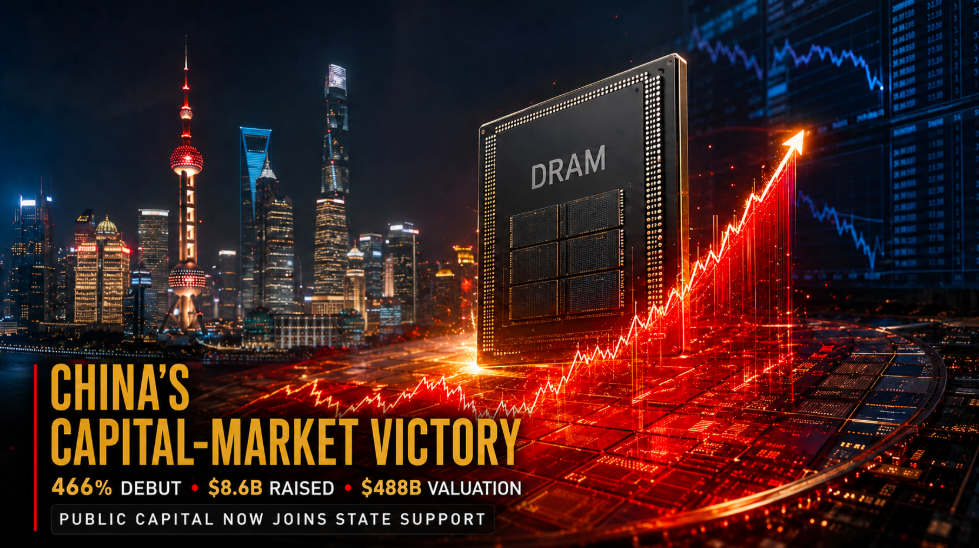
One IPO is becoming an ecosystem story
The listing became more significant when it was followed by reports that China has begun producing domestic immersion DUV lithography machines for companies including SMIC, Hua Hong and CXMT.
The combination matters more than either headline alone.
Domestic investors finance chipmakers. Those companies buy domestic equipment. Suppliers gain revenue, data and experience to improve the next generation of tools.
That is how a parallel semiconductor supply chain begins to reinforce itself.
China has not replicated ASML’s most advanced EUV technology, and producing a DUV machine does not prove competitive throughput, reliability or cost. But China does not need immediate parity everywhere.
It needs equipment, memory and processors that are good enough to support Chinese industry and AI workloads without complete dependence on Western suppliers.
The goal is not necessarily to beat the Western chip stack everywhere. It is to become much harder to isolate from it.
What it means for the United States
Washington now faces an increasingly uncomfortable policy dilemma.
Export controls have probably delayed China’s access to advanced GPUs and manufacturing equipment. Yet they also create guaranteed customers for Chinese alternatives. Every restricted Nvidia accelerator or American tool strengthens the commercial case for a domestic replacement.
The likely U.S. response is more industrial policy, tighter technology controls and greater scrutiny of Chinese chips. Domestic manufacturing and advanced packaging could become even more politically important.
Preventing China from building a semiconductor industry may no longer be realistic. Maintaining a durable technological lead is the more achievable objective.
For U.S. investors, that means China may become a structurally smaller market for Nvidia and American equipment suppliers—even if those companies remain global leaders.
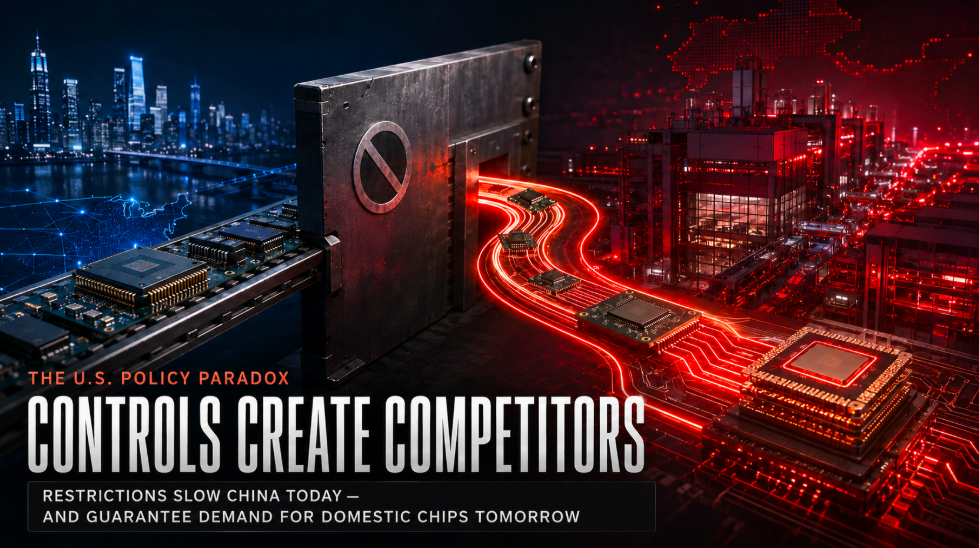
What it means for Europe
Europe’s exposure is clearest through ASML.
ASML cannot sell its most advanced EUV systems to China, but Chinese customers remain important buyers of DUV equipment. If domestic tools become commercially viable, part of that demand could disappear.
This does not destroy ASML’s moat. Matching its precision, uptime, throughput and service network remains extremely difficult, and ASML still holds a unique leading-edge position.
However, Europe faces the same policy contradiction as the United States. Restricting exports can protect sensitive technology today while accelerating customer substitution tomorrow.
European governments may have to spend more on research, fabrication capacity and supply-chain security while balancing alignment with Washington against the interests of strategic European companies.
The CXMT IPO strengthens the argument that Europe cannot treat semiconductor sovereignty as a slogan. China is combining policy, manufacturing and capital markets; Europe will need a similarly coherent long-term response.
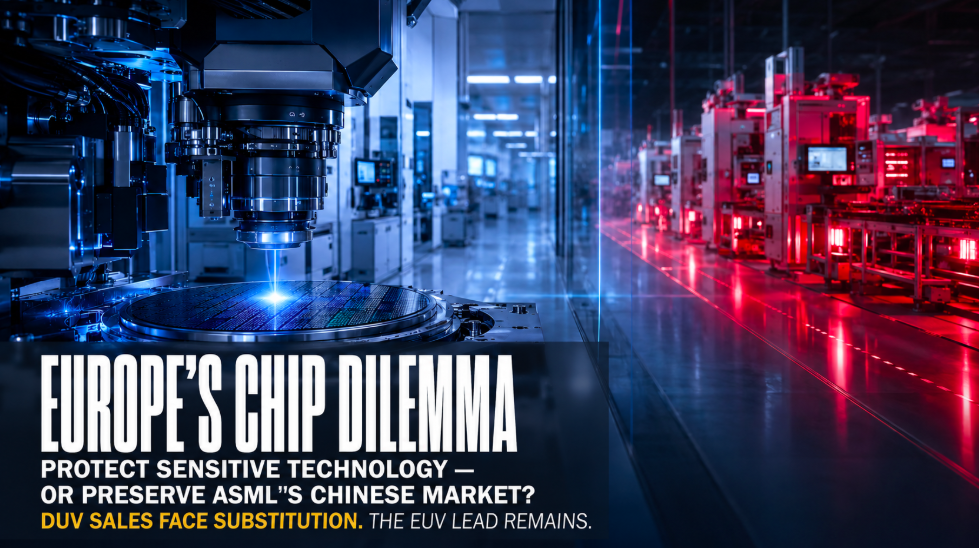
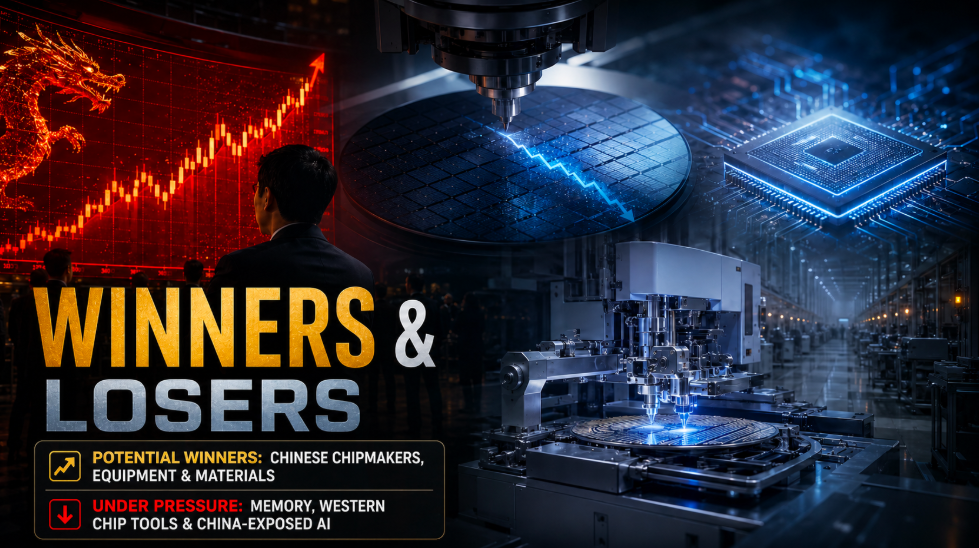
Which stock-market segments are most exposed?
- Chinese semiconductor shares are the clearest potential winners. CXMT can lift domestic equipment, materials, foundry, packaging and chip-design names. The danger is that enthusiasm outruns operational progress.
- Memory stocks face the most direct pressure. CXMT is a DRAM producer, not “China’s Nvidia.” Additional capacity could weaken pricing and margins, making Micron more directly exposed than Nvidia.
- Chip-equipment stocks are on the second front line. ASML, Applied Materials, Lam Research and KLA could lose future Chinese demand. Initially, however, parallel supply chains may require more factories and investment.
- AI accelerator stocks face an indirect risk. CXMT does not reproduce Nvidia’s GPUs, networking or CUDA ecosystem. But a viable domestic stack could still leave Nvidia as the technology leader while reducing its share of China’s AI spending.
A victory for China is not automatically a victory for CXMT shareholders
There is a crucial difference between a successful national strategy and a good entry price.
CXMT’s 466% debut was amplified by a small tradable float and discounted IPO price. Its $488 billion valuation reflects scarcity, strategic importance and speculation—not simply earnings power.
CXMT still faces huge capital requirements, memory-industry cyclicality and a gap in the most advanced products. Its share price could fall dramatically without changing the strategic value of the listing for China.
That is the real lesson.
The IPO did not prove that China has overtaken Nvidia, ASML or the Western semiconductor ecosystem. It proved that China can combine state support, domestic demand and public capital to keep financing the attempt.
So which side is the market underestimating: China’s ability to turn restrictions into self-sufficiency, or the technological lead that U.S. and European chipmakers still possess? And for the next five years, would you rather own CXMT, Micron, ASML or Nvidia?
This article is for informational purposes only and does not constitute financial advice. AI-related investments and semiconductor stocks can be highly volatile, and capital-expenditure forecasts remain subject to substantial revision.

Marc has been involved in the Stock Market Media Industry for the last +5 years. After obtaining a college degree in engineering in France, he moved to Canada, where he created Money,eh?, a personal finance website.