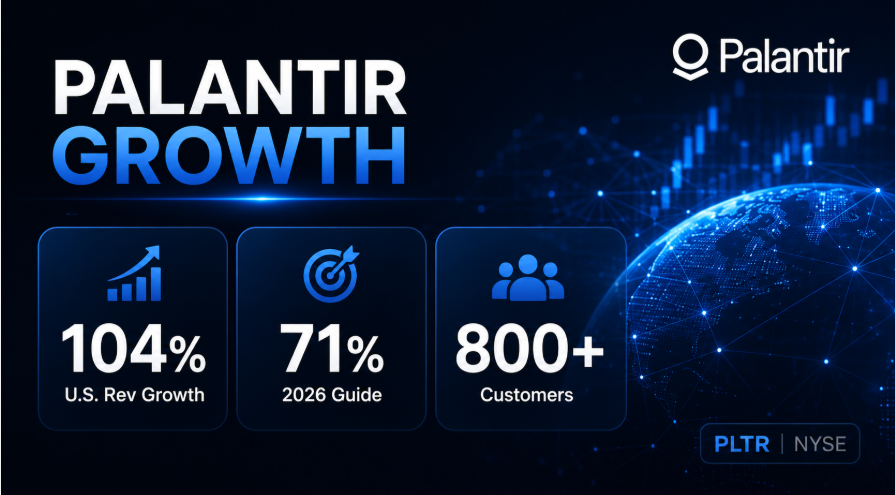
- Palantir is growing rapidly, with 2026 revenue guidance implying around 71% year-over-year growth after U.S. revenue surged 104% in Q1 2026, with total revenue potentially exceeding $4.4 billion in adjusted operating income.
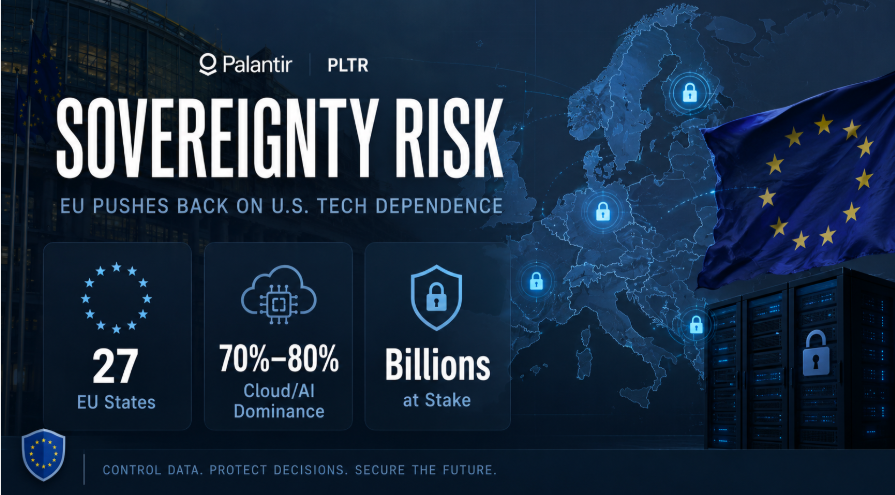
- Geopolitical risk is real: Europe and other regions increasingly want digital sovereignty, with over 27 EU member states pushing policies to reduce reliance on U.S. tech providers.
- The investment case depends on whether Palantir becomes trusted infrastructure for allies across 30+ NATO countries — or is viewed as a dependency risk in over 50+ global markets.
The Big Question
Palantir is one of the most important AI software companies today, operating across more than 40 countries and serving hundreds of clients.
It operates at the intersection of defense, intelligence, enterprise AI, and data infrastructure — sectors collectively worth trillions of dollars globally. That makes it powerful — and controversial.
The key investment question is no longer whether Palantir can grow. It already is, with triple-digit growth in key segments.
The real question is: can Palantir expand globally in a world where over 100 countries want less dependence on American technology?
This matters because Palantir is not a typical SaaS company. It helps governments, militaries, and large enterprises — often with budgets exceeding $1 billion — make decisions using sensitive data. That places it at the core of national security and economic infrastructure.
For investors, this creates a unique setup: strong growth and massive opportunity, but also a potential geopolitical ceiling across dozens of international markets.
Why Palantir Is Still a Beast
The numbers are impressive.
In Q1 2026, Palantir reported 104% U.S. revenue growth and raised full-year guidance to about 71% growth, alongside adjusted operating income guidance of approximately $4.44 billion to $4.45 billion and strong free cash flow.
Earlier data showed similar momentum: U.S. commercial revenue grew 93% year over year, customer counts increased by over 60%, and total customers exceeded 800+ globally.
This growth reflects Palantir’s positioning in the AI deployment cycle. While thousands of companies talk about AI, Palantir focuses on integrating it into real-world operations — messy data, complex workflows, and mission-critical decisions across industries worth trillions.
That’s why demand is strong.
If AI continues moving from experimentation (estimated at less than 20% adoption globally) to deployment (potentially exceeding 70% adoption over the next decade), Palantir is well positioned to benefit.
The Valuation Problem
The challenge is that the market already recognizes Palantir’s strength.
The company trades at a valuation above $300 billion to $350 billion, with extremely high multiples — over 50x sales, 120x–140x earnings, and significantly above the average SaaS multiple of around 10x–15x sales.
That creates a simple bear case: Palantir may be a great company, but the stock already prices in a lot of future success — potentially 5–10 years of growth.
To justify its valuation, Palantir must sustain rapid growth above 40%–70% annually, maintain margins above 30%, and continue winning contracts worth tens or hundreds of millions of dollars — all while navigating geopolitical risks across dozens of countries.
That’s a high bar.
The Digital Sovereignty Problem
This is the core risk.
Governments increasingly view technology — especially AI and data platforms — as strategic infrastructure worth billions annually. They want control over their data, systems, and decision-making.
Europe, with its 27 member states, has been especially vocal about “digital sovereignty,” aiming to reduce reliance on foreign tech providers that dominate over 70%–80% of global cloud and AI infrastructure.
For Palantir, this creates tension.
As a U.S. company with deep ties to American defense and intelligence — including contracts worth billions — it may raise concerns for foreign governments. The key question becomes:
Should a country rely on a U.S. company for critical data and decision systems that could impact millions of citizens or billions in economic activity?
That concern is likely to grow as AI becomes more central to national security and economic competitiveness.
The Palantir Paradox
Despite sovereignty concerns, countries still need capability — and they need it now.
Building domestic alternatives can take 5–10 years and often costs billions, with failure rates exceeding 50% in large government IT projects. AI deployment is complex, and security threats are immediate.
That’s why Palantir continues to win contracts.
For example, NATO — representing over 30 member countries — adopted Palantir’s AI-enabled system in 2025 through a rapid procurement process completed in roughly 6 months, far faster than typical multi-year defense acquisitions.
This shows that even sovereignty-conscious institutions may prioritize capability and speed.
This is the paradox: governments want independence, but they also need effective solutions immediately.
Europe: Resistance and Adoption
Europe illustrates this tension clearly.
On one hand, policymakers across 27 EU countries are pushing for digital sovereignty and reduced reliance on U.S. tech, which currently dominates over 60%–80% of enterprise software markets.
On the other hand, European institutions and NATO members still use Palantir in sensitive areas, including healthcare, defense, and law enforcement.
This highlights a key point: Palantir is controversial because it is useful.
If its products weren’t effective, the debate would be simple. The fact that governments continue to use it — despite political resistance — shows its strategic value.
The Defense AI Angle
Defense may be Palantir’s strongest opportunity.
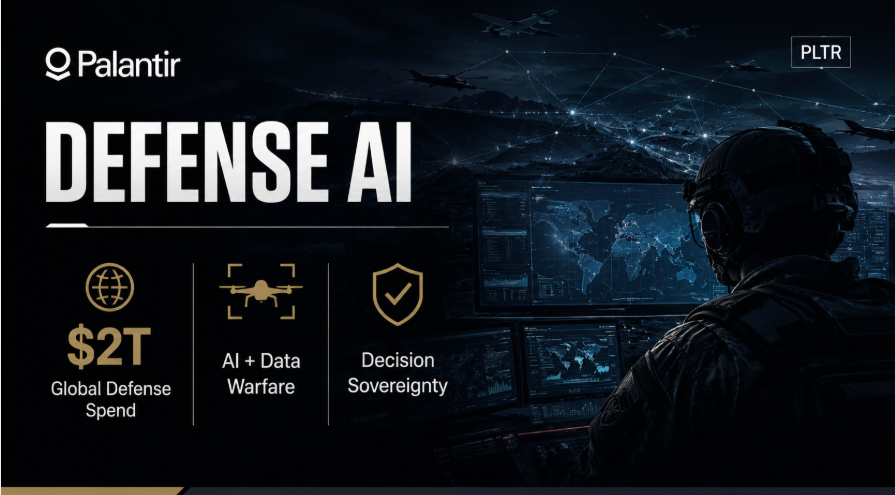
Global defense spending exceeds $2 trillion annually, with increasing allocation toward AI, data analytics, and digital warfare capabilities.
Modern warfare is increasingly data-driven, requiring AI for logistics, intelligence, and decision-making. Palantir is well positioned in this space.
However, trust is critical.
Governments want “decision sovereignty” — control over data, systems, and final decisions affecting millions of lives and billions in defense budgets. If Palantir can provide powerful tools while preserving that control, it can reduce concerns.
If not, governments may limit adoption or invest billions into alternatives.
The U.S. Advantage
Palantir’s strength is its U.S. market.
The U.S. spends over $800 billion annually on defense and hundreds of billions more on enterprise technology and AI. Palantir is deeply embedded in that ecosystem, driving its rapid growth.
However, this also creates concentration risk.
If international expansion slows due to sovereignty concerns across dozens of countries, Palantir may rely heavily on U.S. growth — which could limit long-term upside at its current valuation.
The Commercial AI Opportunity
Palantir is also expanding into commercial AI.
Its U.S. commercial business has grown rapidly, with revenue growth above 90%, customer growth above 60%, and deal sizes often exceeding $1 million per contract.
This helps diversify beyond government contracts, which historically made up a large portion of revenue.
The challenge is competition. Thousands of companies are entering the AI space, including major players with market caps exceeding $1 trillion.
Palantir’s advantage is execution — integrating AI into real operations, not just offering tools.
If it maintains this edge, commercial AI — a market projected to exceed $1 trillion globally — could be a major growth driver.
The Bear Case
The bear case has three parts:
- Valuation: The stock trades at over 50x sales and 100x+ earnings, leaving little room for error.
- Geopolitics: Sovereignty concerns across 20+ regions may limit international growth.
- Dependency risk: Governments may avoid long-term reliance on a U.S. provider, especially for systems affecting millions of users.
These factors could cap growth or pressure margins over time.
The Bull Case
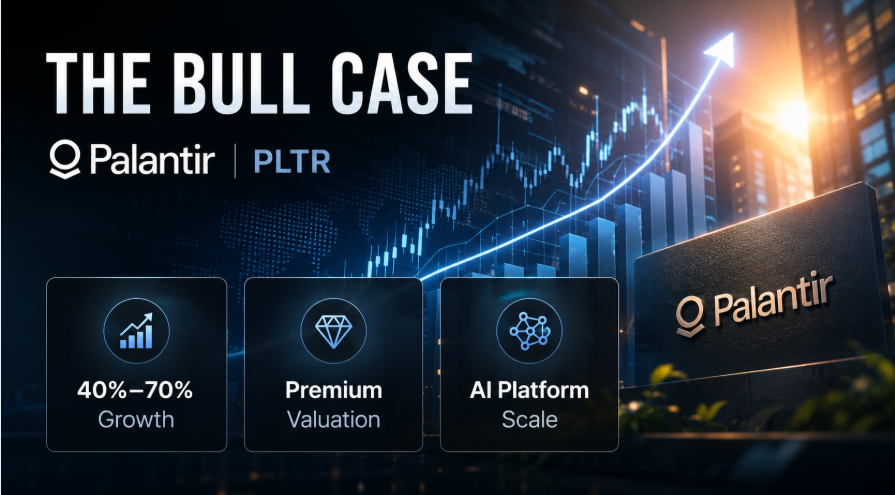
The bull case is that Palantir becomes a core platform for AI deployment across hundreds of organizations globally.
If governments and enterprises prioritize capability over vendor nationality — and if Palantir adapts to sovereignty concerns — it could continue growing at 40%–70% annually.
Its current performance suggests strong demand and execution, with billions in revenue and expanding margins.
That’s why the market assigns it a premium valuation.
So, Does It Make Sense to Invest?
It depends on the investor.
- Conservative investors may find the valuation too high given multiples above 50x sales.
- Growth investors may see long-term potential but should be cautious about entry points after significant price increases.
- Geopolitical investors may view Palantir as a unique play on AI, defense, and global power dynamics across dozens of countries.
A simple takeaway:
Palantir is likely a world-class company, but not necessarily a world-class stock at any price — especially above $300 billion valuation levels.
What Investors Should Watch
Key factors include:
- revenue growth (targeting 40%–70% annually)
- commercial adoption (customer growth above 50%+)
- government contracts (often worth $10M–$100M+)
- margins and cash flow (operating margins above 30%)
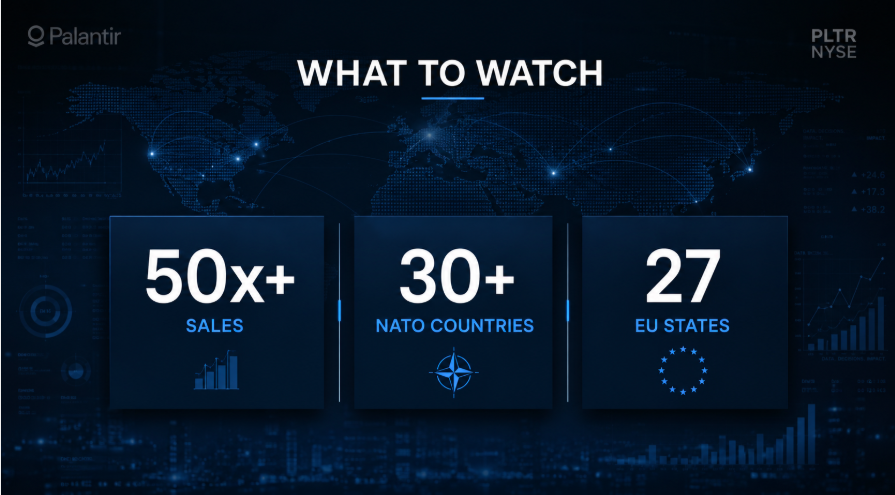
- valuation multiples (currently 50x+ sales)
- NATO and allied adoption across 30+ countries
- European sovereignty policies across 27 EU states
- emergence of local alternatives funded with billions
The most important signal is whether international governments continue adopting Palantir despite sovereignty concerns.
Bottom Line
Palantir is one of the strongest AI software companies today, operating in markets worth trillions and growing at rates above 70% in key segments.
It has rapid growth, strong positioning, and deep ties to critical sectors like defense and enterprise AI.
But the geopolitical risk is real.
Countries representing billions of people want control over their data and systems, which creates tension for a U.S.-based provider.
Palantir can succeed if it becomes trusted infrastructure for allies across dozens of countries.
But at its current valuation above $300 billion, success requires more than growth — it requires global trust and acceptance.
The opportunity is massive — potentially trillions in market size.
So is the risk.
Disclaimer
This article is for informational purposes only and does not constitute financial advice. Investing in technology and AI stocks involves risk, including volatility exceeding 20%–50% annually in some cases. Always conduct your own research and consult a financial advisor before making investment decisions.

Marc has been involved in the Stock Market Media Industry for the last +5 years. After obtaining a college degree in engineering in France, he moved to Canada, where he created Money,eh?, a personal finance website.