- Sekur Private Data, trading under SWISF on the OTCQB, has signed a defense distribution agreement with Elyon International.
- The agreement strengthens SWISF’s push into defense, intelligence, government, and enterprise secure communications.
- With SekurOne expected to launch commercially in June 2026, the story is shifting from privacy-tech concept to defense-channel execution.
Sekur Private Data is beginning to look less like a niche privacy communications company and more like a micro-cap cybersecurity name attempting to enter the defense and government communications market.
For SWISF investors, the latest news matters because it adds another potential route into higher-value customers at a time when secure communications, encrypted voice, data sovereignty, and operational privacy are becoming bigger priorities.
- The key investor question is simple: can SWISF convert defense distribution agreements into real recurring revenue?
The company’s latest announcement centers on a partner distribution agreement with Elyon International, a Vancouver, Washington-based defense-focused services firm. Sekur described the agreement as its second defense distributor agreement and said it marks its entry into defense, intelligence, and special operations communications.
That distinction matters because SWISF’s valuation story depends less on consumer privacy adoption and more on whether the company can convert higher-value government, defense, and enterprise channels into paid accounts.
The Main News: SWISF Adds Elyon as a Defense Distribution Partner
Sekur said Elyon International will help identify target users for its defense-grade communications suite, including secure voice and video capabilities expected to launch in late June 2026.
The company also said sales are expected to start once Elyon training has been completed, which management expects within the next 60 days.
- For investors, this creates a near-term execution window rather than a vague long-term product roadmap.
SWISF is moving toward the commercial launch of SekurOne, its all-in-one secure communications plan combining encrypted voice, video, email, messenger, and VPN.
SekurOne is expected to be available for sale in the third week of June 2026, with video and video conferencing capabilities expected by late July 2026. Annual plans begin at US$3,500 and include a Sekur-provisioned privacy eSIM data card.
- That pricing gives investors a clearer way to model potential recurring revenue if defense and government adoption starts to materialize.
Why This Matters for Investors
The attractive part of the SWISF setup is not simply that the company signed another distribution agreement. It is that several parts of the story are now lining up at the same time.
The company has a defense-focused channel partner, a near-term product launch, a premium annual pricing model, and a target customer base that includes defense, intelligence, government, federal agencies, and enterprise users.
- Distribution: Elyon gives SWISF another defense-focused sales channel.
- Product launch: SekurOne is expected to move into commercial availability in June 2026.
- Pricing: Plans begin at US$3,500 per year, making each account materially more valuable than a low-cost consumer subscription.
- Market focus: SWISF is targeting defense, intelligence, government, federal agencies, and enterprise users.
- Procurement path: Sekur’s solutions are also available through a U.S. GSA Multiple Award Schedule contract via i3ICS.
The company is still very small, but that is also why the numbers matter. A few hundred or a few thousand paid operator accounts could become meaningful relative to the company’s current micro-cap profile.
Earlier in May, Sekur projected deployment of no fewer than 1,000 SekurVoice operator accounts over the next 12 to 18 months, driven by existing reservations from defense partners, resellers, and government channel partners.
- At US$3,500 per year, 1,000 accounts would imply US$3.5 million in annualized revenue potential before any upsells, broader agency deployments, or enterprise packages.
That is the basic re-rating math investors are watching. SWISF does not need to become a cybersecurity giant overnight to change the conversation. It needs to prove that its defense-channel strategy can produce paid, recurring accounts.
Investor Snapshot
| Item | Detail |
|---|---|
| Company | Sekur Private Data |
| Ticker | SWISF |
| Core business | Swiss-hosted secure communications and cybersecurity |
| Latest catalyst | Defense distribution agreement with Elyon International |
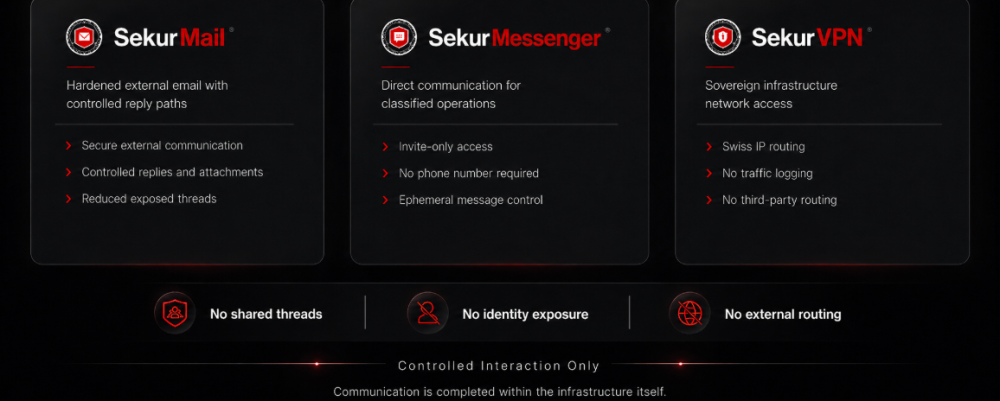
| Product focus | SekurOne, SekurVoice, SekurMail, SekurMessenger, SekurVPN, SekurRelay |
| Target customers | Defense, intelligence, government, enterprise, federal agencies |
| SekurOne pricing | Starts at US$3,500/year |
| Launch timing | SekurOne expected in June 2026, video by late July 2026 |
| Investor angle | Micro-cap cybersecurity name attempting a defense-channel pivot |
From Privacy App to Defense Communications Platform
SWISF’s positioning has changed materially over the past year. The company still markets Swiss-hosted privacy communications, but its public messaging is increasingly focused on defense-grade operational communications, Controlled Unclassified Information protection, secure voice, anonymous calling, on-premises deployment options, and reduced reliance on Big Tech infrastructure.
That shift matters because consumer privacy tools can be hard to scale. Customer acquisition is expensive, churn can be high, and individual users often pay low monthly subscription rates.
- Defense, government, and enterprise customers can be slower to close, but they can also carry higher annual contract values, longer customer relationships, and stickier deployments.
SWISF is trying to move into that second category. The Elyon agreement follows several recent defense-related moves, including the appointment of Lt. Gen. Raymond Palumbo, U.S. Army Retired, as Chairman of the Strategic Advisory Board, and the appointment of retired CIA Senior Intelligence Service expert John T. Lewis as CTO and Strategic Advisory Board member.
This gives the SWISF story a more coherent shape: product, advisors, procurement access, and distribution are now all pointing toward defense and government communications.

Why the Valuation Setup Could Be Interesting
SWISF remains a micro-cap, which means execution risk is high, liquidity can be limited, and the stock can move sharply on news. But for 10x-style investors, the attraction is the asymmetry.
If the company fails to convert the defense pipeline into contracts, the story remains speculative. But if SekurOne launches on schedule, Elyon and other channel partners begin generating paid accounts, and the company validates demand across defense or government users, the current valuation could start to look disconnected from the potential recurring revenue base.
- 1,000 SekurOne accounts at US$3,500/year = US$3.5 million annualized revenue potential.
- 2,500 accounts at US$3,500/year = US$8.75 million annualized revenue potential.
- 5,000 accounts at US$3,500/year = US$17.5 million annualized revenue potential.
That does not include higher-priced enterprise packages, broader agency deployments, Sekur Platinum products, or additional international government opportunities.
For a micro-cap cybersecurity company, even modest traction can change the conversation quickly. The key is whether SWISF can move from distribution announcements to signed customer deployments.
Key Comparisons
| Company | Market Position | Investor Angle |
| Sekur Private Data | Micro-cap secure communications and privacy platform | Early defense/government pivot with high operating leverage if contracts convert |
| Palantir | Large-cap government and enterprise software leader | Mature defense/data analytics platform with premium valuation |
| BlackBerry | Cybersecurity and secure communications legacy platform | Turnaround-style cybersecurity exposure |
| Cloudflare | Large-scale internet security and infrastructure platform | High-growth cybersecurity infrastructure, but much larger valuation base |
| Zscaler | Enterprise zero-trust cybersecurity leader | Best-in-class cloud security growth, already institutionally followed |
The key difference is scale. SWISF is not competing with larger cybersecurity names on enterprise reach, balance sheet strength, or institutional coverage.
Instead, the SWISF thesis is about whether a very small company can carve out a specialized niche in secure, sovereign, encrypted communications for sensitive users.
- That is a narrower market, but it could become meaningful if execution improves and paid deployments begin to show up in the numbers.
What Could Re-Rate SWISF
The next phase is about proof. Investors should focus less on the number of partnerships and more on whether those partnerships create recurring revenue.
The Elyon agreement is a positive strategic signal, but the market will likely want evidence that the defense pipeline is turning into actual paying users.
- Confirmation that SekurOne launches commercially in June 2026.
- Evidence that Elyon training is completed and sales activity begins.
- Announcements of contracted deployments, not just discussions.
- More clarity around the first 1,000 projected operator accounts.
- Government, defense, or enterprise customers moving from demos to paid usage.
- Revenue growth showing that the defense pivot is translating into actual recurring sales.
For SWISF, the next re-rating trigger is not another headline alone. It is proof that the company’s defense-channel strategy can generate real account growth.
Bottom Line
Sekur Private Data’s latest defense distribution agreement with Elyon International gives SWISF another channel into defense, intelligence, government, and enterprise communications. With SekurOne expected to launch commercially in June 2026 and plans starting at US$3,500 per year, the story is becoming more numbers-driven.
SWISF remains a speculative micro-cap, but if the company converts its defense pipeline into recurring operator accounts, the current setup could become far more interesting for investors looking for under-the-radar cybersecurity exposure.
Disclaimer: This article is for informational purposes only and is not financial advice. Investors should conduct their own research and consider the risks associated with micro-cap and early-stage public companies.

Marc has been involved in the Stock Market Media Industry for the last +5 years. After obtaining a college degree in engineering in France, he moved to Canada, where he created Money,eh?, a personal finance website.