The KOSPI went from the world’s hottest AI trade to a historic rout. Its warning for U.S. investors is what happens when concentration, leverage and impossible expectations collide.
- The KOSPI has lost nearly 35% in one month and almost 40% from its June peak as Samsung Electronics and SK Hynix plunged.
- The Bank of Korea’s July meeting started a new rate-hiking cycle, while leveraged single-stock ETFs turned a valuation reset into forced liquidation.
- A similar fall is less likely for the broader S&P 500, but record U.S. margin debt, rising leveraged-ETF exposure and heavy AI concentration make a violent correction in semiconductors and the Nasdaq entirely plausible.
From the world’s best market to a historic collapse
Only weeks ago, South Korea looked like the purest way to invest in the AI infrastructure boom.
Samsung Electronics and SK Hynix sat at the center of the global memory shortage. Investors borrowed aggressively to increase exposure. Even after the collapse, the KOSPI remained up 41.5% in U.S. dollar terms for 2026.
Then the entire trade reversed.
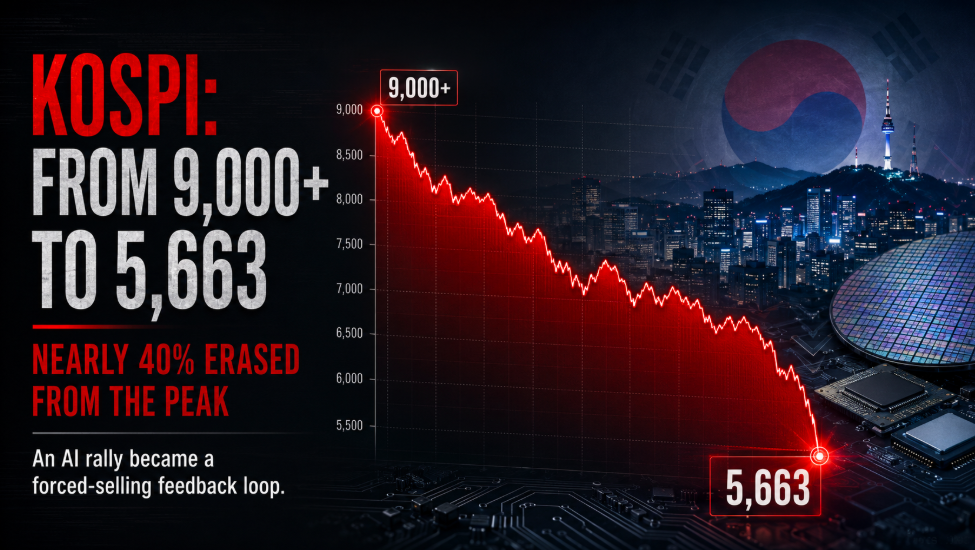
The KOSPI fell nearly 11% on Tuesday and another 6% on Wednesday, after dropping as much as 12.6% intraday. The index closed at 5,663.24, having recently traded above 9,000. According to Reuters, almost 40% of its peak value has disappeared in little more than a month. Market data put the one-month decline near 35%.
That speed matters more than the label “bear market.” A collapse over several weeks creates margin calls, mechanical selling and disappearing liquidity. Korea did not simply experience a correction. It experienced a feedback loop.
The meeting that changed the backdrop
At its July 16 meeting, the Bank of Korea raised its benchmark interest rate by 25 basis points to 2.75%, its first increase in three and a half years. It also signaled that further tightening could follow.
The decision was economically understandable. Semiconductor exports had strengthened growth, inflation remained elevated and the won was under pressure. For equities, however, the message was less comfortable.
The same AI boom supporting profits was now strong enough to justify tighter policy. Higher rates increase the cost of leverage and pressure the value investors assign to distant earnings—particularly when a rally has already been financed with borrowed money.
The increase did not cause the crash. It removed support just as investors questioned AI valuations, memory supply and Big Tech capital expenditure.
Why the fall became so violent
The first problem was concentration. Samsung and SK Hynix together account for more than half of the KOSPI’s market value. When both fall sharply, the rest of the index cannot absorb the damage.
The second problem was expectation. SK Hynix reported a six-fold increase in quarterly profit, yet its shares fell 9.6% after trading almost 20% lower. The results were excellent but below the extraordinary expectations embedded in the stock. In an overheated market, “strong” can disappoint because the price already assumes perfection.
The third problem was China. CXMT’s spectacular listing and reports of progress in domestic Chinese chipmaking equipment challenged the assumption that Korean memory producers would face limited competition. That does not erase SK Hynix’s leadership in high-bandwidth memory, but it changes the long-term risk calculation.
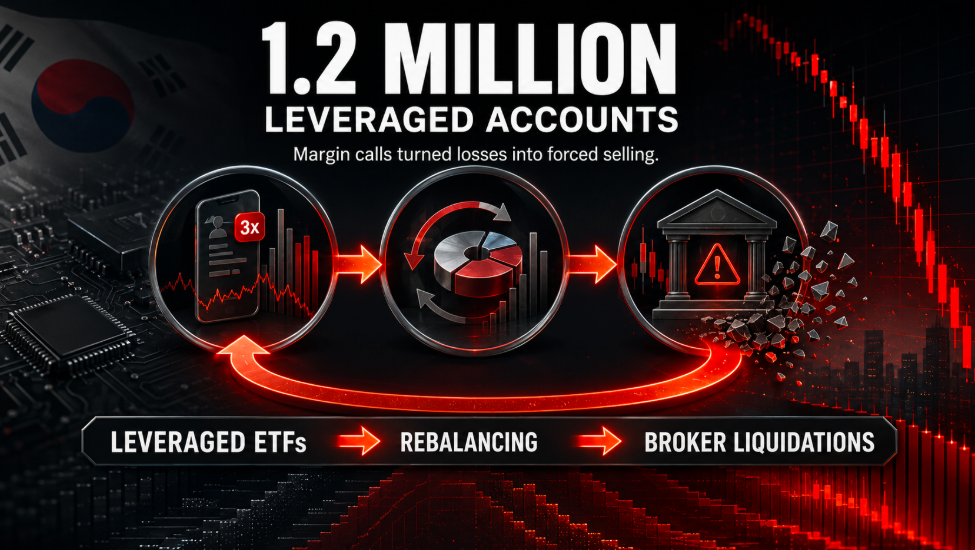
The final—and most explosive—problem was leverage. Single-stock leveraged ETFs tied largely to Samsung and SK Hynix allowed retail investors to multiply daily exposure. When the shares fell, the funds had to rebalance while brokers closed losing margin positions, creating more selling and additional margin calls.
More than 1.2 million leveraged retail accounts had reportedly received margin calls by July 13. Officials have since apologised, stopped new listings temporarily and raised minimum cash requirements.
What does the one-month collapse actually mean?
It does not mean South Korea is entering a depression or that the AI boom is over. The economy is growing and SK Hynix is producing record profits. Analysts cited by Reuters largely described the selloff as liquidity- and sentiment-driven, not a sudden collapse in fundamentals.
The KOSPI has exposed a vulnerability in modern markets: an index can appear diversified while becoming dependent on one narrative. Passive inflows, retail leverage and daily-reset ETFs reinforce it on the way up—and accelerate its destruction on the way down. Once prices fall far enough, leverage must be reduced regardless of whether the businesses remain healthy.
Could this happen in the United States?
The honest answer is yes—but probably not in exactly the same form.
The S&P 500 is broader, deeper and more liquid than the KOSPI. Its two largest companies do not represent more than half of the index, and capital can rotate into healthcare, financials, industrials or energy when technology falls.
That makes a 35% to 40% one-month S&P 500 collapse unlikely without a recession, credit event or severe liquidity crisis. It is not impossible: the index lost 26.7% during the 2020 pandemic shock.
The similarities with Korea are nevertheless becoming difficult to ignore.
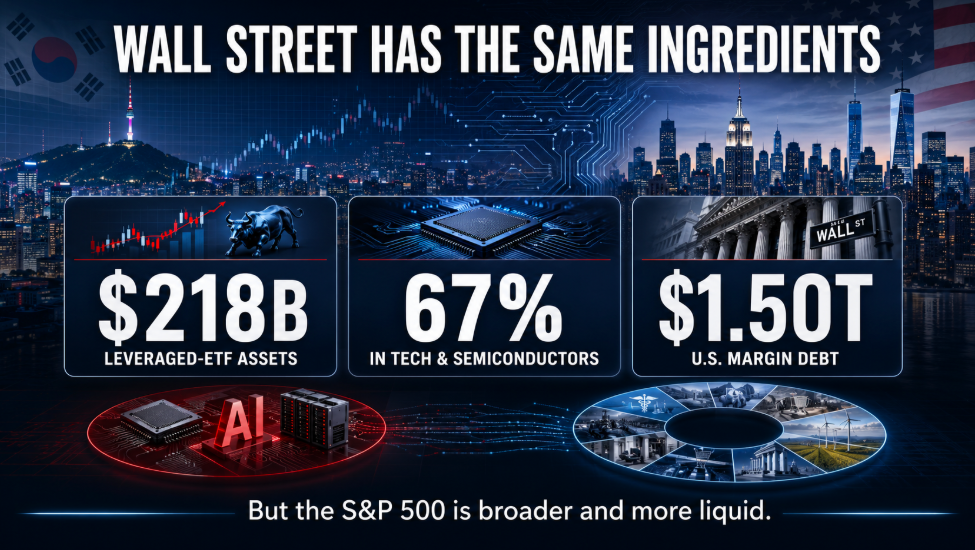
U.S. leveraged-ETF assets recently reached a record $218 billion, up 60% since the end of March. Technology and semiconductor products represented 67% of that total. Almost 40 cents of every dollar allocated to the S&P 500 flows to its ten largest holdings, while approximately one-third goes to the Magnificent Seven.
Meanwhile, FINRA data show U.S. margin debt reached $1.50 trillion in June, up roughly 49% from a year earlier.
Wall Street therefore has three of Korea’s ingredients: concentration, leverage and an extremely popular AI thesis.
What it lacks is the same dependence on two companies and the same scale of forced retail liquidation.
The most realistic U.S. version of the Korean crash
The American version would probably begin inside the AI complex rather than across the entire market.
A cloud company could cut capital-expenditure guidance. Nvidia could deliver strong results that fail to beat extreme expectations. Memory prices could weaken, China could introduce another credible alternative, or higher rates could pressure valuations.
Semiconductors fall first. Leveraged products rebalance, hedge funds face higher collateral demands and investors sell other winners to cover losses. The Nasdaq corrects sharply while defensive rotation cushions the S&P 500.
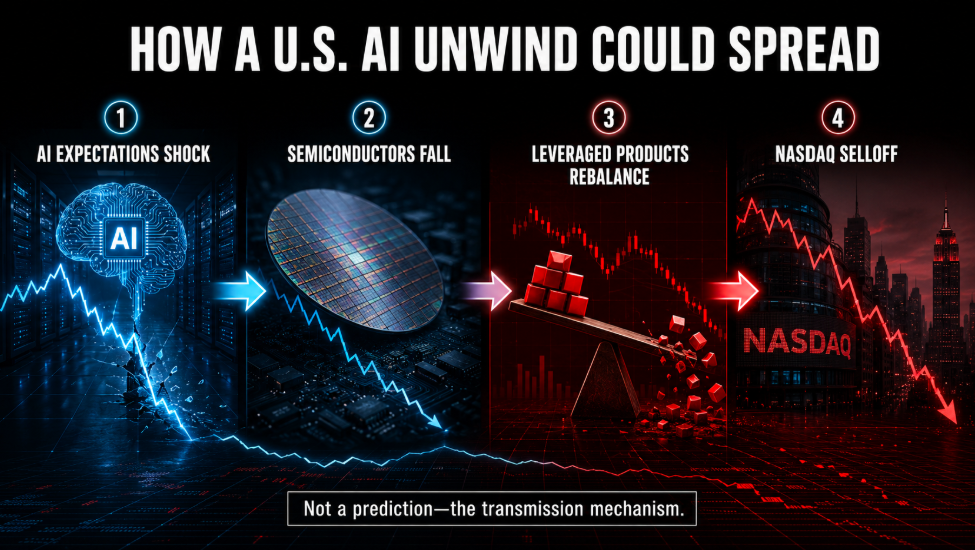
That is not a prediction. It is the transmission mechanism Korea has just demonstrated.
My view is that a KOSPI-style collapse in the S&P 500 is not the base case. A 20% to 30% drawdown in the most crowded AI and semiconductor names, however, requires no economic catastrophe—only a gap between excellent results and even higher expectations, plus enough leverage to turn disappointment into forced selling.
South Korea’s message is not “sell every AI stock.” It is that the biggest danger often appears when a correct investment thesis becomes an overcrowded trade.
What do you think: is Korea a unique leverage accident, or a preview of what could happen to Wall Street’s AI trade? And if the unwind reaches the U.S., which breaks first—Nvidia, semiconductors, the Nasdaq or the wider S&P 500?

Marc has been involved in the Stock Market Media Industry for the last +5 years. After obtaining a college degree in engineering in France, he moved to Canada, where he created Money,eh?, a personal finance website.