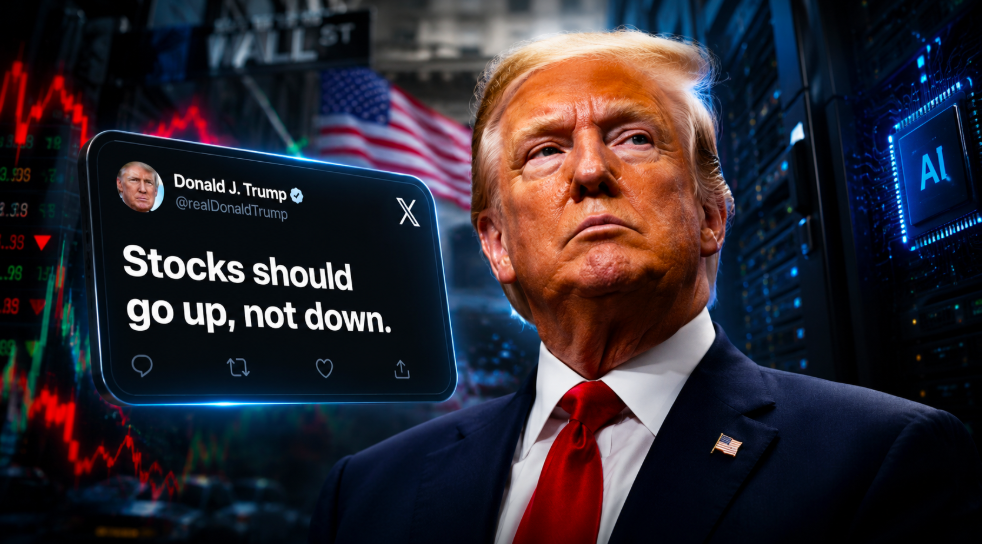
- Trump said stocks “should go up, not down” after a stronger-than-expected jobs report triggered a market selloff.
- His administration is reportedly exploring government equity stakes in major AI companies.
- The proposal comes as analysts forecast AI could become one of the largest wealth-creation opportunities in modern history.
Donald Trump has always viewed the stock market as a measure of economic success.
That is why his recent comments drew attention after a strong U.S. jobs report failed to lift stocks. The economy added 172,000 jobs in May, far above expectations of roughly 85,000, yet markets sold off as investors worried stronger growth could keep interest rates higher for longer.
Trump reportedly argued that stocks “should go up, not down.”
While the comment sparked debate, an even bigger story emerged: reports that U.S. officials have discussed the possibility of government equity stakes in major AI companies.
The idea raises a major question for investors: should taxpayers share in the upside of the AI boom?
The Bigger Story: Government Stakes in AI
According to reports from Reuters and Axios, officials have explored whether the federal government should receive equity stakes in AI companies as part of broader efforts to support America’s technological leadership.
The argument is straightforward.
The government is already helping fund AI growth through semiconductor incentives, infrastructure spending, energy projects, research programs, and defense contracts. If taxpayers help build the foundation, some policymakers believe they should benefit from the rewards.
Supporters argue this is not nationalization. Instead, they see it as a strategic investment in an industry expected to generate trillions of dollars in economic value.
Why AI Is Such a Big Opportunity
The AI sector is growing at a pace rarely seen in technology.
Major Wall Street firms estimate AI could add $10 trillion to $20 trillion to the global economy over the next decade through productivity gains, automation, software innovation, and new business models.
Companies are spending aggressively to capture that opportunity.
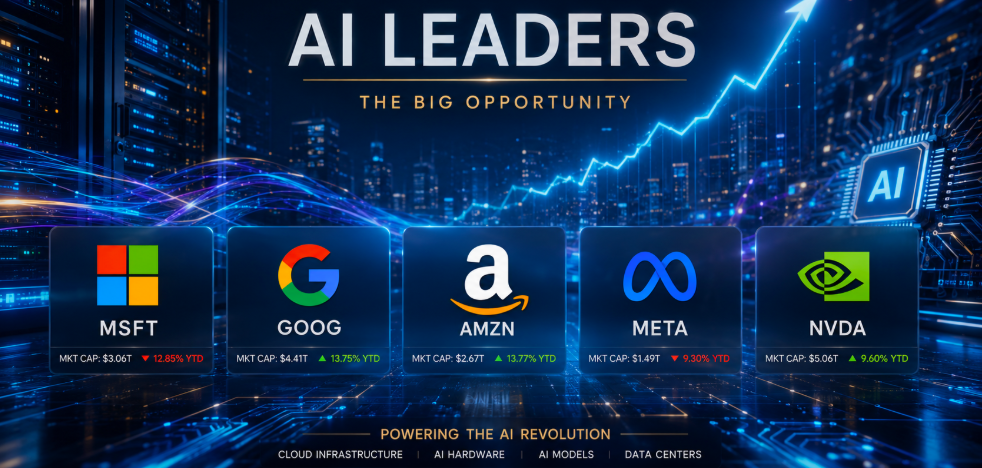
- Microsoft (NASDAQ: MSFT) has invested heavily in OpenAI and continues integrating AI across its products. Based on the latest screenshot, Microsoft has a market capitalization of approximately $3.06 trillion, a stock price near $412.19, and is down 12.85% year-to-date.
- Alphabet (NASDAQ: GOOG) is expanding Gemini and AI-powered search capabilities. Alphabet currently carries a market capitalization of approximately $4.41 trillion, trades near $358.68, and is up 13.75% year-to-date.
- Amazon (NASDAQ: AMZN) is pouring billions into AI infrastructure through AWS. Amazon’s market capitalization stands near $2.67 trillion, its stock trades around $246.86, and shares are up 13.77% over the past year.
- Meta Platforms (NASDAQ: META) is investing aggressively in AI models, chips, and data centers. Meta currently has a market capitalization of roughly $1.49 trillion, trades near $589.91, and is down 9.30% year-to-date.
Meanwhile, Nvidia (NASDAQ: NVDA) has become one of the biggest winners in the AI trade, carrying a market capitalization of approximately $5.06 trillion. Nvidia currently trades near $206.98 and is up 9.60% year-to-date.
Investors are also closely watching other chipmakers tied to the AI buildout.
- Advanced Micro Devices (NASDAQ: AMD) currently trades near $484.77, has a market capitalization of approximately $794.79 billion, and is up 116.93% year-to-date.
- Broadcom (NASDAQ: AVGO) trades near $393.61, carries a market capitalization of roughly $1.87 trillion, and is up 13.23% year-to-date.
- Intel (NASDAQ: INTC) trades near $108.58, has a market capitalization of approximately $547.99 billion, and is up 175.74% year-to-date.
Analysts remain bullish on the broader ecosystem as well.
Many expect AI spending to accelerate through the rest of the decade as businesses adopt AI tools, governments build sovereign AI capabilities, and enterprises upgrade infrastructure.
The Companies That Could Benefit
If government support for AI expands, several groups of companies could benefit.
Chipmakers
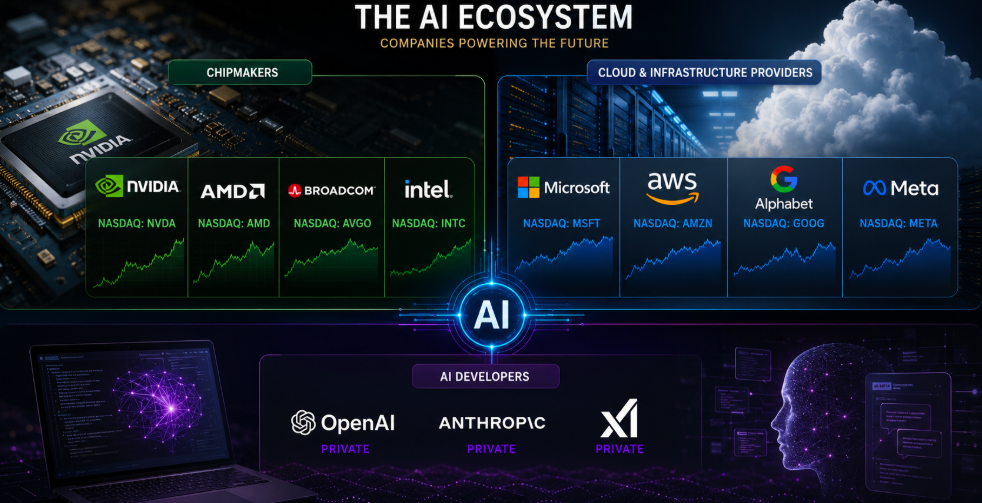
- Nvidia (NASDAQ: NVDA) — Market Cap: $5.06T | Stock Price: $206.98 | YTD: +9.60%
- Advanced Micro Devices (NASDAQ: AMD) — Market Cap: $794.79B | Stock Price: $484.77 | YTD: +116.93%
- Broadcom (NASDAQ: AVGO) — Market Cap: $1.87T | Stock Price: $393.61 | YTD: +13.23%
- Intel (NASDAQ: INTC) — Market Cap: $547.99B | Stock Price: $108.58 | YTD: +175.74%
These firms provide the hardware powering AI systems and data centers.
Cloud and Infrastructure Providers
- Microsoft (NASDAQ: MSFT) — Market Cap: $3.06T | Stock Price: $412.19 | YTD: -12.85%
- Amazon (NASDAQ: AMZN) — Market Cap: $2.67T | Stock Price: $246.86 | 1Y: +13.77%
- Alphabet (NASDAQ: GOOG) — Market Cap: $4.41T | Stock Price: $358.68 | YTD: +13.75%
- Meta Platforms (NASDAQ: META) — Market Cap: $1.49T | Stock Price: $589.91 | YTD: -9.30%
These companies operate the cloud platforms where AI applications are built and deployed.
AI Developers
- OpenAI (Private Company) — No public ticker, market valuation estimated above $500 billion.
- Anthropic (Private Company) — No public ticker, market valuation estimated above $170 billion.
- xAI (Private Company) — No public ticker, market valuation estimated above $200 billion.
These firms are developing the large language models driving the current AI revolution.
Energy and Data Centers
AI requires enormous amounts of electricity and computing capacity.
That could create opportunities for:
- Data-center operators
- Utility companies
- Nuclear-energy providers
- Grid infrastructure firms
Many analysts believe energy could become one of the biggest secondary beneficiaries of AI growth.
The Bull Case for Government Participation
Investors who support the idea argue government involvement could accelerate AI development.
Potential benefits include:
- Faster data-center approvals
- Expanded energy infrastructure
- Increased AI research funding
- More defense contracts
- Greater semiconductor investment
- Stronger U.S. competitiveness against China
If Washington becomes financially invested in AI success, supporters believe policymakers will have even greater incentives to help the industry grow.
That could be bullish for AI-related stocks and infrastructure providers.
The Risks Investors Should Watch
Critics see obvious concerns.
Government ownership could blur the line between regulator and shareholder.
Questions immediately emerge:
- Which companies receive support?
- Will political considerations influence investment decisions?
- Can regulators remain objective?
- Could future administrations change the rules?
For free-market investors, these concerns are significant.
The fear is not simply government involvement—it is the possibility that political influence begins shaping competitive outcomes.
Why This Matters for Investors
The real story is not Trump’s frustration with a one-day market decline.
It is the growing recognition that AI is becoming a strategic industry similar to defense, energy, and semiconductors.
Governments increasingly view AI as critical to:
- Economic growth
- National security
- Productivity
- Cybersecurity
- Military technology
- Global competitiveness

As a result, policymakers are becoming more involved in shaping the industry’s future.
That creates opportunities, but also new risks.
Bottom Line
Trump’s comments about stocks may have grabbed headlines, but the discussion around government stakes in AI companies could have far greater implications.
The AI sector is expected to generate trillions of dollars in economic value over the coming decade, with companies like Nvidia (NVDA), Microsoft (MSFT), Amazon (AMZN), Alphabet (GOOG), Meta Platforms (META), OpenAI, and Anthropic positioned at the center of that growth.
Among publicly traded leaders, Nvidia currently carries a market capitalization of approximately $5.06 trillion, Alphabet about $4.41 trillion, Microsoft roughly $3.06 trillion, Amazon around $2.67 trillion, and Meta approximately $1.49 trillion. Broadcom stands near $1.87 trillion, while AMD and Intel remain key semiconductor names with market capitalizations of roughly $794.79 billion and $547.99 billion, respectively.
If the U.S. government decides it wants a financial stake in that future, investors could see stronger policy support for AI development.
But they may also need to consider something that has traditionally mattered less in technology investing: politics.
The AI boom is already reshaping markets. The question now is whether governments want to be more than regulators—and become investors too.

Marc has been involved in the Stock Market Media Industry for the last +5 years. After obtaining a college degree in engineering in France, he moved to Canada, where he created Money,eh?, a personal finance website.