- Sekur appointed Annette L. Redmond, a former senior U.S. State Department intelligence-policy official, to its Strategic Advisory Board.
- The move strengthens SWISF’s positioning around government, diplomacy, defense, intelligence, and secure communications.
- The upside case is no longer just “privacy app growth” — it is whether Sekur can turn elite advisory credibility into real institutional demand.
Sekur Adds Another Senior Intelligence Figure
Sekur Private Data has added another serious name to its Strategic Advisory Board.
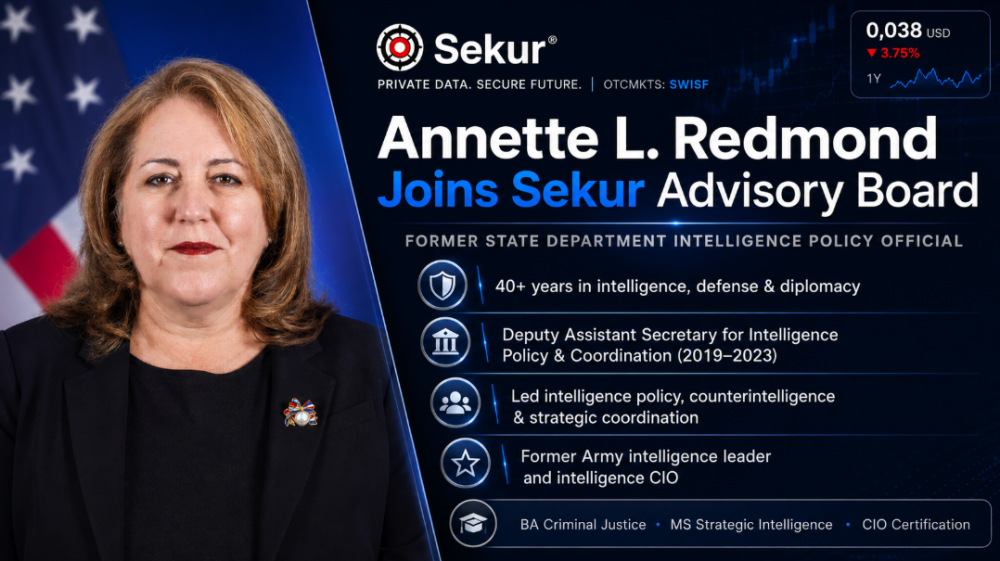
The company appointed Annette L. Redmond, a former U.S. government official with roughly 40 years of experience across the Intelligence Community, Department of Defense, and Department of State.
That matters because Sekur is trying to build a very specific market identity.
This is not just a company saying “we do encrypted messaging.” Sekur is trying to position itself as a Swiss-hosted secure-communications platform for government, defense, diplomacy, intelligence-adjacent users, enterprises, and privacy-conscious customers.
For a microcap stock like SWISF, appointments like this do not guarantee revenue. But they can help change the way investors think about the company’s target market.
The story becomes less about a tiny privacy app and more about whether Sekur can become a trusted secure-communications provider for high-sensitivity users.
Why Annette L. Redmond Matters
Redmond’s background is the core reason this update is interesting.
According to the release, she served in the U.S. government for four decades, including roles connected to the Intelligence Community, the Department of Defense, and the Department of State. Most recently, she served as Deputy Assistant Secretary for Intelligence Policy and Coordination in the State Department’s Bureau of Intelligence and Research from September 2019 to December 2023.
In that role, she was involved in policy development and coordination for intelligence operations and counterintelligence activities.
That is a strong fit for Sekur’s narrative.
Secure communications are not only a consumer privacy issue. In government, diplomacy, defense, and intelligence settings, communications security can become mission-critical. Sensitive users care about identity exposure, metadata risk, telecom vulnerabilities, data sovereignty, platform trust, and whether the provider depends on infrastructure controlled by large third parties.
Redmond’s experience sits directly inside that world.
That is why her appointment is more than a résumé headline. It supports the idea that Sekur is trying to build its product, messaging, and go-to-market strategy around the needs of serious institutional users.
The Bigger Pattern: Sekur Is Building a Defense Advisory Bench
The Redmond appointment is not happening in isolation.
Sekur has been adding people with direct defense, intelligence, and government backgrounds. That includes Lieutenant General Raymond Palumbo, appointed Chairman of Sekur’s Strategic Advisory Board, and John T. Lewis, a former CIA senior executive who was named Chief Technology Officer and Strategic Advisory Board member.
This pattern matters.
A company trying to sell into defense, government, and intelligence-related markets needs more than software. It needs credibility. It needs procurement understanding. It needs people who know how sensitive organizations evaluate technology, security, trust, and risk.
That is the key investor angle.
Sekur is trying to surround its technology with people who understand the exact markets it wants to enter.
For SWISF, the upside is that this advisory bench could help sharpen product-market fit, improve institutional messaging, guide procurement strategy, and open conversations with government, defense, diplomatic, and enterprise buyers.
The risk is that advisory boards alone do not create revenue. Investors still need to see contracts, customers, subscriber growth, channel traction, and recurring revenue.
What This Implies for SWISF
The appointment implies that Sekur is leaning harder into a higher-value market.
Consumer privacy is one lane. Enterprise and government secure communications is another.
That second lane is more difficult, but potentially more valuable.
If Sekur can become credible with government, defense, diplomacy, and intelligence-adjacent customers, the revenue profile could look very different from a basic consumer VPN or privacy email product. Institutional customers may have higher security needs, longer retention, more users per account, and a greater willingness to pay for trusted infrastructure.
That is where the upside case becomes interesting.
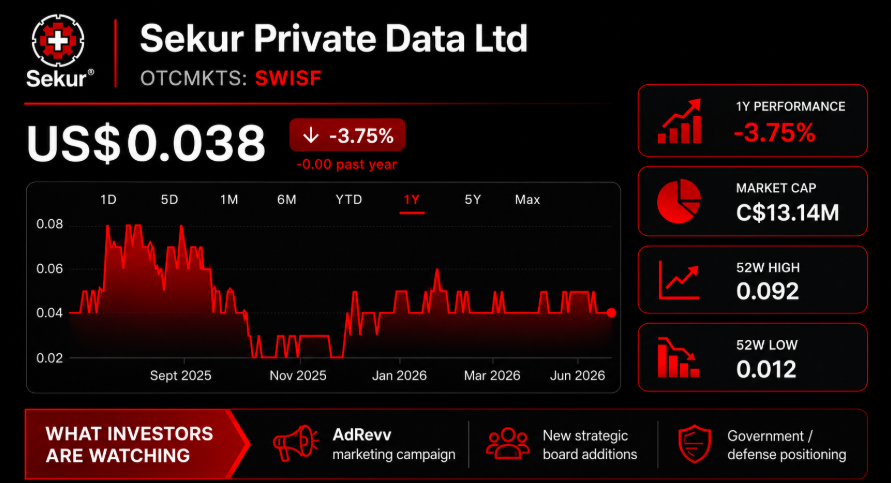
SWISF currently has a very small market capitalization, recently reported around $10 million. At that size, even modest institutional traction could matter. A few meaningful enterprise or government-related wins could change investor perception quickly.
The market does not need Sekur to become a cybersecurity giant overnight. It needs evidence that the company can convert its positioning into real commercial demand.
Recent AdRevv Deal Adds the Growth Angle
The board additions help with credibility. The AdRevv deal adds the customer-acquisition angle.
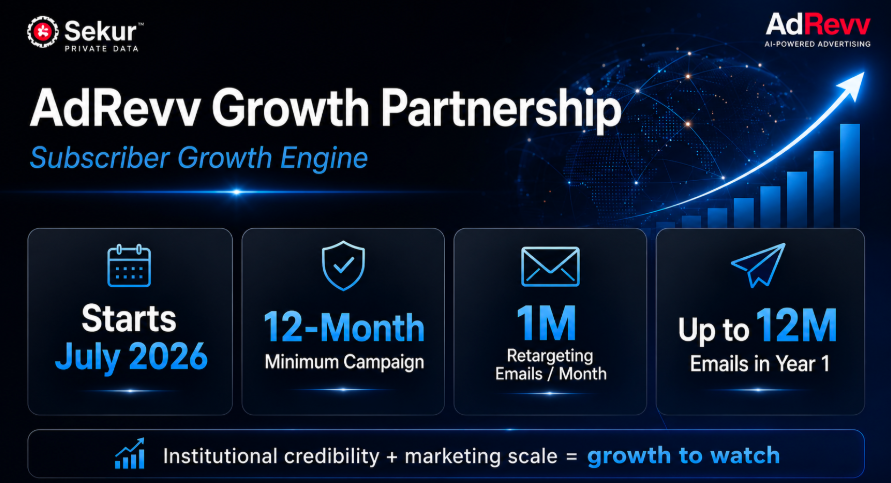
Sekur recently signed a partnership with AdRevv, a U.S. AI-powered advertising and revenue company, to market Sekur’s privacy and security products. The program is expected to start in July 2026 and run for a minimum of 12 months, with 1 million retargeting emails per month.
That equals up to 12 million retargeting emails over the first year.
This matters because Sekur needs growth evidence.
The Redmond appointment helps the institutional narrative. The AdRevv campaign could help the subscriber-growth narrative. Together, they give investors two things to watch:
- can Sekur build credibility with higher-value government and defense users?
- can Sekur grow paying customers through a scaled marketing channel?
If both start moving in the same direction, the SWISF story gets more interesting.
The Upside Case
The upside case for SWISF is based on the idea that the market may still be viewing Sekur too narrowly.
If investors see Sekur only as a small privacy app company, the valuation stays limited.
But if Sekur can prove that its Swiss-hosted secure communications platform has relevance for government, diplomacy, defense, intelligence-adjacent users, and enterprise privacy markets, the valuation conversation could change.
The ingredients are now visible:
- a microcap valuation around the low double-digit millions
- a Swiss-hosted privacy and secure-communications platform
- a GSA Multiple Award Schedule route for U.S. government sales
- a defense and intelligence advisory bench
- a new State Department intelligence-policy advisor
- a former CIA technology leader as CTO
- a retired three-star general leading the advisory board
- an AdRevv marketing deal expected to reach 1 million retargeting emails per month
That does not make the stock low-risk. It makes the setup asymmetric.
The company is still early, revenue scale remains small, liquidity can be thin, and execution risk is high. But for a microcap, the market does not need perfection. It needs proof that the story is moving from narrative to traction.
What Investors Should Watch Next
The next phase is all about evidence.
The most important updates would be paying customer growth, enterprise adoption, government-related sales, new distributor traction, SekurOne progress, VPN conversion data from the AdRevv campaign, and any signs that the strategic advisory board is translating into real commercial activity.
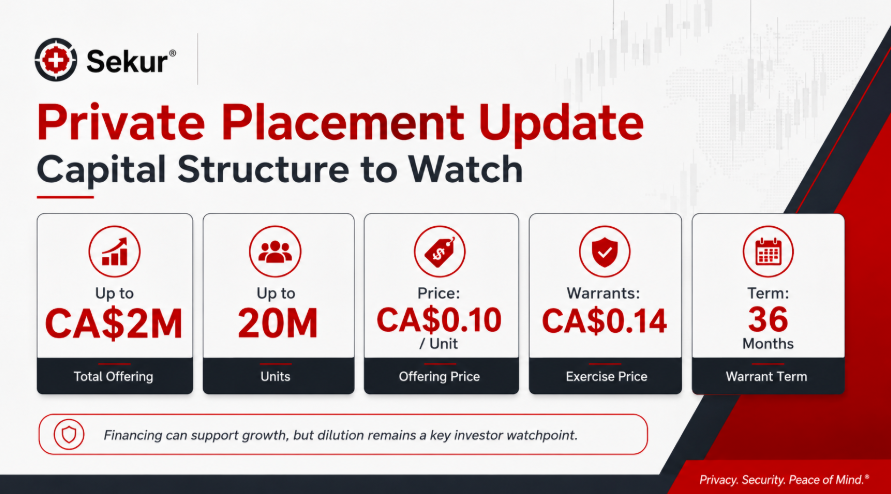
Investors should also watch capital structure. Sekur recently announced a non-brokered private placement of up to CA$2 million, through up to 20 million units priced at CA$0.10 per unit, with warrants exercisable at CA$0.14 for 36 months.
For a microcap, financing can help growth, but dilution is always part of the risk discussion.
That is why the next few months matter. Sekur has added credibility. Now it needs commercial proof.
Why This News Could Matter More Than It Looks
On the surface, adding an advisor may not look like a major stock catalyst.
But for Sekur, the context is different.
The company is trying to sell secure communications into markets where trust is everything. Government, defense, diplomacy, and intelligence users do not evaluate communications platforms the same way consumers evaluate an app. They care about operational risk, data sovereignty, procurement credibility, information security, and whether the company understands their environment.
That is where Redmond’s appointment could help.
It signals that Sekur wants to speak the language of high-sensitivity users, not just retail privacy buyers.
For investors, that is the implication: Sekur is trying to graduate from consumer privacy microcap to institutional secure-communications platform.
Bottom Line
Sekur’s appointment of Annette L. Redmond adds another credibility layer to the SWISF story.
The company is building a pattern: a retired three-star Army general chairing the Strategic Advisory Board, a former CIA senior executive as CTO, and now a former State Department intelligence-policy official advising on diplomacy and intelligence.
That does not guarantee revenue. But it does strengthen the company’s positioning in exactly the markets it says it wants to target: government, defense, diplomacy, intelligence, enterprise privacy, and secure communications.
The hot investor take is this: SWISF is still a high-risk microcap, but the story is becoming more institutional, more defense-oriented, and potentially more valuable than a simple privacy-app narrative.
Now the market will need proof.
If Sekur can convert this advisory credibility into customer wins, subscriber growth, government traction, or enterprise contracts, the upside could become meaningful relative to its current microcap valuation.
Not financial advice. Sponsored content may involve compensation. Investors should conduct their own due diligence and consider the volatility and liquidity characteristics commonly associated with microcap securities, including OTCQB-listed stocks such as SWISF.

Marc has been involved in the Stock Market Media Industry for the last +5 years. After obtaining a college degree in engineering in France, he moved to Canada, where he created Money,eh?, a personal finance website.