- Small and mid-cap growth stocks are back on investor screens as traders look beyond mega-cap AI.
- The strongest setups combine hard numbers, fresh catalysts, and a clear market narrative.
- This watchlist includes five U.S.-traded names with different angles: secure communications, AI infrastructure, edge defense computing, satellite intelligence, and semiconductor test equipment.
Why Small and Mid-Cap Stocks Are Getting Attention Again
The market has spent the past few years obsessing over mega-cap AI winners. Nvidia, Microsoft, Broadcom, Amazon, and other large-cap names have pulled most of the attention, capital, and headlines.
But once the biggest AI trades become crowded, investors often start looking one layer down.
That is where small and mid-cap growth stocks become interesting. These companies are usually riskier, less liquid, and more volatile than large-cap leaders, but they can also move faster when their story starts to work.
The best small-cap setups usually share three traits: a large addressable market, a recent catalyst, and numbers that show the business is not just selling a story.
This list focuses on five U.S.-traded names with current investor narratives and fresh data points:
- Sekur Private Data — SWISF
- TSS Inc. — TSSI
- One Stop Systems — OSS
- Satellogic — SATL
- Aehr Test Systems — AEHR
These are not the same type of business. That is the point. Each one offers a different way to play a high-interest theme: cybersecurity, AI data centers, defense AI, space intelligence, and semiconductor infrastructure.
Recap Table: Top 5 U.S.-Traded Small/Mid-Cap Stocks
| Company | Ticker | Recent Stock Price | Market Cap | Core Theme | Main Catalyst |
|---|---|---|---|---|---|
| Sekur Private Data | SWISF | ~$0.04–$0.05 | ~$10M–$14M | Secure communications / privacy | AdRevv marketing deal + diplomacy/intelligence advisor |
| TSS Inc. | TSSI | $13.56 | $380.7M | AI data-center infrastructure services | Systems Integration revenue up 88% YoY |
| One Stop Systems | OSS | $18.44 | $455.1M | Rugged edge AI / defense compute | Q1 revenue up 55% YoY |
| Satellogic | SATL | $6.03 | $849.9M | Earth observation / defense space intelligence | $18M defense imagery contract |
| Aehr Test Systems | AEHR | $115.30 | $3.54B | Semiconductor test / AI data-center infrastructure | Strong AI/data-center bookings cycle |
1. Sekur Private Data — SWISF
Sekur Private Data is the smallest and most speculative name on this list, but it has one of the clearest micro-cap narratives.
The company is focused on Swiss-hosted secure communications, including encrypted email, messaging, VPN, voice, and enterprise privacy products. Sekur’s pitch is simple: users, businesses, government organizations, and sensitive-sector customers need private communications that do not depend on Big Tech infrastructure.
That story has become more interesting after two recent updates.
First, Sekur signed a marketing partnership with AdRevv, a U.S.-based AI-powered advertising and revenue company. The agreement is designed to market Sekur’s privacy products to a target audience of users interested in VPNs, secure email, secure messaging, secure voice calls, and privacy phones.
The numbers behind that campaign are what make it worth watching.
AdRevv’s target database includes 271 million U.S. users, and the campaign is expected to deploy 1 million retargeting emails per month over a minimum 12-month period. That creates a potential top-of-funnel of roughly 12 million retargeting emails over the first year.
The deal is structured around revenue sharing. AdRevv is expected to receive 40% of revenue generated from SekurVPN sales and 25% of revenue generated from other Sekur products sold through the campaign.
That makes the setup simple: if the campaign converts even a small percentage of users, SWISF could see better customer-acquisition momentum from a very low market-cap base.
The second update is the company’s continued push into government, diplomacy, and intelligence-focused communications. Sekur recently appointed Nathan R. Price as Special Advisor for Diplomacy & Intelligence. Price previously served as a foreign affairs analyst at the U.S. Department of State and worked in areas tied to diplomatic negotiations and intelligence-policy integration.
This matters because Sekur is trying to move beyond the consumer privacy-app narrative. The company wants to be seen as a secure-communications platform for sensitive environments: diplomats, negotiators, government users, defense-linked customers, and enterprise clients.
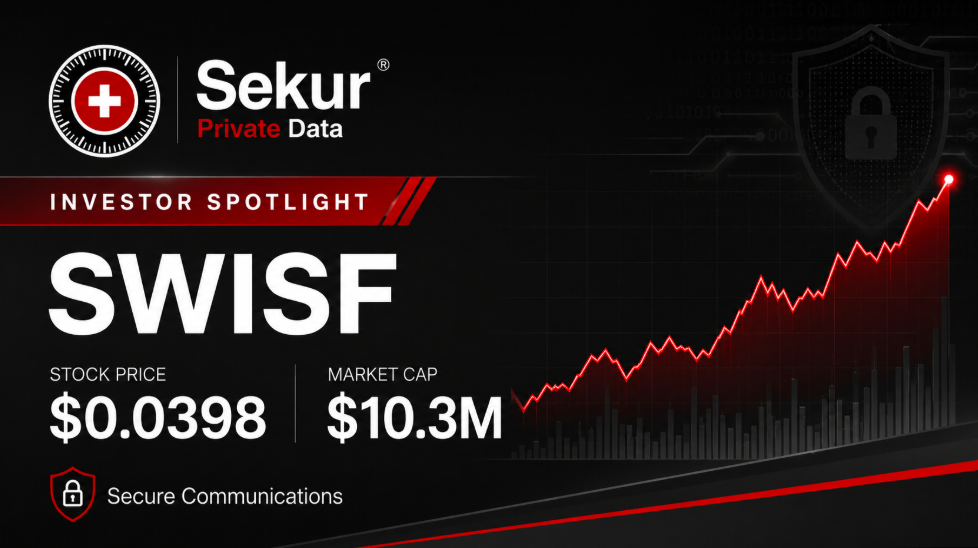
SWISF is not a low-risk stock. It is a micro-cap with limited scale, low liquidity, and execution risk. But that is also why the setup is asymmetric. At a market cap around the low double-digit millions, even modest evidence of customer growth could matter.
The investor angle: SWISF is a high-risk micro-cap privacy and secure-communications bet with a new marketing engine and a stronger diplomacy/intelligence narrative.
2. TSS Inc. — TSSI
TSS Inc. is a small-cap name that has attracted investor attention because of its connection to AI data-center infrastructure.
The company provides integration, procurement, deployment, and infrastructure services, which makes it a potential “picks and shovels” play on data-center growth. Instead of building chips or owning data centers, TSS helps support the physical and operational infrastructure required for complex technology deployments.
The latest numbers show why TSSI remains interesting despite mixed headline results.
In Q1 2026, TSS reported $55.3 million in total revenue. That was down 44% year over year, mainly because procurement activity normalized after an unusually strong prior-year comparison. On the surface, that revenue decline looks weak.
But the more important part of the quarter was the shift in business mix. Systems Integration revenue increased 88% year over year to $14.1 million, which is a much better signal for investors watching higher-value infrastructure work.
TSS also reported $2.3 million in net income, $0.08 diluted EPS, and $5.3 million in adjusted EBITDA. Management refined its full-year 2026 outlook and said it now expects adjusted EBITDA toward the high end of the $20 million to $22 million range.
That gives TSSI a clean investor story: headline revenue may look uneven, but the higher-margin integration business appears to be gaining traction.
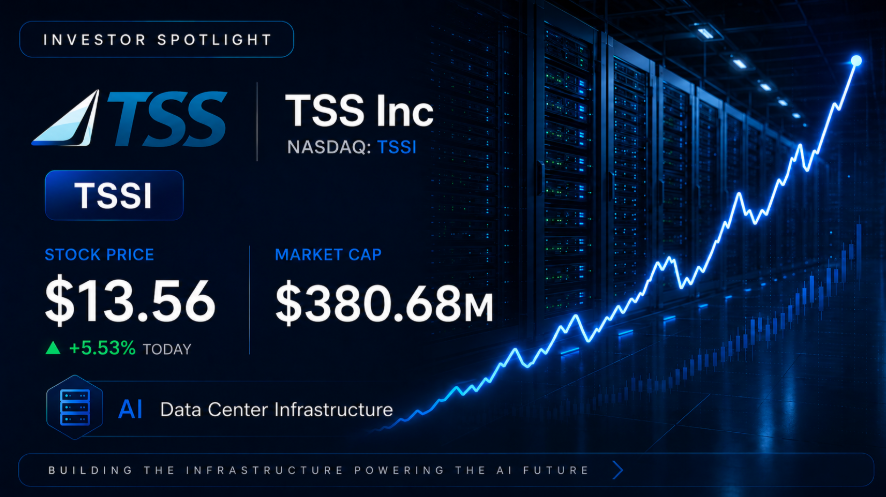
At a recent price of $13.56 and a market cap around $380.7 million, TSSI is still small enough that continued execution could move the valuation meaningfully.
The risk is that TSS remains tied to customer timing, procurement cycles, and data-center spending patterns. If AI infrastructure demand slows or customers delay projects, quarterly results can remain volatile.
The investor angle: TSSI is a small-cap AI infrastructure services name where Systems Integration growth is the key metric to watch.
3. One Stop Systems — OSS
One Stop Systems is another small-cap infrastructure name, but its angle is different from TSS.
OSS focuses on rugged high-performance computing, storage, and AI-enabled systems designed for harsh environments. That means edge AI, defense, autonomous systems, sensor fusion, and compute-heavy applications where standard data-center hardware may not work.
This makes OSS relevant to two major themes: AI at the edge and defense modernization.
The latest numbers were strong. In Q1 2026, One Stop Systems reported revenue of $8.1 million, up 55% year over year. Gross margin improved by 610 basis points to 51.6%, showing better operating quality as revenue increased.
That is the type of combination small-cap investors like to see: revenue growth plus margin improvement.
The business is still small, but the market is starting to care because OSS sits inside a high-interest niche. AI is not only about cloud data centers. Increasingly, defense and industrial customers need compute closer to the battlefield, the vehicle, the aircraft, the ship, or the sensor.
At a recent price of $18.44 and a market cap around $455.1 million, OSS is still a sub-$500 million company. That leaves room for investor re-rating if the company can keep proving that rugged edge AI is moving from niche to scalable demand.
The risk is scale. OSS needs to show that revenue growth can continue beyond a few strong quarters and that defense and industrial programs can translate into larger, repeatable business.
The investor angle: OSS is a small-cap rugged edge AI company with strong recent growth and a defense-compute narrative that fits the current market.

4. Satellogic — SATL
Satellogic is a space and Earth-observation company with a high-risk, high-upside profile.
The company builds and operates satellites for high-resolution Earth imagery and geospatial intelligence. Its story is tied to defense, government monitoring, persistent observation, sovereign space capabilities, and lower-cost satellite economics.
That matters because space intelligence is becoming more strategic. Governments, defense agencies, commercial customers, and infrastructure operators increasingly need frequent, high-resolution visibility of what is happening on Earth.
Satellogic’s latest results and contracts show why SATL is still worth watching.
In Q1 2026, revenue increased 80% year over year to $6.1 million. The company also reported improvement in operating loss and adjusted EBITDA loss, suggesting the business is moving in the right direction even though profitability remains a key challenge.
The catalyst profile has also improved. Satellogic secured a one-year contract valued at more than $18 million with an international defense customer for persistent Earth observation imagery. It also signed a $12 million agreement to deliver an in-orbit NewSat satellite to a sovereign defense customer.
For a company with a recent market cap around $849.9 million, those contract numbers matter.
SATL remains speculative. Space companies often face capital intensity, customer concentration, execution risk, and long sales cycles. But the theme is strong: defense and intelligence customers want more data, more often, and from more resilient satellite networks.
At a recent price of $6.03, SATL offers a lower-priced, higher-volatility way to play the public space-intelligence theme.
The investor angle: SATL is a small-cap space intelligence play where defense contracts and revenue growth are starting to give the story more substance.

5. Aehr Test Systems — AEHR
Aehr Test Systems is the largest name on this list by market cap, but it still fits the small/mid-cap growth category better than the mega-cap semiconductor leaders.
The company provides test and burn-in solutions for semiconductor devices. Its technology is relevant to AI processors, silicon photonics, data-center infrastructure, electric vehicles, silicon carbide, and power semiconductor markets.
This makes AEHR an indirect AI infrastructure play.
The stock has attracted attention because investors are looking for smaller companies that can benefit from the semiconductor test bottleneck. AI systems need more chips. More chips need more testing, burn-in, quality control, and reliability validation.
Aehr’s recent numbers are mixed, but the bookings story is strong.
In fiscal Q3 2026, Aehr reported revenue of $10.3 million, down sharply year over year. The company also posted a loss, which shows that the near-term financials are not perfect.
But the key number was bookings. Aehr reported more than $37 million in quarterly bookings driven by AI and data-center infrastructure demand. It also received a record $41 million production order from a lead hyperscale AI customer, with second-half bookings exceeding $92 million.
That is why AEHR remains interesting despite uneven revenue. Investors are looking past the current quarter and asking whether the bookings cycle is signaling stronger fiscal 2027 growth.
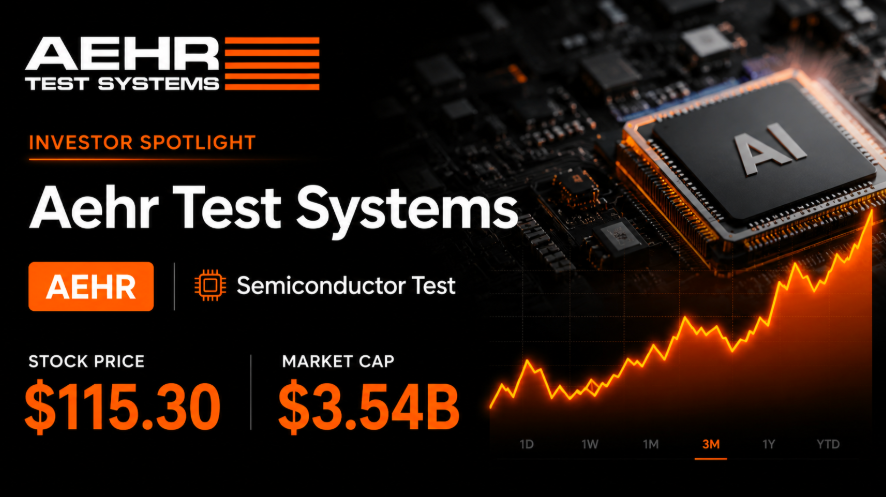
At a recent price of $115.30 and a market cap around $3.54 billion, AEHR is no longer a tiny semiconductor name. The market is already giving it credit for future AI-related growth. That means execution risk is higher. If bookings convert into revenue, the story can keep working. If conversion is delayed, the valuation could become vulnerable.
The investor angle: AEHR is a mid-cap semiconductor infrastructure play with strong AI/data-center bookings, but the stock already prices in a lot of future growth.
What These Five Stocks Have in Common
These companies are very different, but they all sit inside active investor themes.
SWISF is trying to turn privacy and secure communications into a defense, government, and enterprise story. TSSI is tied to the physical infrastructure layer of AI data centers. OSS brings AI compute into rugged and defense environments. SATL offers exposure to space-based intelligence and defense imagery. AEHR plays the semiconductor test layer behind AI and data-center hardware.
The common thread is this: all five are attempting to attach themselves to larger structural markets.
Those markets include:
- AI infrastructure
- secure communications
- defense modernization
- satellite intelligence
- semiconductor testing
- edge computing
- data-center expansion
- privacy and cybersecurity
That is exactly what makes small and mid-cap growth stocks interesting. When a smaller company finds itself inside a larger market theme, investor attention can build quickly.
Ranking by Risk and Potential
The highest-risk name in the group is SWISF because it is a micro-cap with a tiny market cap, low liquidity, and early-stage revenue scale. But it also has the most asymmetric setup because the starting valuation is so small.
The cleanest small-cap operating momentum setup may be OSS, given its 55% Q1 revenue growth and gross margin improvement.
The strongest AI data-center services angle is TSSI, especially if Systems Integration continues growing faster than lower-margin procurement.
The most speculative space-intelligence name is SATL, with recent defense contracts giving the story more weight.
The highest-quality semiconductor infrastructure angle is likely AEHR, but its valuation already reflects much more investor optimism than some of the smaller names.
Bottom Line
Investors looking beyond mega-cap AI are starting to pay attention to smaller companies tied to infrastructure, security, defense, space, and semiconductor supply chains.
This watchlist gives five different angles:
SWISF for secure communications and privacy, TSSI for AI data-center infrastructure services, OSS for rugged edge AI, SATL for space intelligence, and AEHR for semiconductor test and AI hardware infrastructure.
The most important point is that these are not low-risk stocks. Small and mid-cap names can move sharply in both directions, and several of these companies still need to prove consistent execution.
But for investors looking for under-the-radar growth stories with fresh catalysts, hard numbers, and active narratives, these five stocks are worth watching closely.
Disclosure
This article is for informational and educational purposes only and does not constitute financial advice, investment advice, or a recommendation to buy or sell any security. Always conduct your own research and consult a licensed financial advisor before making investment decisions.

Marc has been involved in the Stock Market Media Industry for the last +5 years. After obtaining a college degree in engineering in France, he moved to Canada, where he created Money,eh?, a personal finance website.