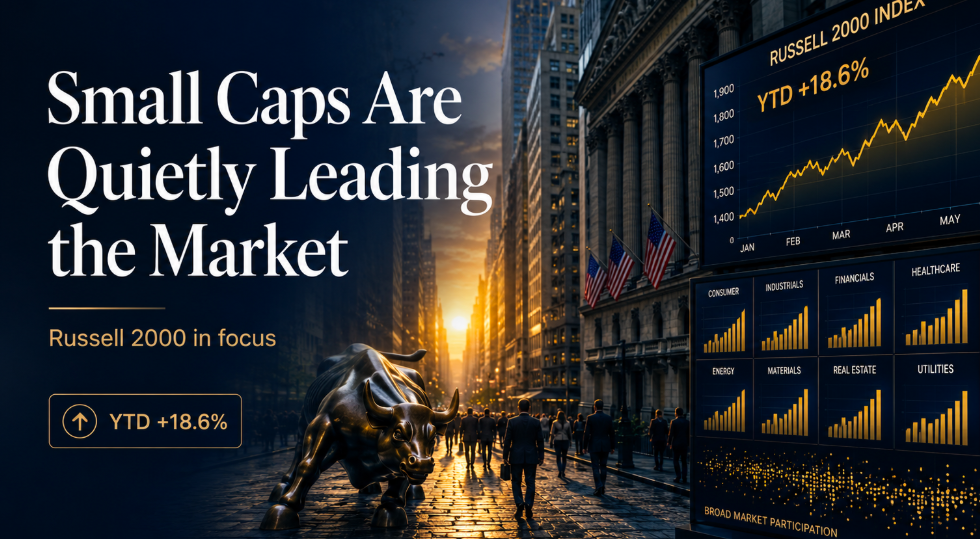
- The Russell 2000 is outperforming major indexes in the short term and year-to-date.
- Small caps are benefiting from risk-on sentiment, lower oil pressure, and improving economic confidence.
- The key question: is this a real market broadening — or another short-lived small-cap squeeze?
What Happened
Small caps are starting to steal attention from mega-cap tech.
On June 12, the Russell 2000 rose 0.8% to 2,943.99, outperforming the S&P 500, which gained 0.5% to 7,431.46, the Dow Jones Industrial Average, which rose 0.7% to 51,202.26, and the Nasdaq Composite, which added 0.3% to 25,888.84.
The weekly performance was even more interesting.
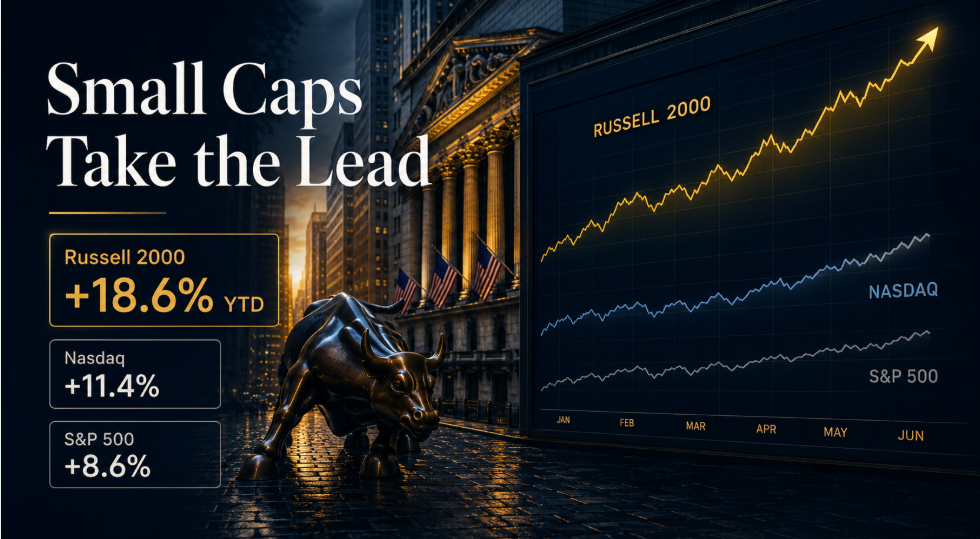
For the week, the Russell 2000 gained 3.9%, ahead of the S&P 500, Nasdaq, and Dow. Year-to-date, the Russell 2000 is also leading with an 18.6% gain, compared with 11.4% for the Nasdaq, 8.6% for the S&P 500, and 6.5% for the Dow.
• The market is no longer being led only by mega-cap AI. Small caps are quietly taking leadership.
Why This Matters
Small caps are often treated as a signal for broader market risk appetite.
When investors are defensive, they usually prefer larger, more liquid companies with stronger balance sheets. But when confidence improves, money often starts moving into smaller companies where valuations are lower and upside can be more explosive.
That is why the Russell 2000’s leadership matters.
A stronger small-cap tape suggests investors are becoming more willing to take risk outside the usual mega-cap technology trade.
It also suggests the market may be broadening.
For months, the biggest criticism of the bull market was that too much performance came from a narrow group of AI-linked mega-caps. If small caps keep outperforming, that criticism weakens.
• A broad market rally is healthier than one driven by five or six giant stocks.
The Numbers Behind the Move
The latest ETF data confirms the same rotation.
The iShares Russell 2000 ETF (IWM) recently traded around $292.95, up 0.92% on the session, with intraday volume above 34.4 million shares. The SPDR S&P 500 ETF (SPY) traded around $741.75, up 0.57%, while QQQ traded around $721.34, up 0.59%. The DIA, tracking the Dow, traded around $513.06, up 0.73%.
That means small caps were not just outperforming in index terms. The ETF flows and trading activity also showed investors actively buying small-cap exposure.
MarketWatch also reported that the Russell 2000 was up as much as 1.6% intraday, trading around 2,969, which would put it above its prior record closing high of 2,936.57 set on May 28.
• Small caps are not just bouncing — they are testing record territory.
Why Small Caps Are Catching a Bid
Several forces are helping small caps.
First, lower oil pressure and easing geopolitical fear have improved market sentiment. When oil risk drops, investors usually become more comfortable buying cyclical and rate-sensitive parts of the market.
Second, small caps are more tied to domestic economic growth. If investors believe the U.S. economy is holding up better than feared, smaller companies can benefit disproportionately.
Third, small caps spent years lagging mega-cap technology. That creates a catch-up setup. If investors believe valuation gaps have become too extreme, small caps can attract rotation capital.
Fourth, expectations for earnings improvement matter. Columbia Threadneedle cited Bloomberg consensus estimates showing the Russell 2000 expected to deliver 43% year-over-year earnings growth over the next 12 months, compared with 11% for the S&P 500.
• The small-cap story is not only about price momentum. It is also about a potential earnings inflection.
The Controversial Angle
The controversial part is that small-cap rallies have disappointed investors before.
Small caps are more sensitive to credit conditions, rates, labor costs, refinancing risk, and economic slowdowns. Many smaller companies carry more debt, have less pricing power, and depend more heavily on domestic demand.
That means a small-cap rally can reverse quickly if yields rise, the economy weakens, or investors return to mega-cap safety.
There is also a quality issue.
Not every small-cap rally is driven by strong businesses. Some rallies are fueled by short covering, speculative flows, and lower-quality names bouncing after heavy declines.
That is why investors need to separate broad small-cap exposure from high-quality small-cap leadership.
• The risk is that this is not a durable rotation — it could be another high-beta squeeze.
What Investors Should Watch
The most important signal is whether small caps continue outperforming without relying only on rate-cut hopes.
Investors should watch whether the Russell 2000 can hold above prior highs, whether IWM continues outperforming SPY and QQQ, and whether earnings revisions improve for smaller companies.
They should also watch credit spreads, Treasury yields, oil prices, and the Federal Reserve outlook. Small caps can benefit from stronger growth, but they can struggle if rates stay high and financing costs become a bigger problem.
The best confirmation would be broad participation: industrials, financials, healthcare, software, and consumer cyclicals all joining the move.
• If the rally broadens across sectors, the small-cap move becomes more convincing.

Bottom Line
Small caps are quietly becoming one of the most important signals in the market.
The Russell 2000 is up 18.6% year-to-date, ahead of the Nasdaq at 11.4%, the S&P 500 at 8.6%, and the Dow at 6.5%.
That is a major shift in leadership.
If small caps keep outperforming, it could mean the bull market is broadening beyond mega-cap AI. If the move fades, it may prove to be another short-lived high-beta rally.
The key takeaway: investors should not ignore small caps anymore. The market’s quiet leader may be telling us that risk appetite is spreading.

Marc has been involved in the Stock Market Media Industry for the last +5 years. After obtaining a college degree in engineering in France, he moved to Canada, where he created Money,eh?, a personal finance website.