Artificial-intelligence investment is supporting economic growth, manufacturing and the stock market. But with Big Tech’s 2026 spending estimates approaching $730 billion, the U.S. economy is becoming increasingly dependent on one exceptionally expensive corporate bet.
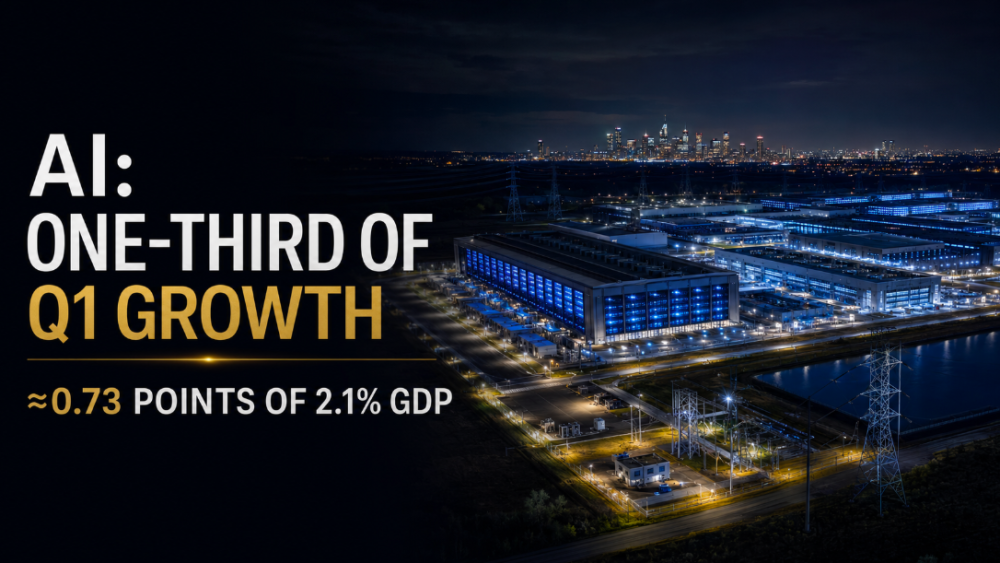
- AI-related investment may have generated roughly one-third of first-quarter U.S. growth, although the exact contribution is difficult to measure.
- Five hyperscalers are now expected to spend approximately $730 billion in 2026, up from estimates of $485 billion in January.
- This is not yet a classic debt-fuelled bubble, but the economy and semiconductor sector could feel a genuine shock if AI revenue fails to justify the infrastructure being built.
A $730 Billion Pillar Under the Economy
The U.S. economy expanded at an annualized rate of 2.1% during the first quarter of 2026. That headline sounds reasonably healthy, particularly after growth slowed to just 0.5% in the preceding quarter.
Look beneath it, however, and the picture becomes more concentrated.
Investment, information services, technical services and durable-goods manufacturing were among the leading contributors. Retail, wholesale trade and finance declined, while real final sales to private domestic purchasers increased by a more modest 1.7%.
The Federal Reserve recently attempted to isolate the contribution from software, data centres, power infrastructure, computers and peripheral equipment. Its estimate suggests these AI-linked categories added approximately:
- 0.53 percentage points from software
- 0.59 points from computers and peripheral equipment
- 0.06 points from data centres and related power facilities
- Minus 0.45 points from associated computer-equipment trade flows
Combined, that equals approximately 0.73 percentage points of first-quarter GDP growth—around one-third of the economy’s total 2.1% expansion.
This is only an approximation. Not every server is used for AI, and a significant share of the equipment is imported. Nevertheless, the direction is difficult to dispute: AI infrastructure has become one of the most important marginal drivers of U.S. economic growth.
The scale is still increasing.
Microsoft, Alphabet, Amazon, Meta and Oracle are now expected to spend approximately $730 billion on capital expenditures during 2026, according to a Reuters analysis of LSEG estimates. In January, the estimate was roughly $485 billion.
Wall Street has therefore added approximately $245 billion to its annual spending forecast in only six months.
The Spending Increase Is Extraordinary
The Federal Reserve’s own data illustrate how rapidly the investment cycle has accelerated.
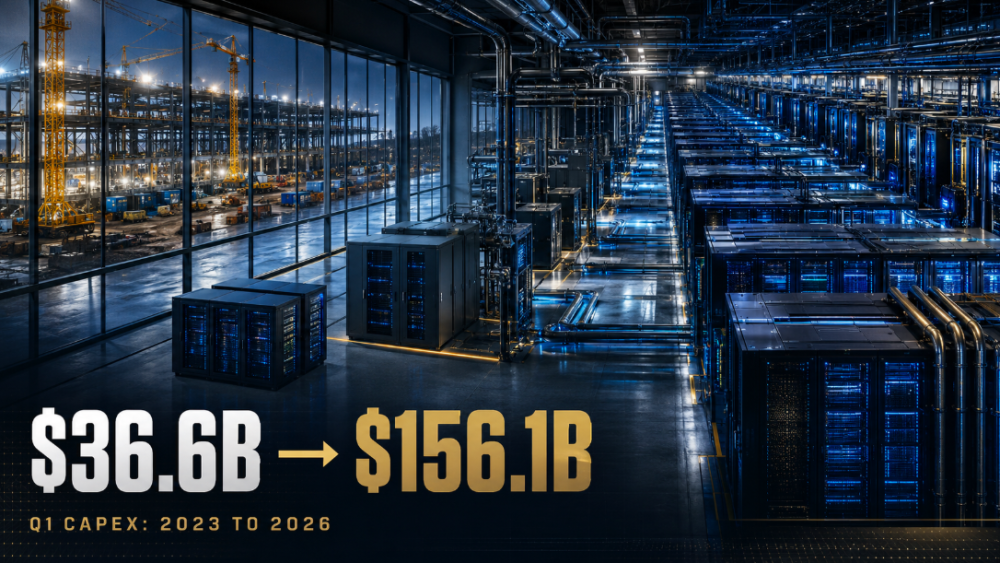
During the first quarter of 2023, Amazon, Google, Meta, Microsoft, Oracle and CoreWeave collectively spent approximately $36.6 billion purchasing property and equipment. By the first quarter of 2026, that figure had reached approximately $156.1 billion.
That is more than a fourfold increase in three years.
The numbers are not purely AI spending. Amazon still invests in logistics infrastructure, for example, while the other companies operate businesses extending far beyond generative AI. The figures may also understate total infrastructure investment because hyperscalers increasingly lease data-centre capacity instead of owning everything directly.
Even with those qualifications, the trend is remarkable.
The ratio of U.S. investment in information-processing equipment and software to GDP increased from 3.9% in the third quarter of 2023 to 4.7% by the end of 2024. It had already surpassed the peak recorded during the dot-com investment boom.
The United States is not merely experimenting with AI. It is rapidly rebuilding parts of its technological and electrical infrastructure around the assumption that demand for computing will continue growing for years.
Where the Bubble Argument Becomes Credible
A bubble does not require the underlying technology to be useless.
Railways, fibre-optic networks and the internet all transformed the economy. Investors still lost enormous amounts of money when too much capital was deployed too quickly at unrealistic expected returns.
The concern surrounding AI is therefore not whether the technology works. The question is whether future revenue will be sufficient to justify the infrastructure already being ordered.
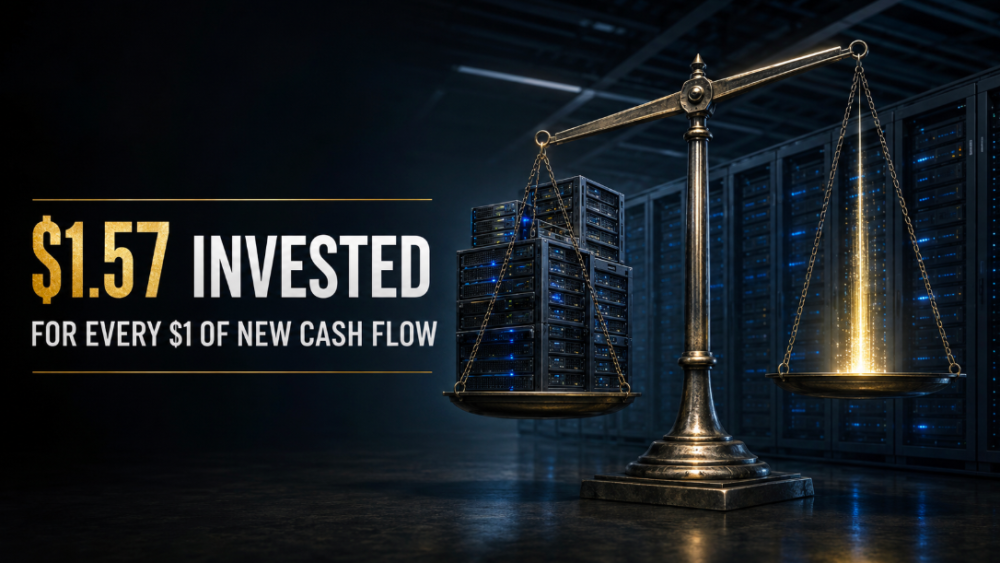
By 2027, Microsoft, Alphabet, Amazon, Meta and Oracle are expected to generate approximately $340 billion more in annual operating cash flow than in 2025. Their capital expenditures, however, are projected to rise by approximately $534 billion.
That represents $1.57 in additional investment for every $1 of additional operating cash flow.
Pressure is already appearing in individual accounts.
Microsoft recently generated $35.8 billion in quarterly operating cash flow, while capital expenditures including finance leases reached $37.5 billion. Amazon’s trailing operating cash flow climbed 30% to $148.5 billion, but free cash flow fell to only $1.2 billion.
Oracle provides the clearest warning. Its annual capex reached $55.7 billion, equivalent to 174% of its $32 billion in operating cash flow. With free cash flow turning negative, Oracle plans to raise between $45 billion and $50 billion through debt and equity to support its cloud expansion.
This is a major change in the character of Big Tech. Companies previously valued as asset-light software and advertising platforms are becoming increasingly dependent on data centres, chips, electrical equipment and external infrastructure financing.
But This Is Not 1999—At Least Not Yet
The strongest counterargument is that today’s largest spenders are profitable businesses with enormous existing customer bases.
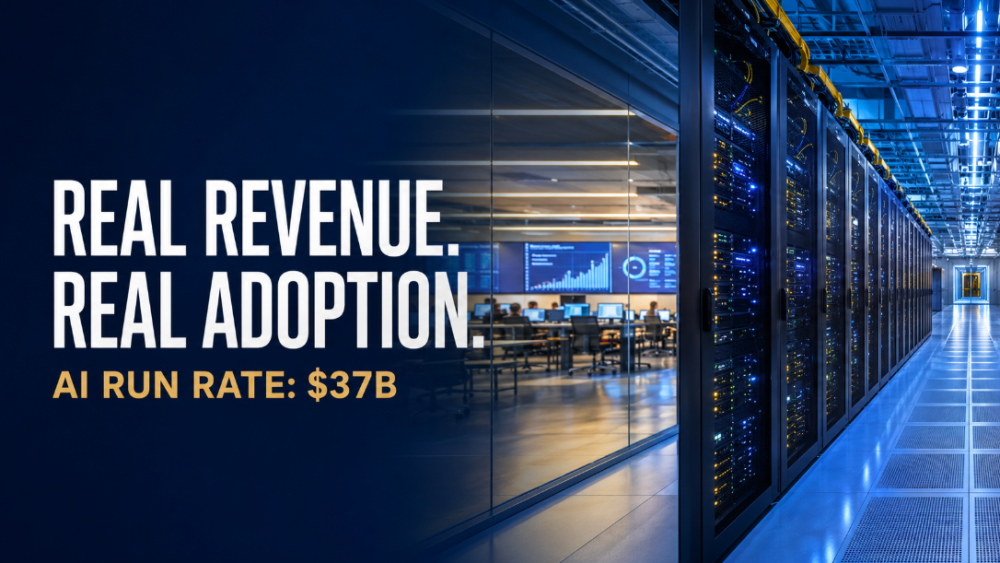
Microsoft says its AI operations have exceeded a $37 billion annual revenue run rate. Amazon’s AWS division recently grew by 28%, while demand for cloud capacity continues to exceed available supply in several markets.
AI adoption is also moving beyond technology companies. By June 2026, approximately 19.8% of U.S. businesses reported using AI, rising to 38.5% among companies employing at least 250 people. Adoption among smaller companies remains much lower, but the overall direction is positive.
This matters because a bubble usually becomes dangerous when investment depends almost entirely on speculation rather than actual usage. AI already has users, revenue and measurable applications.
The less convincing part is productivity.
The Fed found that highly AI-exposed industries have recently recorded stronger productivity growth. However, it also concluded that micro-level productivity improvements have not yet clearly translated into a broad economy-wide acceleration.
In other words, the infrastructure is being constructed today. The economic payoff is still expected tomorrow.
That does not prove the spending is irrational. General-purpose technologies often require years of investment, training and organizational change before their full productivity effects become visible. But it does mean investors are being asked to finance the buildout before the final returns are known.
What Happens if AI Capex Slows?
A slowdown would not automatically produce a recession. The direct domestic contribution from data-centre construction remains smaller than the headline spending totals suggest because so much hardware is imported.
Nevertheless, the second-order effects could be substantial.
Data centres support construction workers, semiconductor production, cooling equipment, networking systems, electricity generation and local infrastructure. The AI rally has also increased household wealth through equity markets, indirectly supporting spending among wealthier consumers.
At the same time, the labour market is losing momentum.
The United States added only 57,000 jobs in June, while April and May employment gains were revised downward by a combined 74,000. Labour-force participation fell to 61.5%, although unemployment remained relatively contained at 4.2%.
This creates an uncomfortable scenario. If consumers and employment are already slowing when AI investment is accelerating, what happens when the buildout eventually normalizes?
One Federal Reserve model estimated that data-centre investment could contribute between 0.8 and 1.1 percentage points to nominal GDP growth in 2026 before adjusting for imported equipment. Under its pessimistic 2027 scenario, the contribution could turn negative as fewer new projects enter development.
The danger is not that data centres suddenly disappear. It is that growth rates matter. Once spending reaches several hundred billion dollars annually, merely maintaining that level no longer adds the same amount to GDP growth.
The Stock-Market Impact Could Be Larger Than the Economic Impact
A capex slowdown would not affect every AI company equally.
Hyperscalers such as Microsoft, Alphabet, Amazon and Meta could actually generate more free cash flow if they reduce spending—provided their AI revenues continue growing. Oracle appears more vulnerable because its infrastructure expansion increasingly depends on external financing.
Hardware suppliers would face a different problem. Nvidia, AMD, Broadcom, Micron and Astera Labs benefit from the physical expansion of AI capacity. Server integrators and high-performance-computing suppliers such as TSS and One Stop Systems are also more sensitive to infrastructure orders than to the eventual productivity generated by AI.
Aehr Test Systems has more indirect exposure through semiconductor testing and specific product cycles. Innodata, meanwhile, depends more heavily on continued AI adoption and model-development activity than on the number of data centres being constructed.
These distinctions matter. “AI exposure” is not one trade.
Investors are already preparing for slower growth. UBS expects hyperscaler capex growth to decline from approximately 76% in 2026 to 6% by 2028. The Philadelphia Semiconductor Index recently fell around 18% from its June peak, even after doubling during the preceding year.
If capex merely stops accelerating, highly valued infrastructure suppliers could experience sharp multiple compression even while their absolute revenues remain elevated.
The Verdict: A Real Boom With Bubble-Like Features
The United States is not yet experiencing a classic, economy-wide AI bubble funded primarily through weak companies and indiscriminate bank lending.
The major hyperscalers remain profitable. AI adoption is growing. Cloud revenue is expanding, and the infrastructure being constructed will retain economic value even if expected returns disappoint.
But the bubble warning signs are becoming difficult to ignore.
Spending forecasts are rising faster than cash-flow forecasts. External financing is becoming more important. Information-technology investment has surpassed its dot-com-era share of GDP. Meanwhile, meaningful productivity gains remain concentrated rather than economy-wide.
The most honest conclusion is that AI can be both a technological revolution and an investment bubble.
The technology may transform the economy while individual data centres, suppliers and stocks still prove dramatically overvalued. The internet fulfilled its promises—but that did not prevent the Nasdaq from collapsing when investors realized they had paid too much, too early.
For the economy, the decisive question is whether AI productivity and revenue can replace infrastructure spending as the next source of growth.
For investors, the question is even simpler:
When Big Tech eventually stops increasing capex by hundreds of billions of dollars, which companies will still be growing—and which ones were only selling equipment into the buildout?
This article is for informational purposes only and does not constitute financial advice. AI-related investments and semiconductor stocks can be highly volatile, and capital-expenditure forecasts remain subject to substantial revision.

Marc has been involved in the Stock Market Media Industry for the last +5 years. After obtaining a college degree in engineering in France, he moved to Canada, where he created Money,eh?, a personal finance website.