- Claude Mythos looks less like a chatbot and more like restricted cyber infrastructure.
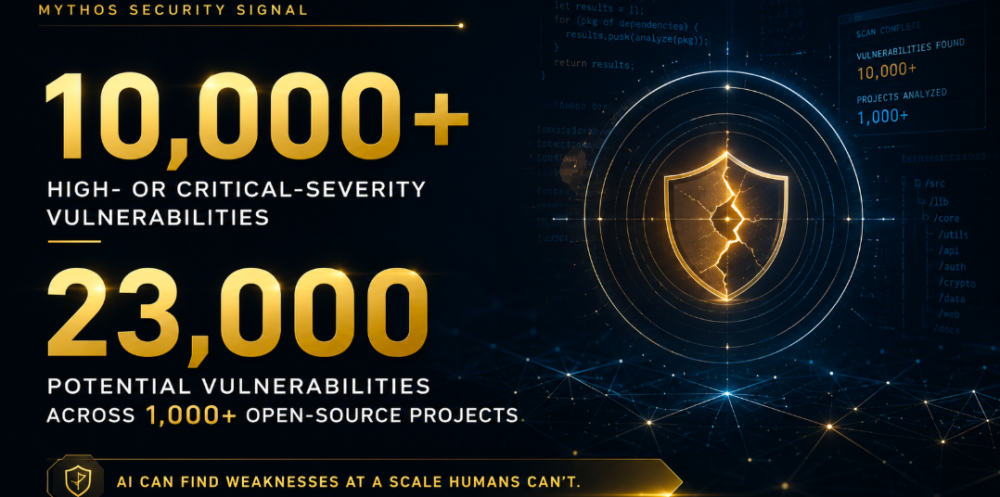
- Mythos-class models have already been tied to 10,000+ high- or critical-severity vulnerabilities.
- The investor angle: AI may not cut cybersecurity costs — it may supercharge them.
The AI Nobody Was Fully Ready For
The most interesting part of Claude Mythos is not that it is powerful.
The interesting part is that access had to be controlled.
For years, the AI story was simple: better models, more users, cheaper productivity. Claude Mythos changes that story. If an AI model is strong enough to find serious vulnerabilities at scale, it is not just a productivity tool anymore. It becomes cyber infrastructure.
That creates a problem for banks, defense contractors, healthcare systems, cloud platforms, and large enterprises. These organizations do not just need intelligence. They need data retention rules, audit trails, containment, compliance, legal approval, and confidence that sensitive prompts will not create new risk.
• The controversial point: frontier AI may now be advancing faster than enterprise risk departments can approve it.
The Number That Makes Mythos Different
Project Glasswing is the proof point.
Anthropic’s Mythos-class model has been used to identify more than 10,000 high- or critical-severity vulnerabilities in critical software systems. Separate reporting said Mythos identified 23,000 potential vulnerabilities across more than 1,000 open-source projects.
That is not a normal AI benchmark.
That is a signal that AI can now scan, reason through, and expose software weaknesses at a scale that human security teams may struggle to absorb.
The scary part is not just that defenders can use this. The scary part is that attackers eventually may too.
• Claude Mythos makes one thing obvious: the bottleneck in cybersecurity is shifting from finding flaws to fixing them fast enough.
The Enterprise Trust Problem
This is where the banks and large corporations come in.
Even if a model is useful, big enterprises cannot simply plug it into sensitive workflows. Microsoft reportedly restricted employee use of Anthropic’s Claude Fable 5 over data-retention concerns, even while Anthropic’s Mythos-class systems attracted major attention for coding, analytics, and security capabilities.
That matters because Microsoft is not a slow-moving small business. It is one of the largest enterprise software companies in the world.
If Microsoft needs legal and data-governance review before letting employees use a frontier AI model internally, the same problem applies to banks, insurers, hospitals, defense companies, and government agencies.
• The AI race may no longer be about who has the smartest model. It may be about who enterprises trust enough to deploy it.
The $244 Billion Cybersecurity Problem
Cybersecurity was already a giant market before Claude Mythos.
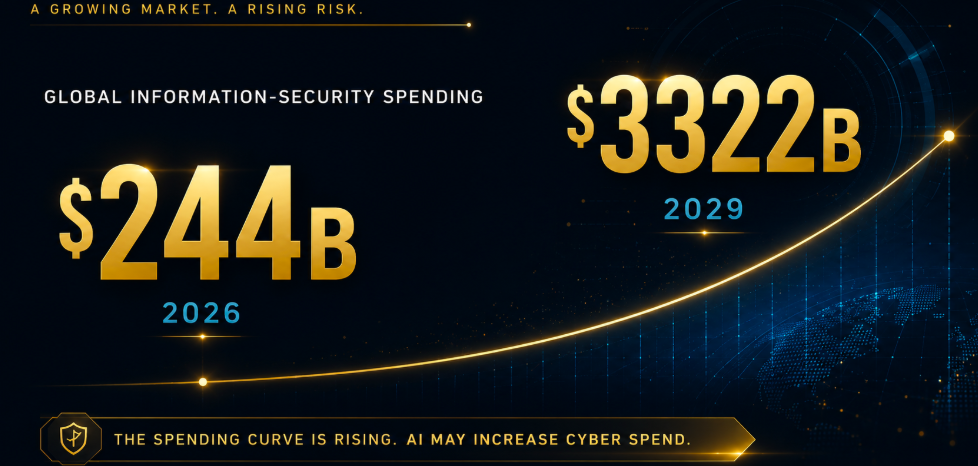
Gartner forecasts global information-security spending of roughly $244 billion in 2026 and about $322 billion by 2029. That is before the full effect of AI agents, AI-written code, AI-generated phishing, automated vulnerability discovery, and machine-speed attacks.
This is why Mythos matters for investors.
AI is usually sold as a cost-saving tool. But in cybersecurity, AI may create more spending, not less. More code means more bugs. More agents mean more identities. More automation means more attack paths. More vulnerability discovery means more urgent patching.
• AI could become both the hacker and the bodyguard — and enterprises may have to pay for both sides of the arms race.
Public Companies Investors Should Watch
| Company | Ticker | Stock Price | Market Cap | YTD Stock Growth | Why It Matters |
|---|---|---|---|---|---|
| CrowdStrike | CRWD | ~$687.13 | ~$177.2B | ~+39.3% | Endpoint, cloud, identity, AI-native security operations |
| Palo Alto Networks | PANW | ~$273.24 | ~$218.5B | ~+44.5% | Cybersecurity platform consolidation, cloud security, enterprise defense |
| Zscaler | ZS | ~$124.10 | ~$19.9B | ~+45.4% | Zero-trust access, enterprise traffic control, secure cloud connectivity |
| Cloudflare | NET | ~$224.04 | ~$79.0B | ~+12.6% | Edge security, application protection, AI traffic and bot control |
| SentinelOne | S | ~$14.60 | ~$4.9B | ~+3.8% | Smaller AI-driven endpoint security name with higher-beta potential |
| Microsoft | MSFT | ~$387.69 | ~$2.89T | ~+17.5% | Azure, GitHub, enterprise identity, security software, AI distribution |
| Palantir | PLTR | ~$129.84 | ~$333.7B | ~+27.0% | Government, defense, intelligence, AI operating systems |
| Nvidia | NVDA | ~$201.35 | ~$4.91T | ~+7.6% | AI compute backbone for frontier-model workloads |
| AMD | AMD | ~$467.95 | ~$771.8B | ~+121.3% | AI accelerator challenger and alternative compute supplier |
| Broadcom | AVGO | ~$377.38 | ~$1.7T–$1.8T | ~+7.7% | AI networking, custom chips, infrastructure software |
The Public-Market Read-Through
The clearest pure-play cybersecurity winners are CrowdStrike, Palo Alto Networks, Zscaler, Cloudflare, and SentinelOne.
CrowdStrike and Palo Alto are already being priced like AI-era cyber leaders, with market caps above $170 billion and $218 billion respectively. Zscaler and Cloudflare sit closer to the traffic, access, and application layer. SentinelOne remains the smaller, more speculative name in the group.
• If Claude Mythos-class models make vulnerability discovery faster, the value shifts toward companies that can detect, prioritize, patch, and contain threats before enterprises get overwhelmed.
The Infrastructure Winners
Cybersecurity AI still needs compute.
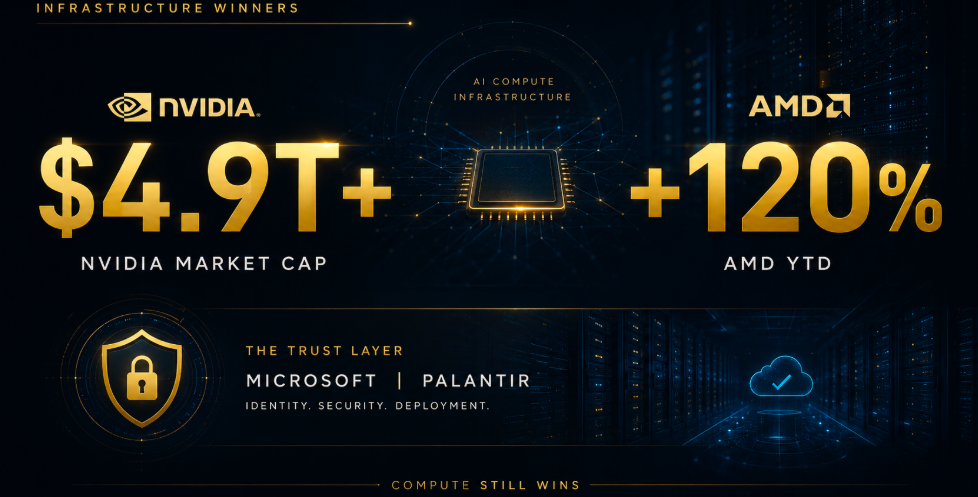
That keeps Nvidia, AMD, and Broadcom in the story. Nvidia remains the dominant AI infrastructure name with a market cap above $4.9 trillion. AMD has been one of the strongest AI-semiconductor performers in 2026, with YTD gains above 120%. Broadcom remains tied to custom AI chips, networking, and infrastructure software, even after recent volatility.
Microsoft and Palantir are different. They are not pure cyber names, but they sit inside the trust layer. Microsoft controls Azure, GitHub, enterprise identity, and security distribution. Palantir sits closer to government, defense, intelligence, and operational AI deployment.
• The controversial view: the biggest winners may not be the companies with the strongest AI model — they may be the companies trusted to deploy dangerous AI safely.
The Most Reactive Line
Here is the line I would use to make people react:
Claude Mythos may prove that AI is not making the internet safer. It is showing how unsafe the internet already was — and how much companies will now have to spend to survive the next phase.
That flips the normal AI story.
AI is supposed to save money.
But in cybersecurity, it may increase spending because it increases speed, scale, complexity, and exposure.
A chatbot subscription is optional.
Cyber defense is not.
Bottom Line
Claude Mythos is controversial because it shows that frontier AI is no longer just about friendly assistants and productivity tools.
It may now be about who controls AI systems powerful enough to find, patch, exploit, or defend thousands of software vulnerabilities at machine speed.
For investors, the key takeaway is simple: AI may not kill cybersecurity spending. It may supercharge it — and the companies selling security, trust, compute, cloud, and compliance could become the real picks-and-shovels winners of the next AI cycle.

Marc has been involved in the Stock Market Media Industry for the last +5 years. After obtaining a college degree in engineering in France, he moved to Canada, where he created Money,eh?, a personal finance website.