Revenue is one of the clearest signs that a business is succeeding—but investing only after growth becomes obvious can mean missing much of the upside. The real question is whether a low-revenue company is approaching commercialization or simply surviving on promises.
- Low revenue is not automatically a red flag. The company’s development stage, product, market opportunity, cash runway and path to commercialization matter more than revenue alone.
- The potential return comes with greater risk. Early investors can benefit from a major valuation reset if revenue accelerates, but face dilution, cash burn and uncertain demand.
- Sekur represents both sides of the debate. Its secure-communications opportunity is substantial, and recent product progress is encouraging—but investors still need evidence that government and defense interest will convert into material contracts.
Revenue Is Evidence—Not the Entire Investment Thesis
A company generating little or no revenue is not necessarily a bad company. Biotechnology developers, resource explorers and pre-commercial technology businesses may spend years building an asset before recording meaningful sales.
Investors in these companies are not paying for current earnings. They are paying for the probability that a product, technology or contract pipeline will eventually create a much larger business.
This can be attractive because markets frequently revalue companies before revenue appears in their financial statements. A successful product launch, regulatory approval or government contract can change expectations almost overnight.
However, low revenue removes one of the strongest tools available to investors: measurable commercial evidence. Forecasts must therefore be treated as probabilities—not certainties.
The Bull Case for Investing Before Revenue Accelerates
The greatest advantage is valuation asymmetry. A small company may only need one meaningful customer or distribution agreement to transform its financial profile.
Low-revenue businesses can also offer exposure to markets that are growing much faster than the broader economy. Worldwide information-security spending is projected to reach US$240 billion in 2026, up 12.5% from 2025, according to Gartner.
The percentage gains can be dramatic when growth begins from a small base. Increasing annual revenue from $500,000 to $5 million is commercially difficult, but it represents 900% growth. The same $4.5 million increase would barely move the needle at a multinational corporation.
Early investors therefore accept greater uncertainty in exchange for the possibility of owning the company before the market recognizes its commercial potential.

The Risks: Cash Burn, Dilution and Unproven Demand
A promising product does not guarantee a sustainable business.
Without sufficient revenue, companies must finance operations using existing cash, debt or new shares. Repeated equity raises dilute existing shareholders, meaning each share represents a smaller percentage of the company.
Low-revenue companies are also difficult to value. Traditional price-to-earnings ratios are useless when earnings are negative, while price-to-sales multiples based on tiny revenue can appear extreme. Investors must instead model future customers, pricing, margins and spending—each of which can be wrong.
Most importantly, partnerships, demonstrations and customer interest are not revenue. Investors should separate five stages:
- Product development
- Testing and demonstrations
- Distribution access
- Signed customer contracts
- Collected recurring revenue
Each stage reduces risk, but only the final two prove commercial adoption.
Sekur Private: Small Revenue, Large Ambition
Sekur Private, traded in the United States as SWISF, illustrates this risk-reward profile.
The company offers Swiss-hosted and on-premises secure email, messaging, VPN, voice and video services for businesses, governments, diplomats and defense users. Its opportunity is based on providing communications outside conventional Big Tech and telecommunications infrastructure.
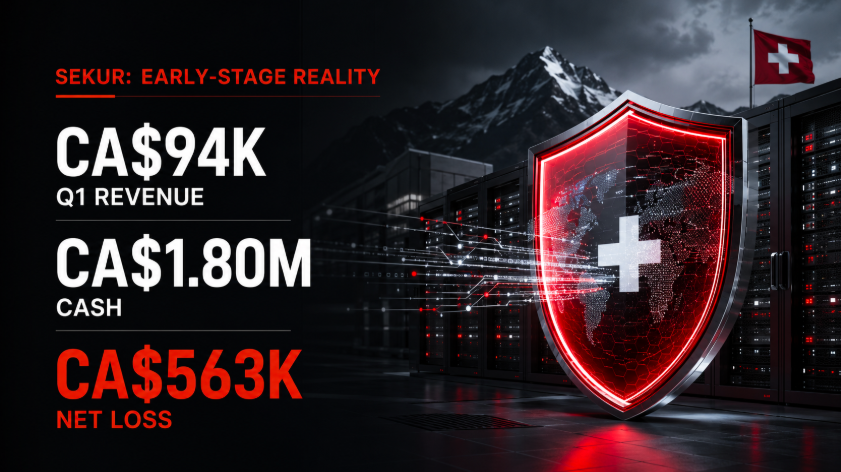
Financially, Sekur remains extremely early. It reported CA$408,707 in 2025 revenue. Revenue for the first quarter of 2026 was CA$94,062, down 32% from CA$138,843 one year earlier, while the quarterly net loss reached CA$563,460.
The company ended March with CA$1.80 million in cash, but used CA$634,723 in operating activities during the quarter. Its filings explicitly identify material uncertainty related to its ability to continue as a going concern unless it increases revenue or obtains additional financing. Sekur’s Q1 2026 financial statements
Those numbers explain the risk. They do not, however, capture the potential impact of Sekur’s strategic shift toward higher-value government, defense and enterprise users.
Recent News Strengthens the Potential Case
On July 15, Sekur announced that SekurOne voice, email, messaging and VPN capabilities were operating across Android, iOS and web platforms. The company expects video and conferencing by late August, followed by the complete SekurOne application on or before September 30. SekurOne product update
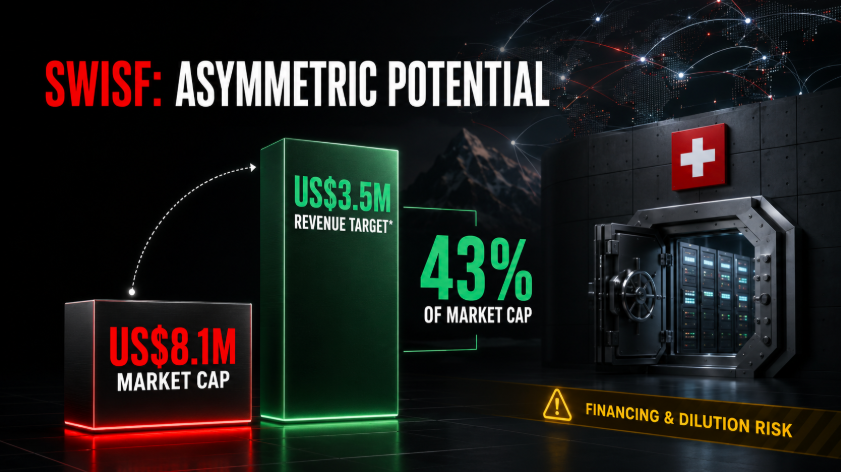
Management previously projected at least 1,000 SekurOne operator accounts over 12 to 18 months, with annual plans starting at US$3,500. If achieved, that would represent at least US$3.5 million in annualized revenue. Importantly, this remains a company projection—not contracted revenue.
Sekur has also improved its route to market:
- Its products became available for government procurement through an existing U.S. GSA Multiple Award Schedule.
- It signed a defense distribution agreement with Elyon International.
- AdRevv plans to send one million targeted emails per month using a 271-million-person U.S. database, although it will receive 40% of SekurVPN revenue and 25% from other Sekur products generated through the program. AdRevv partnership terms
The company has additionally recruited experienced defense, intelligence and diplomatic advisers. These appointments may improve product relevance and access to decision-makers, but they should not be mistaken for purchase orders.
What Could It Mean for SWISF?
At approximately US$0.032 per share on July 17, SWISF had a market value near US$8.1 million. Management’s US$3.5 million SekurOne scenario would therefore equal roughly 43% of that market capitalization in annual revenue. SWISF market data
That helps explain the upside potential: even modest contract conversion could materially change how the market values the company.
The financing risk is equally important. Sekur announced a private placement of up to CA$2 million, involving as many as 20 million new shares and 20 million warrants. The capital could fund commercialization, but it could also dilute existing shareholders. Private-placement terms
The Verdict
Investing in a company with little or no revenue is not automatically bad. It is simply a different type of investment—one driven by milestones, financing capacity and future adoption rather than established earnings.
Sekur has a functional product, premium pricing, growing distribution access and exposure to an expanding cybersecurity market. Its small size means that successful government or defense contracts could have an outsized financial impact.
But the decisive evidence must now come from signed deployments, recurring revenue and reduced cash burn. Sekur’s potential is significant precisely because its current revenue is small. That same fact is also what makes SWISF a speculative, high-risk investment.
This article is for informational purposes only and does not constitute financial advice. Management projections and forward-looking statements may not be achieved.

Marc has been involved in the Stock Market Media Industry for the last +5 years. After obtaining a college degree in engineering in France, he moved to Canada, where he created Money,eh?, a personal finance website.