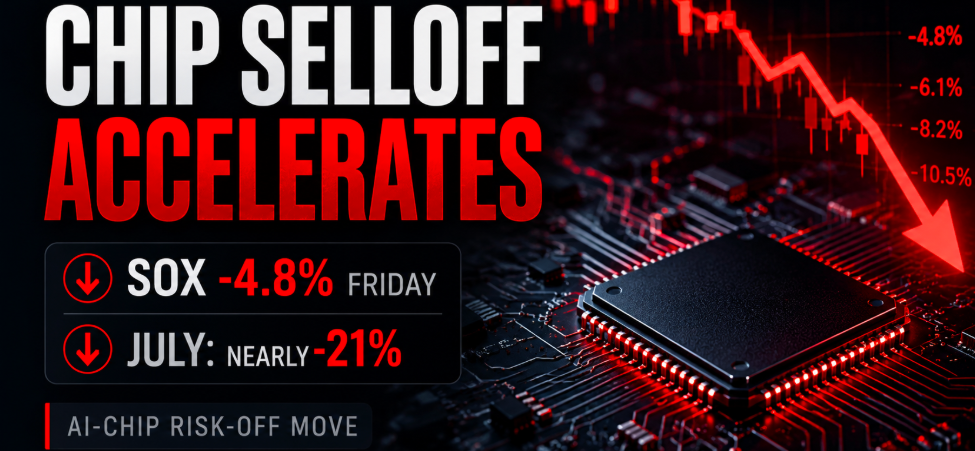
- The chip rout extended into Friday, with the PHLX Semiconductor Index down 4.8% early in the session and nearly 21% lower for July.
- AI leaders saw sharp intraday drawdowns, including Nvidia, AMD, TSMC, Micron, ASML, Arm, and Intel.
- This looks more like a valuation reset after an extreme AI run than a collapse in long-term semiconductor demand.
The Big Picture
The semiconductor trade is getting hit again.
After months of aggressive buying in AI-related stocks, investors are suddenly questioning whether the sector has moved too far, too fast. The selling pressure intensified on Thursday and carried into Friday, spreading from U.S. chip stocks into Taiwan, Japan, and Europe.
Reuters described the move as a semiconductor rout, with global stocks falling as heavyweight chip names dropped for a third consecutive day. The pressure came as investors reduced exposure to AI-linked names while also dealing with rising geopolitical risk, higher oil prices, and renewed concerns about heavy AI spending.
This is important because semiconductors have been one of the biggest drivers of the market in 2026.
When chips fall, the whole AI trade gets tested.
What Happened
The selloff accelerated across the semiconductor complex.
On Thursday, Reuters reported that the U.S. chip index fell 4%, while the Nasdaq was dragged lower by AI jitters. On Friday morning, MarketWatch said the PHLX Semiconductor Index was down another 4.8%, bringing its July decline to nearly 21% after the index had doubled during the first six months of 2026.
That is the key context.
The sector is not selling off from weakness.
It is selling off after an enormous run.
Investopedia also noted that Nasdaq futures were down 1.7% Friday morning, while the iShares Semiconductor ETF fell 3% premarket as Nvidia, Broadcom, Intel, and Micron all retreated.
In short, this is not one stock.
It is a full AI-chip risk-off move.
How Big Was the Damage?
The damage was broad.
At Friday’s intraday lows, several major chip names were down sharply versus the prior close:
- Nvidia: low of $198.05, roughly 4.5% below the prior close
- AMD: low of $460.57, roughly 8.1% below the prior close
- Broadcom: low of $358.05, roughly 4.4% below the prior close
- Micron: low of $804.48, roughly 5.7% below the prior close
- ASML: low of $1,704.26, roughly 4.5% below the prior close
- TSMC ADR: low of $386.15, roughly 5.8% below the prior close
- Arm: low of $243.41, roughly 7.1% below the prior close
- Intel: low of $89.75, roughly 7.5% below the prior close
Even the ETFs were hit hard intraday. SOXX traded as low as $498.69, about 6% below the prior close, while SMH traded as low as $536.90, about 5.6% below the prior close.
The important detail is that several names bounced off their lows later in the session.
That suggests forced selling, profit-taking, and volatility — not necessarily a clean fundamental breakdown.
Why the Selloff Is Happening
There are five main reasons.
First, the trade became crowded. AI semiconductors have been one of the strongest trades of the year, and when a crowded trade reverses, the move can be violent.
Second, valuations became stretched. Investors are no longer asking whether AI demand exists. They are asking whether prices already reflect too much future growth.
Third, AI spending is being questioned. The market is starting to focus on whether hyperscalers can keep spending aggressively on GPUs, memory, data centers, networking, and power infrastructure.
Fourth, memory stocks had run extremely hard. Micron, SK Hynix, Sandisk, and other memory names benefited from tight supply and rising HBM demand. That made the group vulnerable to profit-taking.
Fifth, macro risk returned. Oil moved higher as Middle East tensions escalated, while investors also watched interest rates, the dollar, and global risk appetite.

Why TSMC’s Reaction Was Important
One of the most important signals came from TSMC.
Reuters noted that TSMC reported 77% earnings growth, but its shares still sank 4%. That is a classic late-cycle signal in a hot sector: good news is no longer enough when expectations are extremely high.
That does not mean TSMC is weak.
It means investors may have already priced in perfection.
When a company reports strong earnings and still sells off, the market is saying:
“We believe the story, but we need a better price.”
That is exactly what appears to be happening across the chip sector.
Memory Stocks Are at the Center
Memory is one of the most important parts of this selloff.
The AI trade has moved beyond Nvidia and GPUs. Investors have been aggressively buying high-bandwidth memory and storage names because AI servers need more memory, faster bandwidth, and larger data-center capacity.
Reuters recently noted that tight supplies have boosted memory chip companies globally, including SK Hynix, which jumped more than 10% in its U.S. trading debut after a $26.5 billion share sale. The same report said Micron had the highest expected upside among S&P 500 chipmakers, at more than 60%, while Nvidia was expected to climb more than 40% based on analyst targets.
But that is also the risk.
When expectations are that high, even a small shift in sentiment can trigger a large reset.
The Sector Has Not Lost the AI Thesis
The selloff does not mean the AI semiconductor thesis is dead.
If anything, the long-term drivers remain strong:
- AI training and inference demand
- data-center GPU upgrades
- HBM memory growth
- advanced packaging demand
- networking infrastructure
- power and cooling upgrades
- semiconductor equipment spending
Reuters reported that earnings for companies in the S&P 1500 Semiconductors & Equipment Industry Index are expected to more than double this year, driven largely by Micron and Nvidia. Growth is expected to moderate in 2027, but still rise by 46.1%.
That is not a weak earnings backdrop.
The issue is price.
The sector can be fundamentally strong and still sell off if investors decide the stocks moved too far ahead of earnings.
What Investors Should Do Now
The worst thing to do is panic-buy or panic-sell blindly.
This is the moment to separate companies into three groups.
1. Core AI infrastructure winners
These are companies with real demand, strong balance sheets, and structural exposure to AI infrastructure.
Examples include:
- Nvidia
- TSMC
- ASML
- Broadcom
- Micron
- AMD
For long-term investors, sharp selloffs in these names can create opportunities — but only if the entry is disciplined.
2. Cyclical beneficiaries
These are names benefiting from memory pricing, storage cycles, or capex strength.
They can rise very fast when pricing is tight, but they can also fall hard when investors start pricing in oversupply.
Examples include:
- Micron
- Sandisk
- Seagate
- memory-linked equipment names
These can still work, but position sizing matters.
3. Speculative AI-adjacent names
These are the most dangerous during a selloff.
If a company has no clear earnings, no durable AI revenue, or trades mainly on hype, it can fall much harder than the leaders.
In a correction, quality usually matters more than story.

Buy the Dip or Wait?
The answer depends on your time horizon.
For traders, the sector is still extremely volatile. A 4% to 8% intraday swing in major chip names means entries can be punished quickly if timing is wrong.
For long-term investors, the better strategy is usually staged buying.
That means:
- do not buy everything in one shot
- add only to high-conviction names
- wait for confirmation near key support levels
- avoid leverage
- keep cash for another leg lower
- focus on earnings revisions, not just price action
The best dips are not always the first dip.
Often, the market needs several sessions to flush out momentum traders before a real base forms.
What to Watch Next
The next signals matter more than the first bounce.
Investors should watch:
- whether SOXX and SMH hold Friday’s intraday lows
- whether Nvidia holds the $198 area
- whether AMD holds the $460 area
- whether Micron holds the $800 area
- whether TSMC stabilizes after strong earnings
- whether ASML and equipment names stop falling
- whether oil stays above $80
- whether hyperscaler capex commentary stays strong
- whether analysts cut or defend price targets
The most important signal is simple:
Do chip stocks rise on good news again?
If yes, the correction may be healthy.
If no, the sector may need more time to reset.
The Bull Case
The bull case is that this is a violent but normal correction inside a powerful AI infrastructure cycle.
The sector had doubled in the first half of the year, so a 20% July correction in the PHLX Semiconductor Index may be painful but not irrational. If earnings remain strong, AI capex continues, and HBM demand stays tight, the best companies could recover quickly.
In that scenario, investors who buy high-quality leaders during weakness could benefit over the next 6 to 18 months.
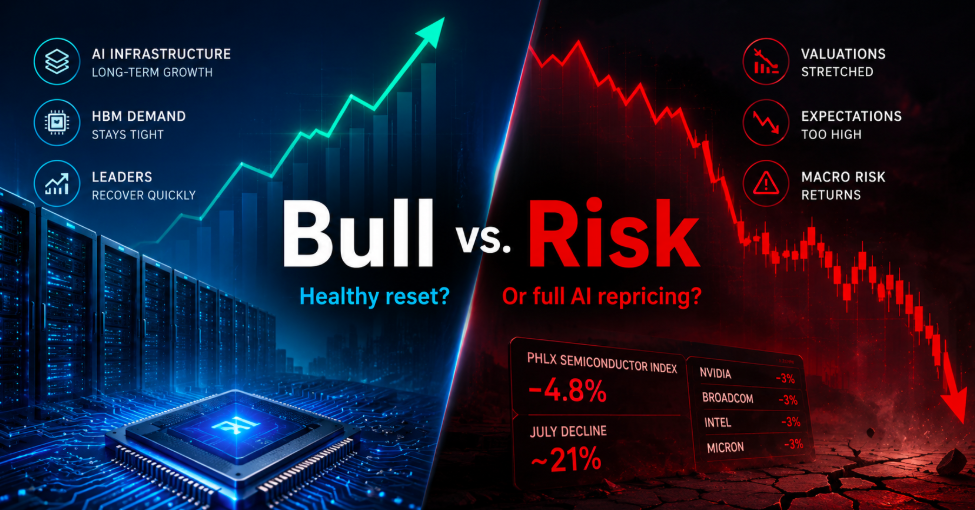
The Risk Case
The risk case is that the market has started to reprice the entire AI trade.
If investors decide that AI capex is too high, returns on AI infrastructure are uncertain, or memory supply will eventually overshoot demand, the selloff could continue.
The danger is not that AI disappears.
The danger is that expectations were too high.
That is why the sector may need either lower prices or stronger earnings guidance before momentum returns.
Bottom Line
Friday’s chip selloff is a major warning shot for AI investors.
The PHLX Semiconductor Index was down 4.8% early Friday and nearly 21% lower for July, after doubling in the first half of 2026. Thursday’s U.S. chip index decline of 4% showed that selling pressure had already started before Friday’s move.
But this does not automatically mean the semiconductor cycle is broken.
It means the market is resetting expectations after an extreme run.
For investors, the playbook is clear:
Do not chase blindly. Do not panic blindly. Focus on quality, wait for confirmation, and use staged buying if the long-term AI thesis remains intact.
The AI chip story is not over.
But the easy part of the trade may be.
Disclaimer
This article is for informational and educational purposes only and does not constitute financial advice, investment advice, or a recommendation to buy or sell any security. Semiconductor stocks can be highly volatile and are affected by earnings expectations, capital spending, geopolitical risk, interest rates, customer concentration, and broader market conditions.

Marc has been involved in the Stock Market Media Industry for the last +5 years. After obtaining a college degree in engineering in France, he moved to Canada, where he created Money,eh?, a personal finance website.