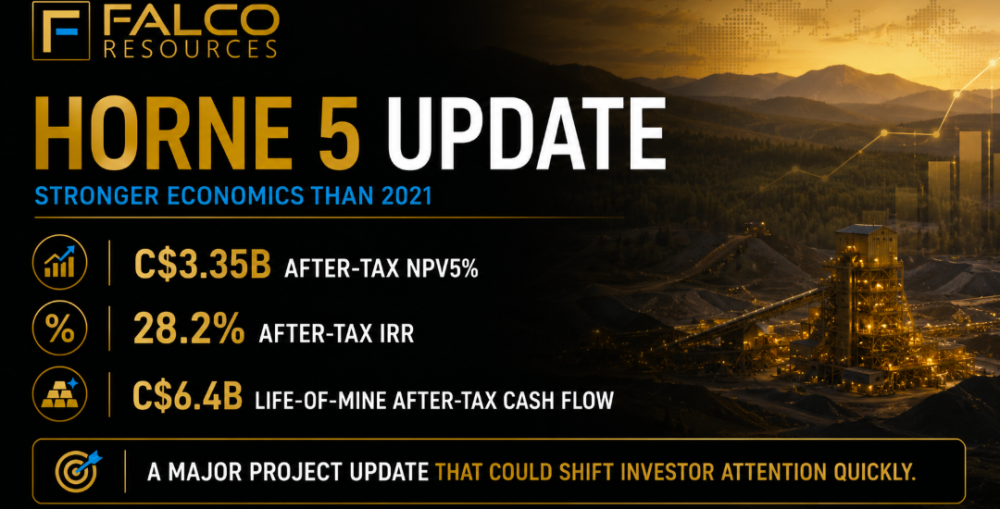
- Falco’s updated Horne 5 study delivered a C$3.35B after-tax NPV5% and a 28.2% IRR.
- At spot prices, the project’s after-tax NPV5% rises to C$5.1B with a 37.2% IRR.
- Québec’s environmental review is nearing completion, giving Horne 5 a clearer path toward a major fall 2026 milestone.
Falco’s Horne 5 Project Just Got Harder to Ignore
Falco Resources has delivered a major update for its flagship Horne 5 Project in Rouyn-Noranda, Québec — and the numbers are now much stronger than they were in the 2021 feasibility study.
The company’s updated 2026 feasibility study gives Horne 5 an after-tax NPV5% of C$3.35 billion, an after-tax IRR of 28.2%, and projected life-of-mine after-tax cash flow of C$6.4 billion under its base-case assumptions.
For a development-stage gold company, that is the kind of update that can shift investor attention quickly.
A Major Step-Up From the 2021 Study
The most important part of the update is the re-rating in project economics.
Falco said the base-case after-tax NPV5% increased 244% versus the 2021 feasibility study. The project also shows a 3.3-year after-tax payback period, which is important because shorter payback periods can make large mining projects more financeable and easier for investors to understand.
At spot prices, the economics become even stronger. Falco said Horne 5’s after-tax NPV5% rises to C$5.1 billion, with an after-tax IRR of 37.2% and a 2.6-year payback period.
That puts Horne 5 back into focus as one of the larger undeveloped gold projects in Canada.
Large-Scale Production With Lower-Cost Potential
Horne 5 is expected to produce an average of 220,300 payable ounces of gold per year over a 15-year mine life.
The project also benefits from silver, copper, and zinc by-product credits, which help reduce costs. Falco’s updated study points to average all-in sustaining costs of US$782 per ounce, positioning Horne 5 as a potential low-cost gold producer if developed as planned.
That cost profile matters. In a stronger gold-price environment, projects with large scale and lower projected costs can attract more investor attention because they offer stronger potential margins.
The By-Product Angle Adds Another Layer
Horne 5 is not only a gold project.
The deposit also contains meaningful silver, copper, and zinc exposure. Falco’s study outlines projected life-of-mine output of roughly 27.3 million ounces of silver, 247.3 million pounds of copper, and 1.19 billion pounds of zinc.
That matters for two reasons.
First, those metals can help lower net gold costs through by-product credits. Second, copper and zinc give the project a connection to critical and strategic minerals, which remains an important theme in Québec and across North America.
Stock Price Momentum Is Also Turning Heads
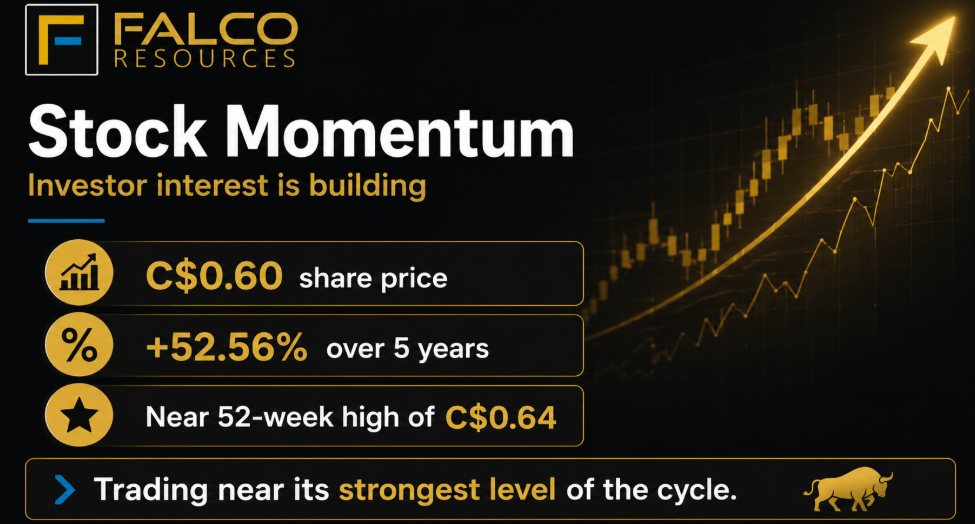
Falco’s stock performance is adding another layer to the story. Based on the chart you shared, Falco Resources (CVE: FPC) was trading at C$0.60, up 52.56% over the past five years, and sitting close to its 52-week high of C$0.64. On the five-year view, the stock appears to be trading near its strongest level of the cycle, which suggests the market is increasingly paying attention to the Horne 5 story. When a junior mining stock starts pushing toward its highs while major project news improves, it often signals that investor interest is building and that the market is beginning to price in more of the project’s potential.
The Environmental Update Is a Key Catalyst
The economics are strong, but permitting remains one of the biggest pieces of the story.
That is why Falco’s separate environmental update matters. The company said Québec’s Ministry of the Environment confirmed that the environmental acceptability analysis is nearing completion and that the process is progressing well.
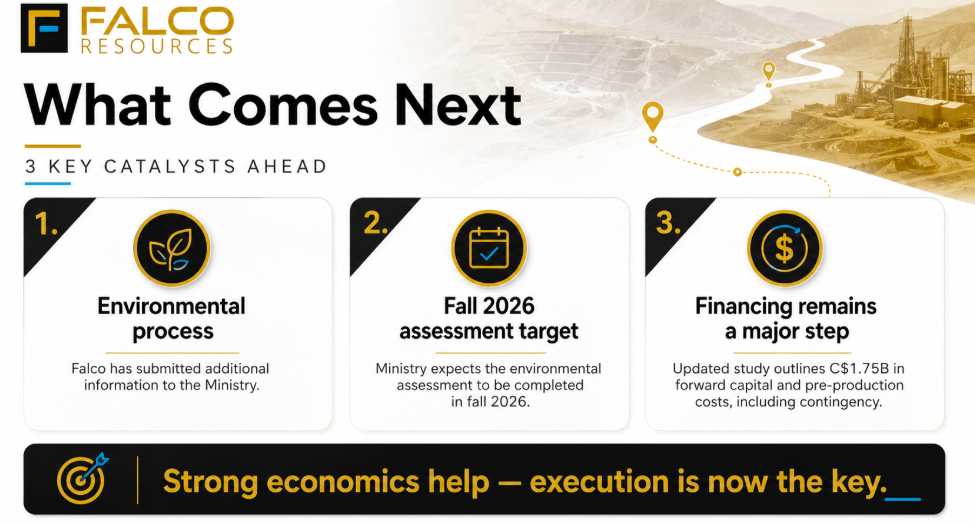
Falco also said the Ministry expects the environmental assessment to be completed in fall 2026, subject to the company providing additional information.
This does not mean the project is fully authorized yet. But it does suggest the file is moving forward, which is important for investor confidence.
Why This Matters for Investors
Falco now has two things working together: improved economics and visible regulatory progress.
That combination can be powerful for a junior mining story. A strong feasibility study helps investors understand the size of the opportunity. Regulatory progress helps reduce uncertainty around whether the project can actually move forward.
The updated numbers also give investors a clearer framework. Horne 5 is no longer just a large historical deposit under a famous mining camp. It is now being presented as a long-life, large-scale, potentially low-cost gold project with multi-billion-dollar economics.
What Comes Next
The next major item to watch is the environmental process.
Falco said the Ministry expects the environmental assessment to be completed in fall 2026, after the company submits additional information. After that, the project would still need government authorization before moving toward construction.
Investors will also watch financing. Falco’s updated study outlines forward capital and pre-production costs of C$1.75 billion, including contingency. Strong economics help, but funding a project of that size is still a major step.
Bottom Line
Falco Resources’ latest Horne 5 update gives the market a much stronger development story.
The updated feasibility study shows C$3.35 billion in after-tax NPV5% at base case, C$5.1 billion at spot prices, a 15-year mine life, average annual gold production above 220,000 ounces, and projected AISC of US$782 per ounce.
With Québec’s environmental review also moving toward a potential fall 2026 milestone, and with the stock trading near its strongest level in years, Horne 5 now looks like one of the more important Canadian gold-development stories for investors to watch.
Disclaimer: This content is for informational and educational purposes only and does not constitute financial advice, investment advice, or a recommendation to buy or sell any security. Always conduct your own research and consult a licensed financial advisor before making investment decisions.

Marc has been involved in the Stock Market Media Industry for the last +5 years. After obtaining a college degree in engineering in France, he moved to Canada, where he created Money,eh?, a personal finance website.