- Sekur Private Data, trading on the OTCQB under SWISF, signed a partnership with AdRevv to market its privacy and cybersecurity products to a large U.S. audience actively searching for VPNs, secure email, secure messaging, secure voice calls, and privacy-focused communication tools.
- The campaign is expected to deploy 1,000,000 retargeting emails per month for at least 12 months, creating a potentially scalable lead-generation engine for Sekur’s subscription products.
- If SWISF can convert even a very small fraction of this audience into paying users, the revenue impact could become meaningful relative to Sekur’s current microcap revenue base.
A New AI-Powered Marketing Channel for Sekur
Sekur Private Data has added another growth angle to the SWISF story.
The company announced a partnership with AdRevv, a U.S.-based AI-powered ad revenue and marketing platform, designed to promote Sekur’s privacy and security products to users actively searching for solutions such as VPNs, secure email, secure messaging, secure voice calls, and privacy phones.
For investors watching SWISF, the most important part of the announcement is not only the size of the database. It is the intent behind it.
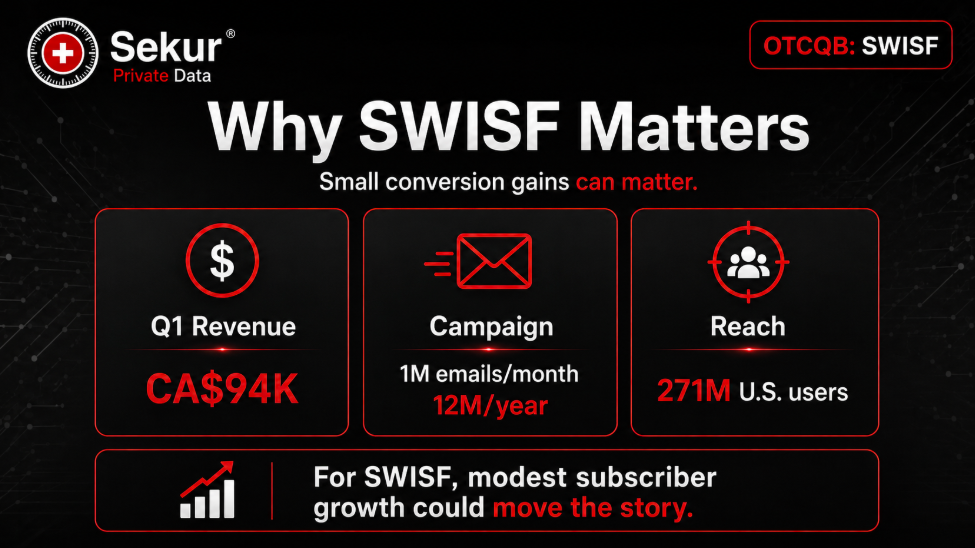
AdRevv is expected to target a database of 271 million people in the United States, using AI to identify users already showing interest in privacy-related products. That creates a potentially more focused customer-acquisition channel than broad advertising, because Sekur is not simply trying to convince random users that privacy matters. It is targeting people who are already searching for privacy solutions.
Why This Matters for a Microcap Story
Sekur’s current revenue base remains small, which is exactly why this type of marketing channel could become important for SWISF.
In Q1 2026, the company reported revenue of CA$94,062. That means the company does not need massive adoption for new customer growth to become noticeable. Even a modest number of incremental paid subscriptions could begin to change the revenue profile if the campaign produces consistent conversions.
This is the key investor angle: the AdRevv agreement gives SWISF exposure to scale without requiring the company to build a large internal consumer marketing machine from scratch.
The campaign is expected to deploy 1,000,000 retargeting emails per month for a minimum of 12 months. That equals up to 12 million retargeting emails over the first year. For a company at Sekur’s size, even a tiny conversion rate could matter.
The Conversion Math: Small Fractions Could Matter
The real question is simple: what happens if SWISF converts even a small fraction of the campaign?
This is not company guidance. It is only a basic sensitivity framework to understand the upside potential.
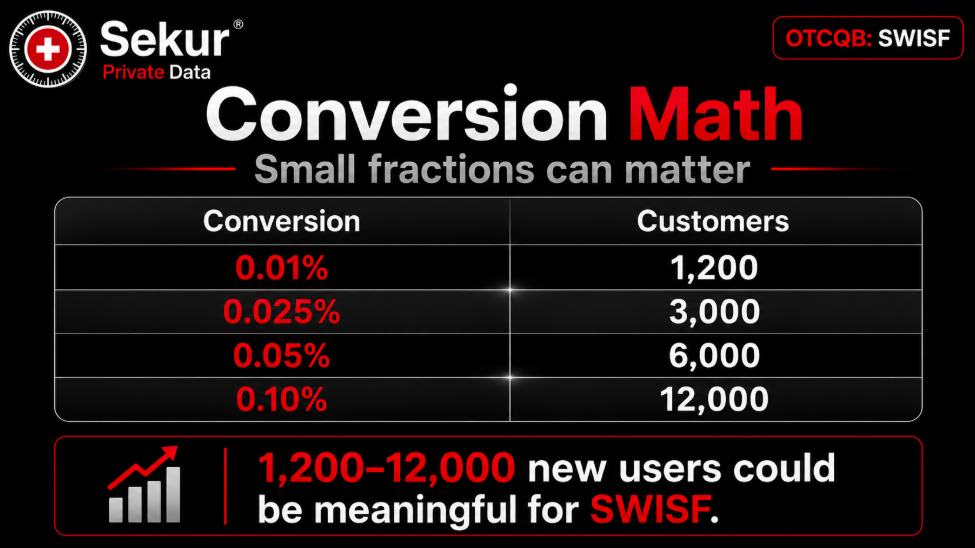
| Conversion Rate on 12M Retargeting Emails | Potential Paying Customers |
|---|---|
| 0.01% | 1,200 customers |
| 0.025% | 3,000 customers |
| 0.05% | 6,000 customers |
| 0.10% | 12,000 customers |
That is where the setup becomes interesting.
If Sekur converts only 0.01% of 12 million campaign touches, that could still represent around 1,200 paying customers. If conversion reaches 0.05%, that number rises to roughly 6,000 customers. At 0.10%, the campaign could theoretically generate around 12,000 customers.
For a larger cybersecurity company, those numbers may not move the needle much. For SWISF, they could.
Recurring Revenue Potential
Sekur’s product suite includes SekurVPN, SekurMail, SekurMessenger, SekurRelay, and SekurVoice. This matters because SWISF is not promoting a single one-time purchase. It is promoting subscription-style privacy and communications products.
That gives the campaign a more attractive investor angle. If new users become recurring subscribers, the value is not just one month of revenue. The real upside comes from retention, upselling, and product bundling.
A user who starts with SekurVPN could later move into secure email. A business customer could add secure messaging. A professional user could eventually become a higher-value account if the platform solves a real privacy or communications need.
That is the brighter side of the AdRevv deal: it gives Sekur a funnel.
A Performance-Based Deal Structure
The agreement is also structured in a way that may be attractive for a small company like Sekur.
AdRevv is expected to receive 40% of revenue from SekurVPN sales and 25% of revenue from other Sekur products generated through the partnership. That means the deal is tied to actual sales performance rather than a large upfront advertising spend.
For a microcap company, that structure can be useful. SWISF can access a large marketing engine without necessarily carrying the full cost burden of a traditional national advertising campaign.
The trade-off is that Sekur gives up part of the revenue generated through the channel. But if the campaign produces customers the company would not otherwise have reached, the revenue share may still be worthwhile.
The Bigger Strategic Picture
This partnership also broadens the SWISF growth story.
Over the past several months, Sekur has increasingly positioned itself around defense communications, government sales, sovereign infrastructure, and secure communications for high-trust users. The AdRevv partnership adds a complementary consumer and professional privacy angle.
That combination could be important.
On one side, Sekur is pursuing higher-value defense, government, and enterprise opportunities. On the other side, SWISF is now trying to reach privacy-conscious individuals, professionals, executives, and small businesses through AI-powered marketing.
That gives Sekur two potential growth tracks:
- Higher-value institutional and defense communications.
- Scalable subscription growth through consumer and professional privacy demand.
If both tracks begin producing results, the company’s revenue story could become more balanced.
Why the Timing Matters
The timing of the announcement is also notable.
Sekur recently announced a private placement to raise up to CA$2 million, with proceeds intended for SekurOne sales efforts, U.S. government sector sales, business development, and working capital. The AdRevv partnership now adds another sales channel at the same time the company is trying to expand its commercial reach.
That makes the next few quarters important for SWISF.
Investors will likely watch whether Sekur can turn these announcements into measurable results: campaign launches, customer additions, recurring revenue growth, product adoption, and more visible sales traction.
What Investors Should Watch Next
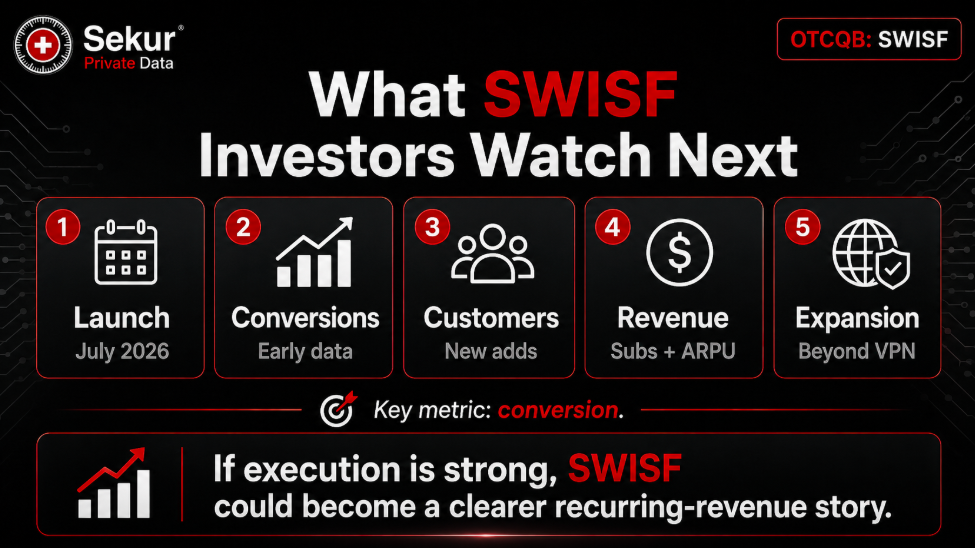
The key checkpoint is the July 2026 campaign launch.
After that, SWISF investors should watch for any update on conversion data, new customer additions, subscription revenue, average revenue per user, and whether the AdRevv campaign expands beyond SekurVPN into broader product bundles.
The most important metric will not be the size of the database. It will be conversion.
A 271 million-person database sounds large, but the real investment case depends on how effectively AdRevv can identify high-intent users and how well Sekur can turn those users into paying subscribers.
Bottom Line
Sekur’s AdRevv partnership gives SWISF a new AI-powered customer-acquisition channel at a time when demand for privacy, secure communications, and anti-surveillance tools continues to grow.
The upside is not that Sekur suddenly reaches 271 million customers. The upside is that even a tiny conversion rate on a large targeted campaign could become meaningful against Sekur’s current revenue base.
If the campaign converts only a small fraction of users into paying subscribers, SWISF could begin to show a more visible recurring-revenue growth story. For investors, that makes this partnership worth watching closely — not as guaranteed revenue, but as a potentially scalable funnel that could strengthen Sekur’s commercial momentum.
Not financial advice. Sponsored content may involve compensation. Investors should conduct their own due diligence and consider the volatility and liquidity characteristics commonly associated with microcap securities, including OTCQB-listed stocks such as SWISF.

Marc has been involved in the Stock Market Media Industry for the last +5 years. After obtaining a college degree in engineering in France, he moved to Canada, where he created Money,eh?, a personal finance website.