- SpaceX hype is pulling attention into public space stocks like Rocket Lab and AST SpaceMobile.
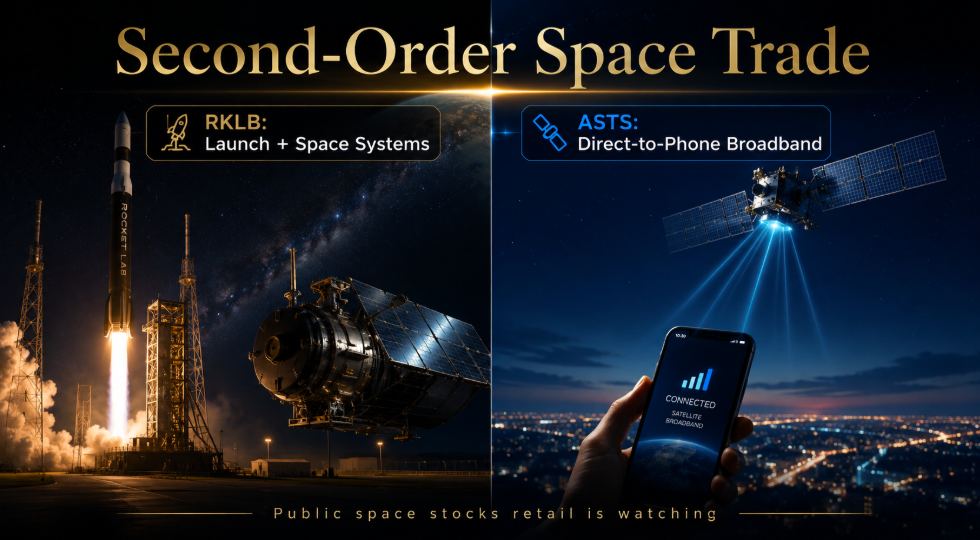
- RKLB and ASTS are very different trades: Rocket Lab is launch + space systems, while ASTS is direct-to-phone satellite broadband.
- Both stocks remain high-risk, high-volatility names — but that is exactly why retail investors are watching them as the “second-order SpaceX trade.”
Why This Story Matters
SpaceX has become the center of the space-investing conversation.
But for many public-market investors, the more practical question is not whether SpaceX is an incredible company. It is how to get exposure to the broader space economy without buying directly into SpaceX.
That is where the “second-order trade” comes in.
Retail investors are looking at publicly traded names that could benefit from rising interest in launch, satellites, defense space systems, direct-to-device connectivity, and commercial space infrastructure.
Two of the most watched names are Rocket Lab and AST SpaceMobile.
Rocket Lab trades under RKLB. AST SpaceMobile trades under ASTS.
They are not the same business. But they are both tied to the same bigger theme: space is moving from science-fiction narrative to investable infrastructure.
• The SpaceX IPO may be the headline, but RKLB and ASTS are the public-market names retail can actually trade right now.
Rocket Lab: The Launch and Space-Systems Trade
Rocket Lab is probably the closest public-market comparison to the launch side of the SpaceX story.
The company is already established in small launch through Electron, while also building toward medium-lift capability with Neutron. That matters because the market is not only valuing Rocket Lab as a launch company anymore. Investors are increasingly looking at it as a vertically integrated space infrastructure company.
Rocket Lab reported record Q1 2026 revenue of $200 million and a backlog above $2.2 billion. The company also said it surpassed guidance metrics across revenue, margin, and adjusted EBITDA. That gives investors something more concrete than just a future-space narrative.
As of the latest market snapshot, RKLB traded around $102.39, with a market cap near $62.0 billion. The stock was highly volatile, falling about 10.8% during the session, with an intraday range from $99.75 to $125.71 and volume above 63 million shares.
That kind of range shows how speculative the space trade has become.
• RKLB is no longer just a small-launch story. The real upside case is whether it can become a serious space-systems and medium-lift infrastructure platform.

Why RKLB Is a Second-Order SpaceX Trade
The appeal of RKLB is simple.
SpaceX has validated the economics and strategic importance of reusable rockets, launch access, satellite deployment, and vertically integrated space operations. Rocket Lab is not SpaceX, but it sits in a similar public-market bucket: launch cadence, satellite deployment, defense contracts, and space infrastructure.
That makes RKLB one of the first names investors may look at when space enthusiasm rises.
The big catalyst remains Neutron. If Rocket Lab can successfully bring Neutron online, it could shift the market’s perception of the company. Instead of being mainly a small-launch operator, RKLB could be viewed as a more scalable launch and space-services platform.
The risk is that expectations are already high.
A roughly $62 billion market cap for a company still working toward profitability means execution has to be strong. Investors are not paying only for today’s revenue. They are paying for years of future growth, defense demand, and launch expansion.
• The RKLB thesis is powerful, but it is execution-heavy: Neutron, margins, backlog conversion, and government demand all need to keep moving in the right direction.
AST SpaceMobile: The Direct-to-Phone Satellite Trade
AST SpaceMobile is a very different story.
While Rocket Lab is tied to launch and space systems, ASTS is focused on building a space-based cellular broadband network that can connect directly to standard smartphones.
That makes ASTS more of a telecom-space infrastructure bet.
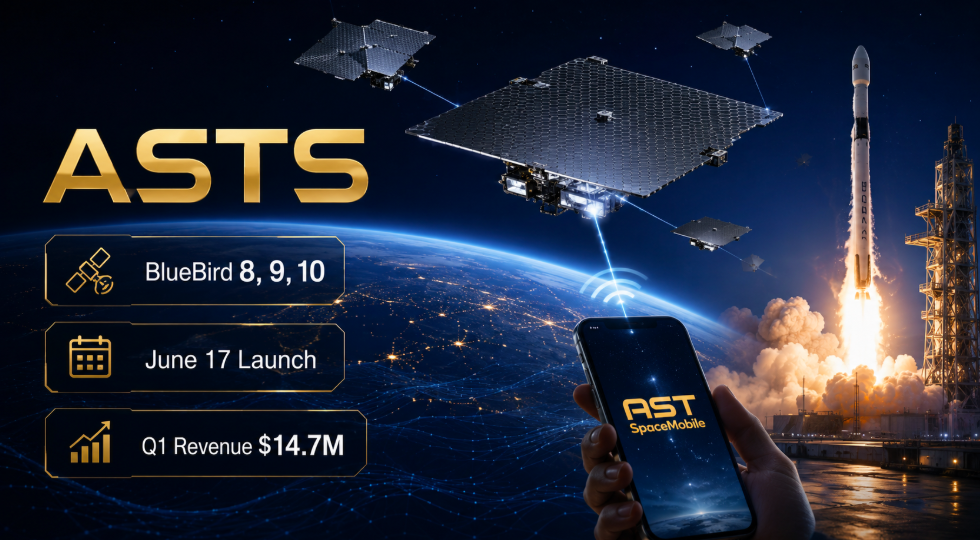
The company’s latest major catalyst is its planned launch of BlueBird 8, 9, and 10 satellites aboard a SpaceX Falcon 9 rocket from Cape Canaveral. MarketWatch reported that the launch is scheduled for June 17, 2026. That launch matters because AST needs more satellites in orbit to move closer toward commercial service.
AST has also said it is targeting roughly 45 BlueBird satellites in orbit during 2026, supported by its manufacturing base and launch agreements. The company reported Q1 2026 revenue of $14.7 million, said approximately half of its full-year 2026 revenue guidance is expected to come from existing contracted backlog, and announced three new U.S. Government awards through prime contractors.
As of the latest market snapshot, ASTS traded around $82.41, with a market cap near $24.0 billion. The stock fell about 15.5% during the session, with an intraday range from $81.52 to $103.69 and volume above 55 million shares.
• ASTS is not a launch company. It is a satellite-to-smartphone connectivity bet — and the next launch is central to the story.
Why ASTS Is Getting Retail Attention
ASTS has the kind of story retail investors love.
The product is easy to understand: satellite connectivity directly to normal phones. No special device. No extra hardware. Potential coverage in areas where traditional networks are weak or unavailable.
That is a huge narrative.
The company also has major telecom relevance. Reuters reported that Orange partnered with AST SpaceMobile and Satellite Connect Europe to support direct-to-device satellite communication, with trial demonstrations of voice, SMS, and data services planned in Romania by late 2026.
That gives the story more credibility. ASTS is not just pitching a futuristic idea. It is building partnerships with telecom operators and targeting commercial and government use cases.
But the risk is also obvious.
ASTS still needs launches, satellite deployment, manufacturing scale, regulatory progress, and commercial activation. The valuation already reflects massive future expectations, while profitability is still ahead of the company.
• ASTS has one of the most exciting stories in public space stocks, but the stock will likely trade launch-by-launch until commercial service becomes more visible.
RKLB vs ASTS: Two Very Different Space Bets
RKLB and ASTS should not be treated as interchangeable.
Rocket Lab is a space infrastructure company. Its key drivers are launch cadence, Neutron progress, spacecraft manufacturing, government contracts, and backlog conversion.
AST SpaceMobile is a connectivity company. Its key drivers are satellite deployment, telecom partnerships, direct-to-device performance, commercial service timing, and government revenue.
The risk profiles are also different.
RKLB has more diversified space infrastructure exposure, while ASTS may have a more explosive upside case if its network becomes commercially viable. But ASTS also depends heavily on constellation deployment and execution milestones.
In simple terms:
- RKLB = launch + space systems + defense infrastructure
- ASTS = satellite broadband + telecom partnerships + direct-to-phone connectivity
• Rocket Lab is the space-infrastructure trade. AST SpaceMobile is the space-connectivity trade.
The SpaceX Effect
SpaceX changes the psychology around both stocks.
When investors see SpaceX command massive attention, they naturally start asking which public stocks could benefit from the same theme.
That can create short-term momentum in names like RKLB and ASTS.
But it can also create dangerous volatility.
The latest trading action proves it. RKLB and ASTS both saw huge intraday volume and sharp price swings. That suggests investors are aggressively trading the theme, not calmly accumulating slow-growth industrial companies.
This is the key tension.
SpaceX validates the space economy. But SpaceX hype can also inflate expectations for every public company in the sector.
• The SpaceX effect can lift the whole space trade, but it can also make valuation discipline harder.
What Investors Should Watch Next
For RKLB, investors should watch Neutron progress, launch cadence, government contract wins, margin expansion, backlog conversion, and whether the company can continue growing space systems revenue.
For ASTS, investors should watch the June 17 BlueBird launch, deployment milestones, satellite manufacturing pace, telecom partner updates, government awards, and any timeline changes around commercial service.
The most important thing is to separate real catalysts from sympathy momentum.
A stock can rise because SpaceX made the sector hot.
But long-term value comes from contracts, revenue, margins, operational execution, and successful deployments.
• The next phase of the space trade needs proof: launches completed, satellites deployed, contracts signed, and revenue converted.
Bottom Line
SpaceX may be the company everyone is talking about, but the more accessible public-market trade is happening in names like RKLB and ASTS.
Rocket Lab offers exposure to launch, space systems, and defense infrastructure. AST SpaceMobile offers exposure to direct-to-phone satellite broadband and telecom partnerships.
Both are high-upside, high-volatility names.
The opportunity is clear: if SpaceX pulls more capital and attention into the space economy, public names like RKLB and ASTS could remain in focus.
The risk is just as clear: both stocks already reflect major future expectations, and any launch delay, execution issue, or valuation reset could hit them hard.
The best way to frame the trade: RKLB and ASTS are not “cheap SpaceX.” They are second-order space-economy bets with their own catalysts, risks, and upside paths.

Marc has been involved in the Stock Market Media Industry for the last +5 years. After obtaining a college degree in engineering in France, he moved to Canada, where he created Money,eh?, a personal finance website.