- SpaceX just raised $75B in the largest IPO ever, setting the tone for a new mega-tech listing cycle.
- OpenAI and Anthropic could follow with valuations near the trillion-dollar mark, testing public-market appetite for AI.
- The controversial question: will these IPOs bring new capital into the market, or drain liquidity from existing AI winners?
Why This Matters
The AI trade may be entering its next major phase.
For the last two years, investors have mainly played artificial intelligence through public-market names like Nvidia, Microsoft, AMD, Broadcom, Palantir, Oracle, and other infrastructure-linked stocks.
Now, the private AI giants are coming to public markets.
SpaceX has already opened the door with a record-setting IPO. OpenAI and Anthropic are also moving toward potential public listings, creating one of the most important capital-market tests for high-growth technology stocks in years.
The question is no longer whether investors want AI exposure.
The question is whether there is enough capital to absorb the next wave.
• The AI trade is moving from public proxies to direct ownership of the private giants investors have wanted for years.
SpaceX Set the Benchmark
SpaceX changed the market psychology.
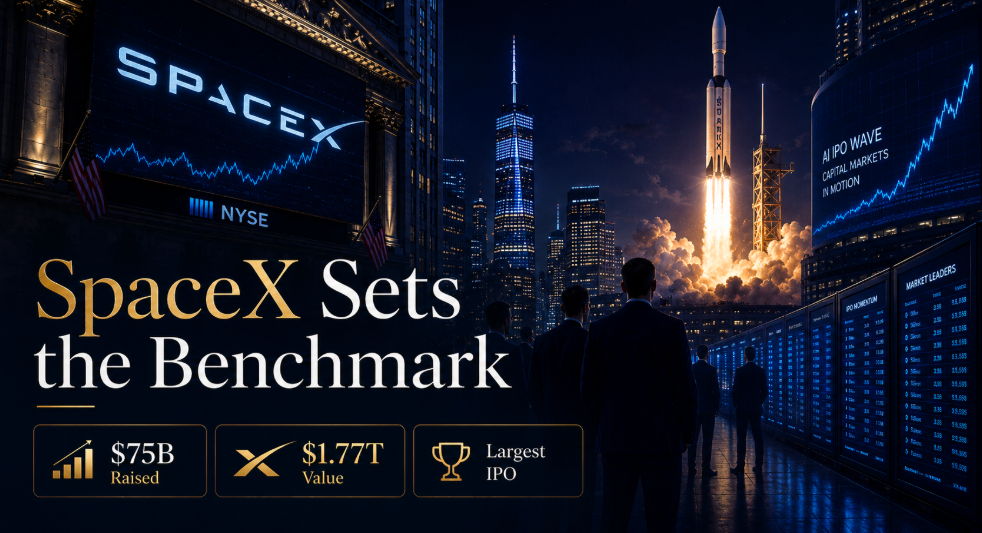
The company priced its IPO at $135 per share, raised $75 billion, and reached a valuation of about $1.77 trillion at the offering price. That alone made it the largest IPO ever.
The deal also reportedly included a greenshoe option that could allow underwriters to buy up to 15% additional shares, potentially raising another $11.2 billion if fully exercised.
That matters because SpaceX is not just another IPO.
It is a liquidity event big enough to influence investor positioning across tech, space, defense, AI, and high-growth equities.
• When one IPO can absorb $75B of demand, investors have to ask what gets sold to fund the next one.

OpenAI and Anthropic Could Be Even Bigger Tests
SpaceX may only be the beginning.
OpenAI is reportedly targeting a public-market valuation of up to $1 trillion, with an IPO potentially coming as early as September. Anthropic has also moved toward the IPO market, with Reuters reporting that it last raised capital at a post-money valuation of $965 billion.
That means public investors could soon face three enormous listings: SpaceX, OpenAI, and Anthropic.
Together, those companies could represent trillions of dollars in potential new market value. One Reuters report said SpaceX, OpenAI, and Anthropic could together add almost $4 trillion in market capitalization to public markets.
That is the center of the story.
• This is not a normal IPO window. It is a potential trillion-dollar reshuffling of AI market exposure.
Bull-Market Fuel: The Positive Case
The bullish case is simple.
Mega IPOs can expand the market.
They can attract new retail money, institutional flows, global investors, sovereign wealth capital, and passive/index-related demand over time. They can also validate the broader AI cycle by showing that public investors are still willing to fund ambitious, capital-intensive technology platforms.
If OpenAI and Anthropic price well and trade strongly, it could reinforce the entire AI narrative.
That would be good for sentiment across chips, cloud, cybersecurity, data centers, power infrastructure, enterprise AI, and software automation.
A successful AI IPO wave could tell investors that the bull market is still alive — and that demand for AI exposure remains deeper than expected.
• If the IPOs work, they could become confirmation that AI is still the market’s strongest growth story.
Liquidity Drain: The Bearish Case
The bearish case is more controversial.
Mega IPOs do not create unlimited buying power.
At some point, investors need cash to buy them. That cash can come from new deposits, but it can also come from selling existing winners.
That is where the risk sits.
If investors sell Nvidia, Microsoft, AMD, Palantir, Broadcom, Tesla, Oracle, or cybersecurity names to fund direct exposure to SpaceX, OpenAI, and Anthropic, the AI trade could temporarily rotate rather than expand.
In that scenario, the IPO wave would not kill the bull market.
But it could change the leadership.
• The risk is not that investors stop loving AI. The risk is that they sell yesterday’s AI winners to buy tomorrow’s AI listings.
Why Public AI Stocks Could Feel Pressure
Public AI stocks have already carried a lot of the market’s growth expectations.
Nvidia became the compute backbone of the AI cycle. Microsoft became the enterprise AI platform. AMD became the accelerator challenger. Broadcom became the custom-chip and networking trade. Palantir became the AI operating-system and government/enterprise AI story.
But when OpenAI and Anthropic become available, investors may no longer need to access the AI theme only through proxies.
That could create a short-term valuation debate.
Do public AI leaders deserve the same premium if investors can buy the model builders directly?
Or do the public infrastructure names become even more important because they power the private AI giants?
That is the key market tension.
• The AI IPO wave could either validate public AI stocks — or force investors to rethink how much premium they deserve.
Why This Could Help Nvidia and the Infrastructure Trade
There is another angle.
Even if OpenAI and Anthropic become public, they will still need massive compute, networking, cloud infrastructure, data-center capacity, and power.
That means Nvidia, AMD, Broadcom, Microsoft, Oracle, Vertiv, and other infrastructure-linked companies could remain essential to the story.
The model builders may get the spotlight.
But the infrastructure providers may still collect the spending.
That is why the IPO wave may not be purely negative for existing AI stocks. If investors view the listings as proof that AI demand is accelerating, the whole ecosystem could benefit.
• The model builders may win attention, but the infrastructure companies may still win the capex cycle.

The Retail Investor Angle
The retail angle could be massive.
SpaceX reportedly generated enormous retail interest, and that matters because OpenAI and Anthropic have consumer mindshare far beyond normal enterprise software companies.
Retail investors know ChatGPT.
They know Claude.
They know Elon Musk.
That brand recognition can create huge opening demand, especially if investors feel they missed Nvidia, Tesla, or early AI winners.
But that can also create risk.
When retail demand becomes emotional, valuations can detach from fundamentals. If IPOs open too high, investors may be buying excellent companies at difficult prices.
• The most dangerous trade is not buying a bad company. It is overpaying for a great one.
The Controversial Take
Here is the uncomfortable part.
The AI IPO wave could be both bullish and bearish at the same time.
Bullish because it proves investor demand is still enormous.
Bearish because it could pull liquidity away from the existing leaders that drove the market higher.
The result could be a split market: direct AI names get the attention, while some public AI proxies face profit-taking.
That does not mean the AI trade is over.
It means the trade may be maturing.
• The next phase of the AI bull market may not lift everything. It may force investors to choose winners more carefully.

What Investors Should Watch
Investors should watch five signals.
First, whether SpaceX continues trading above its IPO price after the initial excitement fades. Second, whether OpenAI and Anthropic confirm IPO timing and valuation ranges. Third, whether hedge funds and institutions reduce exposure to existing public AI winners before new listings. Fourth, whether Nvidia, Microsoft, AMD, Broadcom, and Palantir hold leadership during the IPO wave. Fifth, whether retail demand becomes so strong that IPO valuations gap far above fundamentals.
The most important signal is not the first-day pop.
It is what happens after the hype settles.
• If the IPOs hold their valuations after the opening frenzy, the market may treat them as real AI leaders — not just liquidity events.
Bottom Line
The AI IPO wave could become one of the biggest market events of the year.
SpaceX has already set the tone with a $75 billion raise and a valuation near $1.77 trillion. OpenAI and Anthropic could follow with valuations close to $1 trillion each.
That creates a powerful but controversial setup.
If new money enters the market, the IPO wave could fuel the next leg of the AI bull market.
If investors fund these listings by selling existing AI winners, the same IPO wave could drain liquidity from the stocks that led the rally.
The key takeaway for investors: the AI trade is not ending. It is becoming more crowded, more expensive, and more selective.

Marc has been involved in the Stock Market Media Industry for the last +5 years. After obtaining a college degree in engineering in France, he moved to Canada, where he created Money,eh?, a personal finance website.