The U.S. economy just delivered a surprisingly weak jobs report — and Wall Street responded by sending stocks higher.
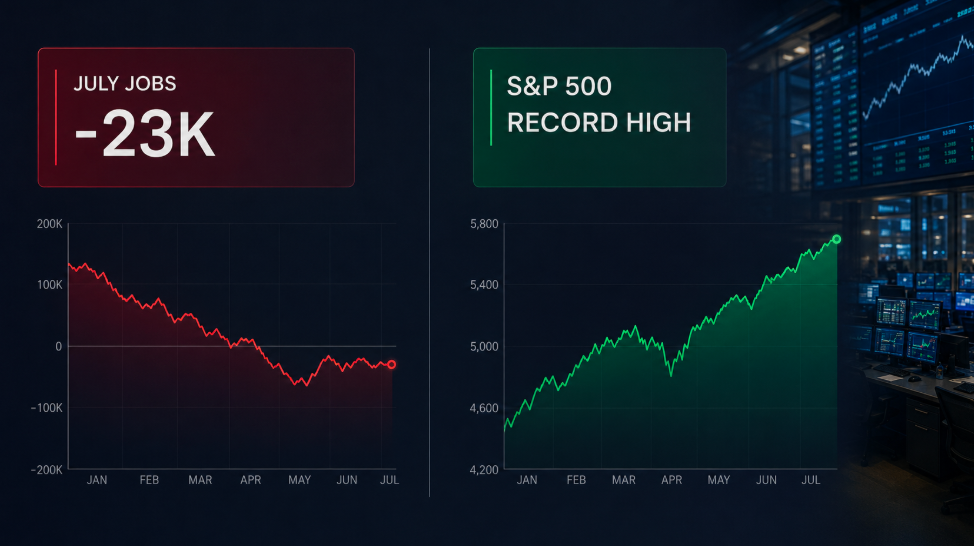
In July, the U.S. lost 23,000 jobs, dramatically missing expectations for roughly 80,000 new positions. Yet the S&P 500 climbed to a record high and the Nasdaq jumped. It sounds backwards, but investors weren’t simply trading the economy. They were trading what the numbers could mean for the Federal Reserve and interest rates.
Three Key Takeaways
- The U.S. unexpectedly lost 23,000 jobs in July.
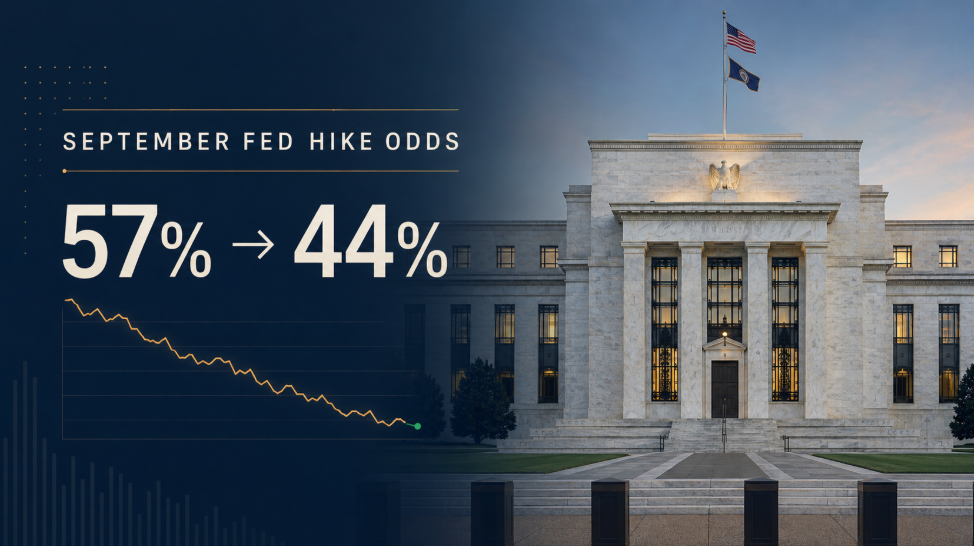
- Weak jobs cut September Fed hike odds from 57% to 44%.
- Stocks love slower growth — until slower growth becomes recession.
The Jobs Report Was Seriously Weak
The headline number was already bad: nonfarm payrolls declined by 23,000 in July.
But the revisions made the report even more concerning.
May’s job gain was revised from 129,000 to 63,000, while June was cut from 57,000 to only 20,000. Together, that removed another 103,000 jobs from previously reported figures.
The weakness also spread across several sectors. Local government education lost 50,000 jobs, retail lost 19,000, and financial activities declined by 14,000. Health care remained one of the stronger areas, adding 22,000 positions.
Despite all of that, stocks moved higher.
The S&P 500 gained around 0.6% to reach a record high, while the Nasdaq jumped roughly 1.3% and the Dow added about 0.3%.
Why?
Wall Street Wasn’t Trading Jobs — It Was Trading the Fed
The biggest explanation is interest rates.
At its July meeting, the Federal Reserve kept its benchmark rate at 3.50%–3.75%. However, three policymakers actually voted for a 25-basis-point rate increase. That meant investors were increasingly worried that another rate hike could be coming. Then the jobs report landed.
Before the data, markets were pricing roughly a 57% probability of a September Fed hike. After the weak employment figures, that probability dropped to around 44%.
Treasury yields moved lower too.
Suddenly, investors saw a weaker economy as something that could prevent the Fed from tightening monetary policy further. And for stocks, particularly high-growth technology companies, that can be very bullish. Lower interest rates make future corporate earnings more valuable today. They can also make bonds less attractive relative to equities. So Wall Street wasn’t necessarily celebrating the loss of 23,000 jobs.
It was celebrating the reduced probability of higher rates.
Then Why Did Unemployment FALL?
Another strange part of the report was the unemployment rate. Despite the economy losing jobs, unemployment actually declined from 4.2% to 4.1%.
The numbers aren’t necessarily contradictory because payroll employment and unemployment come from different surveys. Labor-force participation also stood at only 61.4% and has fallen 0.7 percentage point since January. When people stop actively looking for work, they are no longer counted as unemployed. So a falling unemployment rate doesn’t automatically mean the labor market is strengthening.
That makes July’s report considerably weaker than the 4.1% unemployment headline might suggest.
Is Bad Economic News Now Good for Stocks?
For the moment, Wall Street appears to think so — but only to a point.
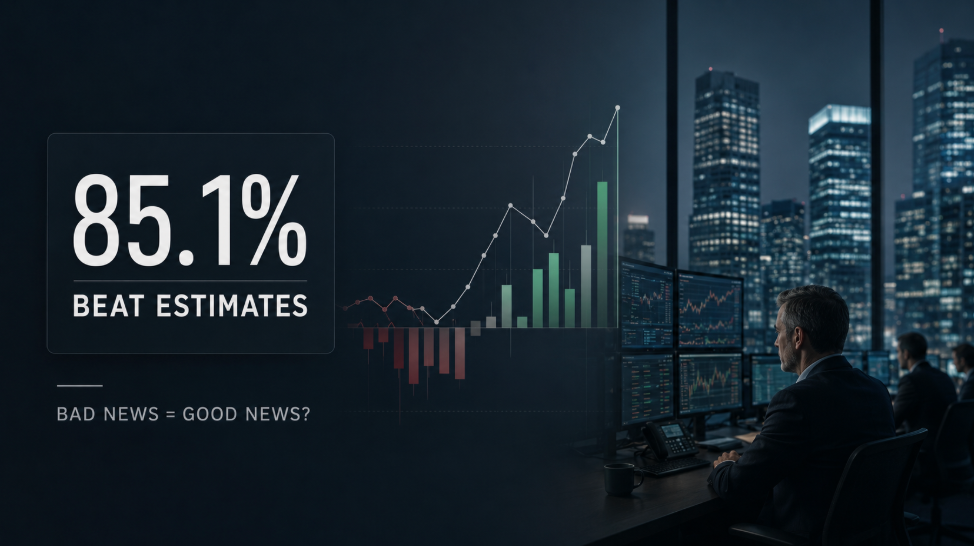
Investors seem to want an economy that is weak enough to prevent additional Fed hikes, but strong enough to keep corporate profits growing. And corporate America is still delivering. Reuters reported that 85.1% of the 436 S&P 500 companies that had reported earnings had beaten profit expectations.
That creates an unusual combination:
- Weaker economy + lower rate expectations + strong earnings = higher stocks.
The problem comes if weakness goes too far.
If job losses accelerate, consumers may spend less. Lower spending eventually hurts company revenues and profits. At that point, investors may stop celebrating weak economic reports. Inflation is another risk. June PCE inflation was still 3.7%, far above the Fed’s 2% target. If inflation remains hot, the Fed could still decide that higher rates are necessary despite a softer labor market.
The Market Is Walking a Fine Line
For now, Wall Street is betting on a very specific outcome: the economy cools, the Fed backs away from hiking, but corporate profits remain strong.
That’s why a report showing 23,000 jobs disappearing could somehow coincide with a record-high S&P 500.
It isn’t necessarily irrational. Markets are forward-looking, and investors care about where rates, earnings and economic growth are heading — not simply whether today’s headline looks good or bad. But the margin for error is getting smaller.
If the economy stabilizes while inflation cools, stocks could be right to celebrate. If job losses accelerate and profits begin to weaken, however, Wall Street may quickly discover that bad news eventually becomes just that: bad news.
Disclaimer: This article is for informational and educational purposes only and does not constitute financial or investment advice. Market data and expectations may change rapidly. Always conduct your own research and consider your individual financial situation before making investment decisions.

Marc has been involved in the Stock Market Media Industry for the last +5 years. After obtaining a college degree in engineering in France, he moved to Canada, where he created Money,eh?, a personal finance website.