AST SpaceMobile and Rocket Lab will both release their second-quarter results after the U.S. market closes. Their conference calls begin at 5:00 p.m. ET—or 11:00 p.m. in France. AST SpaceMobile and Rocket Lab are no longer being treated like obscure speculative space companies. Investors now expect visible progress toward large-scale commercial operations.
- ASTS must prove its launch progress can translate into commercial revenue.
- Rocket Lab needs strong numbers—and continued confidence in Neutron.
- Recent space earnings show that growth alone is no longer enough.
AST SpaceMobile: The Numbers Are Only Half the Story
Wall Street expects AST SpaceMobile to report approximately $34.1 million in revenue and a loss of around $0.28 per share. That would represent a significant increase from the $14.7 million reported in the first quarter, although analyst estimates remain unusually wide for a company still entering commercialization. Zacks
However, the headline EPS figure will probably not determine the stock’s reaction.
Investors will focus on whether ASTS maintains its 2026 revenue guidance of $150 million to $200 million, together with its target of having approximately 45 satellites in orbit during 2026. The company missed Wall Street’s revenue and earnings expectations in Q1, making tonight’s update an important credibility test.
ASTS enters the report with fresh momentum. BlueBird satellites 11, 12 and 13 were successfully launched on August 5, following the BlueBird 8-10 mission in June. AST SpaceMobile must now explain how quickly those satellites will be deployed, tested and connected to its ground infrastructure.
The bullish scenario would include:
- Confirmation of the $150 million–$200 million revenue outlook
- A credible schedule for the next BlueBird launches
- A firm timetable for beta or initial commercial service
- Additional revenue commitments from telecom or government partners
- Continued control over satellite production and network costs

The bearish scenario would be a reduction in the 45-satellite objective, another commercial-service delay or signs that 2026 revenue is shifting into 2027.
For ASTS, tonight is not simply about beating a revenue estimate. It is about convincing investors that satellite launches are finally becoming a repeatable commercial system.
Rocket Lab: Expectations Are Already Extremely High
Rocket Lab arrives with a more established business than ASTS, but it may also face a higher bar.
Analysts expect approximately $231.6 million in Q2 revenue, representing growth of roughly 60% year over year, and an adjusted loss of around $0.08 per share. That revenue estimate sits near the midpoint of Rocket Lab’s official guidance range of $225 million to $240 million.
The company reported record Q1 revenue of $200.3 million, GAAP gross margin of 38.2% and backlog exceeding $2.2 billion. It also guided for a Q2 adjusted EBITDA loss between $20 million and $26 million.
A revenue beat would be encouraging, but management’s outlook will probably matter more. Investors will want evidence that launch services and space systems can continue growing while Rocket Lab funds increasingly ambitious projects.
The central question remains Neutron.
Management previously said the medium-lift rocket remained on track for its debut later in 2026. Any indication of a delay could overshadow otherwise solid financial results. Conversely, successful engine qualification, completed hardware integration or a more precise first-launch window could drive a powerful reaction.
Investors will also listen closely for updates on Rocket Lab’s proposed $8 billion acquisition of Iridium. The transaction would give Rocket Lab a profitable global communications network, valuable spectrum and recurring subscription revenue—but it also introduces financing, integration and potential dilution risks. Rocket Lab has secured $3.6 billion of committed debt financing, with completion currently expected around mid-2027.

Rocket Lab’s ideal report would therefore combine:
- Revenue near or above the top of guidance
- Gross margins holding within or above expectations
- A larger backlog and new government contracts
- Confidence in Neutron’s 2026 debut
- A strong Q3 revenue outlook
- Reassurance regarding Iridium financing and dilution
A basic earnings beat without Neutron progress may no longer be enough.
Other Space Stocks Are Already Sending a Message
The first wave of space earnings has generally been encouraging.
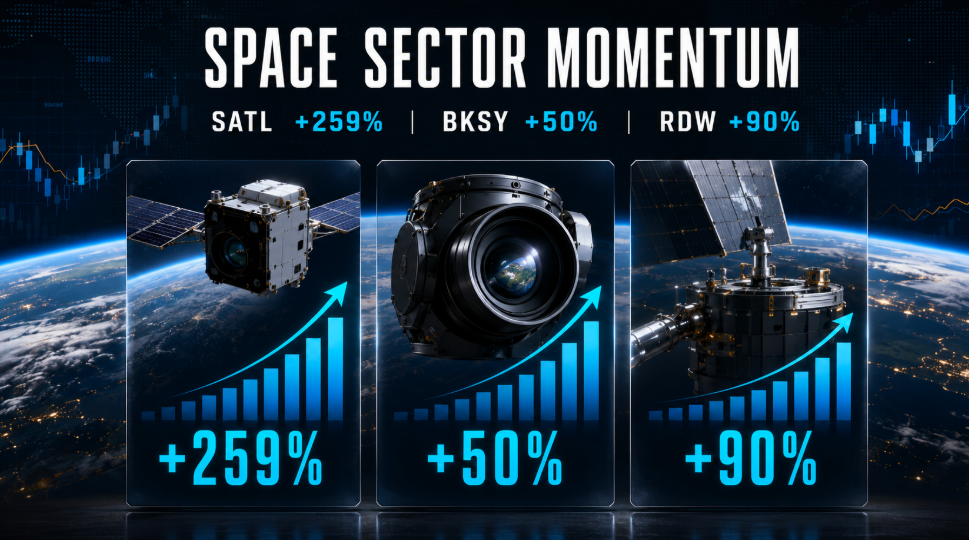
- Satellogic (SATL) reported Q2 revenue of $15.9 million, up 259% year over year, while achieving its first quarter of positive operating income and positive adjusted EBITDA. The company ended the period with $112.8 million in cash and $80.7 million in remaining performance obligations.
- BlackSky Technology (BKSY) delivered $33.3 million in revenue, up approximately 50%, supported by accelerating demand for its Gen-3 imagery and intelligence services. International revenue grew 200%, showing how defense and sovereign customers are becoming increasingly important to the commercial space market.
- Redwire (RDW) generated record revenue of $117.1 million, up nearly 90%, while gross margin improved to 27.8%. Its results reinforced the growing connection between space infrastructure, defense spending and autonomous systems, although part of its expansion came through acquisition.
These reports suggest that investor demand for space stocks remains strong—but the market increasingly wants revenue visibility, margins and funded contracts rather than distant promises.
The Next Space Earnings to Watch
Tonight will not end the space earnings season.
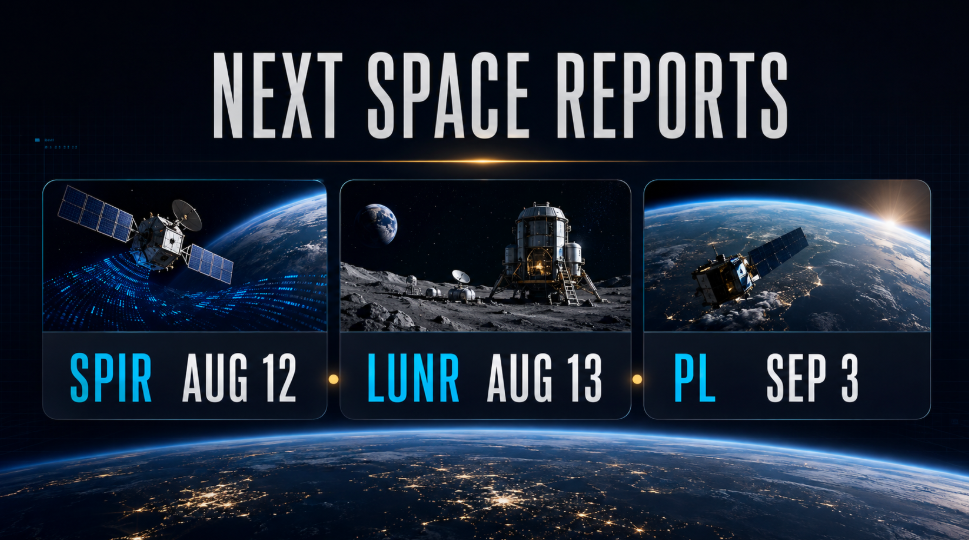
- Spire Global (SPIR) reports on August 12. Investors will focus on recurring data revenue, customer retention, margins and cash generation from its satellite-based weather, maritime and aviation analytics business.
- Intuitive Machines (LUNR) reports before the market opens on August 13. Its reaction will likely depend on NASA contract execution, backlog and the timetable for upcoming lunar missions—not simply quarterly EPS.
- Planet Labs (PL) reports on September 3. The company previously guided for fiscal Q2 revenue between $102 million and $107 million, making it one of the sector’s larger recurring-revenue businesses. Investors will watch margins, defense demand and whether satellite imagery can produce sustainable profitability.
The Bottom Line
AST SpaceMobile and Rocket Lab represent two different versions of the space investment thesis.
ASTS is attempting to prove that a revolutionary direct-to-device network can become commercially operational. Rocket Lab is attempting to evolve from a launch provider into a fully integrated space and communications company.
Both stories are compelling—but both now carry serious expectations.
For ASTS, the decisive question is whether management can convert launches into revenue quickly enough. For Rocket Lab, it is whether Neutron, government growth and the Iridium acquisition can justify the company’s increasingly ambitious valuation.
Tonight’s biggest space-stock moves may therefore have little to do with whether EPS beats by a few cents. The real market reaction will come from what management says about the next launch, the next satellite, the next contract—and when those investments finally become durable cash flow.
Disclaimer: This article is for informational purposes only and does not constitute financial advice. Space-sector stocks can be highly volatile and involve substantial technological, execution, financing and regulatory risks.

Marc has been involved in the Stock Market Media Industry for the last +5 years. After obtaining a college degree in engineering in France, he moved to Canada, where he created Money,eh?, a personal finance website.