Sekur Private Data is attending one of the most important technology conferences serving the U.S. Intelligence Community. That is meaningful progress—but investors should understand exactly what it represents. DoDIIS can open doors, create relationships and accelerate technical evaluations. It does not automatically produce contracts. With Sekur promising paid beta onboarding in September and an official SekurOne launch in early October, expectations are now shifting from introductions to measurable sales.
- DoDIIS puts Sekur directly in front of intelligence and defense decision-makers.
- Investors should expect paid beta customers to begin onboarding in September.
- The next major validation must be recurring revenue—not another announcement.
1. Sekur Has Entered the Right Room
Sekur Private Data’s government team is attending the 2026 DoDIIS Worldwide Conference, held in Tampa, Florida, from August 9 through August 12.
DoDIIS is hosted by the Defense Intelligence Agency and brings together senior government officials, military leaders, intelligence professionals, technical experts, industry partners and representatives from Five Eyes nations.
This is not a generic cybersecurity trade show.
The official DoDIIS conference description presents the event as a gathering focused on technologies supporting intelligence operations, military readiness, command systems, resilient infrastructure and national security.
For Sekur, the audience is almost perfectly aligned with the market it has spent the past year trying to enter.
The company is targeting government agencies, defense organizations, intelligence personnel, diplomatic users, military commands and contractors handling Controlled Unclassified Information, or CUI.
According to Sekur’s conference announcement, its Special and Strategic Advisors are introducing the company’s communications capabilities and meeting interested parties from across the Intelligence Community.
This provides Sekur with direct access to people who understand the communications-security problem the company claims to solve.
For a small company, that access has genuine value.

2. What Investors Should Expect From DoDIIS
Investors should not expect Sekur to return from a four-day conference with a massive intelligence-agency contract ready to announce.
Government and defense procurement rarely works that quickly.
Potential customers may need to conduct technical reviews, cybersecurity assessments, legal evaluations, budget approvals and internal procurement procedures before purchasing or deploying a communications platform.
The realistic path from DoDIIS to revenue could look like this:
| Stage | What it means for Sekur | Evidence investors should expect |
|---|---|---|
| Conference introduction | Initial contact with a potential buyer or partner | Confirmation of follow-up discussions |
| Technical evaluation | Customer examines capabilities and security architecture | Demonstration, evaluation or beta participation |
| Paid beta | Customer pays to test SekurOne | Number of paying users or organizations |
| Commercial conversion | Beta customer becomes a recurring subscriber | Contract value, seats and monthly revenue |
| Larger deployment | Customer expands adoption | Additional users, agencies or departments |
DoDIIS should therefore be judged by what happens after the conference.
If the meetings lead to technical evaluations, paid pilots or distributor relationships, the event will have created meaningful commercial momentum.
If Sekur only reports that it generated “interest” or held “productive conversations,” investors will still lack evidence that the government strategy is producing revenue.
The difference between interest and adoption is payment.

3. The Conference Creates a Direct Test for Sekur’s Government Strategy
Sekur has spent months preparing for this moment.
It has repositioned itself away from low-priced consumer privacy subscriptions and toward higher-value government, defense, corporate and executive clients. It has secured access to the U.S. General Services Administration Multiple Award Schedule through a distribution arrangement and added experienced intelligence and government advisers.
The board and advisory appointments matter because they helped Sekur gain technical guidance, government-market credibility and access to difficult-to-reach decision-makers.
But investors no longer need another long list of credentials.
They need to see whether that team can generate a qualified pipeline and close paying customers.
DoDIIS is where the strategy begins to face the market.
Sekur’s advisers are now attending an event filled with the exact agencies, contractors, acquisition specialists and intelligence professionals they were recruited to reach. If the government team cannot create serious opportunities in this environment, investors would be justified in questioning the commercial value of the entire advisory buildout.
If it does create opportunities, Sekur should begin demonstrating that progress through paid beta activity in September.
4. September and October Are the Real Catalysts
The most important part of Sekur’s announcement is not simply that the company is attending DoDIIS.
It is the newly defined sales timeline.
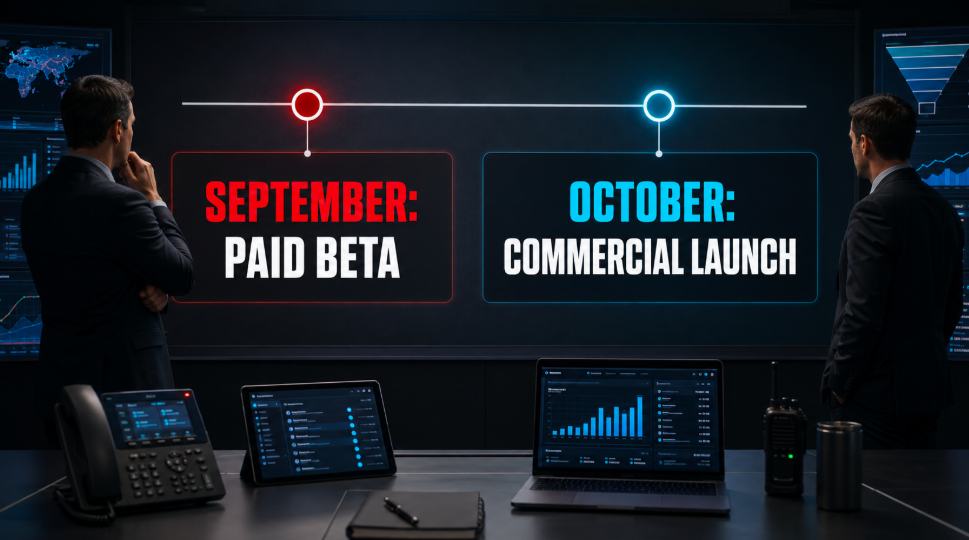
Sekur says it has begun pre-sales engagements with multiple potential clients, partners and distributors. It expects paid beta customers to begin onboarding in September, followed by the official SekurOne launch during the first week of October.
These statements create clear investor expectations.
| Period | Expected development | What investors need to know |
|---|---|---|
| August | DoDIIS introductions and meetings | Did discussions create qualified follow-ups? |
| September | Paid beta onboarding | How many paying customers and seats? |
| Early October | Official commercial launch | Is the complete platform available on schedule? |
| Q4 2026 | Sales and ARPU contribution | Is recurring revenue beginning to accelerate? |
| Next financial results | Revenue validation | Is the government pivot visible in reported numbers? |
September is particularly important because Sekur specifically used the term “paid beta clients.”
That is a much higher standard than a free trial, product demonstration or non-binding expression of interest. It implies that at least some organizations should begin contributing actual revenue before the official launch.
Investors should expect Sekur to quantify that activity.
The company does not need to reveal confidential government identities. However, it can disclose the number of paid organizations, the number of seats, the approximate revenue contribution and whether the customers came through DoDIIS, existing distributors or other government channels.
October then becomes the conversion test.
The key question will be whether September’s paid beta customers become recurring commercial customers—and whether the launch adds new buyers.
5. Why Investors Need Financial Proof Now
Sekur has produced a considerable number of announcements involving product development, marketing partnerships, advisers, distributors, conferences and government positioning.
Its financial results have not yet reflected that progress.
Sekur generated approximately C$408,700 of revenue during 2025, down from C$477,700 in 2024. During the first quarter of 2026, revenue declined to approximately C$94,100 from C$138,800 one year earlier.
The company also recorded a Q1 net loss of approximately C$563,000 and used around C$635,000 of cash in operating activities.
These figures are available in Sekur’s 2025 audited financial statements and its Q1 2026 interim statements.
That financial baseline explains why investor expectations are increasing.
Sekur has already demonstrated that it can develop products, recruit advisers and attend government events. What remains unproven is whether it can sell enough subscriptions to create sustainable recurring revenue.
Conference access becomes valuable only when it improves those numbers.
6. SekurOne Gives Investors a Simple Scoreboard
SekurOne is expected to cost approximately US$300 per month per user.
Management says 200 paying SekurOne users would generate approximately US$60,000 in monthly recurring revenue and could allow the company to reach full profitability.
That claim has not yet been validated through reported results. Nevertheless, it gives investors a measurable target.
| Paying users | Illustrative monthly revenue | Illustrative annualized revenue |
|---|---|---|
| 10 | US$3,000 | US$36,000 |
| 25 | US$7,500 | US$90,000 |
| 50 | US$15,000 | US$180,000 |
| 100 | US$30,000 | US$360,000 |
| 200 | US$60,000 | US$720,000 |
These calculations assume every user pays the complete US$300 monthly price, with no discounts, churn or implementation adjustments. They are illustrative and should not be treated as guidance.
Even a relatively small number of government organizations could move Sekur materially closer to its goal if each organization purchases multiple seats.
For example, four customers deploying 50 subscriptions each would produce 200 paying users. But government organizations may also begin with only a handful of evaluation seats and take months to approve wider deployment.
That is why investors need both customer numbers and seat numbers.
Sekur described the platform as its expected principal ARPU growth driver from the fourth quarter onward in its July operating update.
The fourth quarter must now begin showing evidence of that claim.

7. The Investor Scoreboard After the Conference
Following DoDIIS, investors should focus on six measurable indicators:
- Qualified opportunities: Did the conference create serious evaluations rather than general conversations?
- September paid customers: How many users and organizations begin paying during the beta period?
- Contract size: Are customers purchasing one subscription, ten seats or larger deployments?
- October conversions: Do paid beta clients remain after the commercial launch?
- Monthly recurring revenue: Does Sekur begin disclosing a clear increase in subscription revenue?
- Reported quarterly growth: Does the new strategy reverse the company’s recent revenue decline?
Investors should also distinguish between different types of announcements.
A meeting is not a pilot. A pilot is not necessarily paid. A paid beta is not a long-term contract. And a contract does not become meaningful to shareholders until it generates collectible revenue.
Sekur’s communication should begin progressing through those stages.
The Verdict: DoDIIS Matters—But September Matters More
Sekur’s presence at DoDIIS is a positive and strategically relevant development.
The company is introducing itself to one of the strongest concentrations of intelligence, defense and government-technology decision-makers it could realistically access. Its government team is operating in the market it was created to pursue.
But conference attendance is not commercial validation.
The announcement becomes truly important because it arrives immediately before Sekur’s promised September paid-beta period and early-October commercial launch.
Those dates create accountability.
If Sekur begins onboarding paid clients in September, identifies meaningful follow-up opportunities from DoDIIS and converts beta users into recurring subscriptions during October, investors will finally have evidence that the government pivot is moving beyond preparation.
If those dates pass without quantified sales, recurring revenue or visible customer adoption, the market may begin treating the latest conference as another promising event that failed to reach the financial statements.
Sekur has found the right audience. It has assembled a team capable of speaking that audience’s language. And it now has a premium product carrying potentially transformative revenue per user.
The expectation is no longer simply progress.
It is conversion.
For SWISF investors, DoDIIS opens the door—but September sales must prove that Sekur can walk through it.
Disclaimer: This article is for informational purposes only and does not constitute investment advice. Sekur Private Data is a speculative micro-cap company with limited revenue, operating losses, financing requirements and potential dilution risk. Statements concerning future launches, paid beta users, government opportunities, revenue and profitability are forward-looking and may not be achieved.

Marc has been involved in the Stock Market Media Industry for the last +5 years. After obtaining a college degree in engineering in France, he moved to Canada, where he created Money,eh?, a personal finance website.