Satellite imagery has long promised a better view of the world. The harder business problem is turning that view into timely information that customers will pay for repeatedly. Satellogic (NASDAQ: SATL) is approaching a useful test of that ambition. In October, it plans to launch two satellites that can communicate with others in orbit and another aimed at sovereign customers. Its first Merlin satellite is also targeted for October, with the broader system expected to reach full operational capability in the first half of 2027.
For investors, these milestones matter because the company is trying to move beyond individual images and satellite deliveries toward persistent monitoring. The opportunity is compelling, but the relevant measure will be customer revenue and cash generation after the new systems begin operating.
- October’s planned launches should test whether Satellogic can make its fleet more responsive, while adding capacity for sovereign customers.
- Its maritime partnership with SynMax offers a route to recurring intelligence use cases, though financial terms and future demand remain undisclosed.
- Second-quarter revenue and profitability improved sharply, but the mix of satellite sales and continued cash use make sustained performance the next test.
Three satellites, two commercial purposes
On September 14, Satellogic said it planned to launch two NewSat Mark VI satellites equipped with inter-satellite links and one NewSat Mark V in October. The links are intended to let a satellite detecting a change prompt another satellite to collect a closer look without sending every decision through a ground station first. If the architecture works as described, the time between an observation and an actionable update could shrink. That speed is valuable for customers tracking ships, borders, infrastructure, or rapidly changing events.
The Mark V serves a different demand: governments that want dedicated space capabilities and greater operational control. That is a real commercial path for Satellogic, which has already delivered the first of two satellites under an $18 million program with Portugal’s CEiiA. A sovereign satellite sale can be significant for a company of this size. It should, however, be assessed separately from recurring data revenue, since deliveries can make quarterly comparisons uneven.
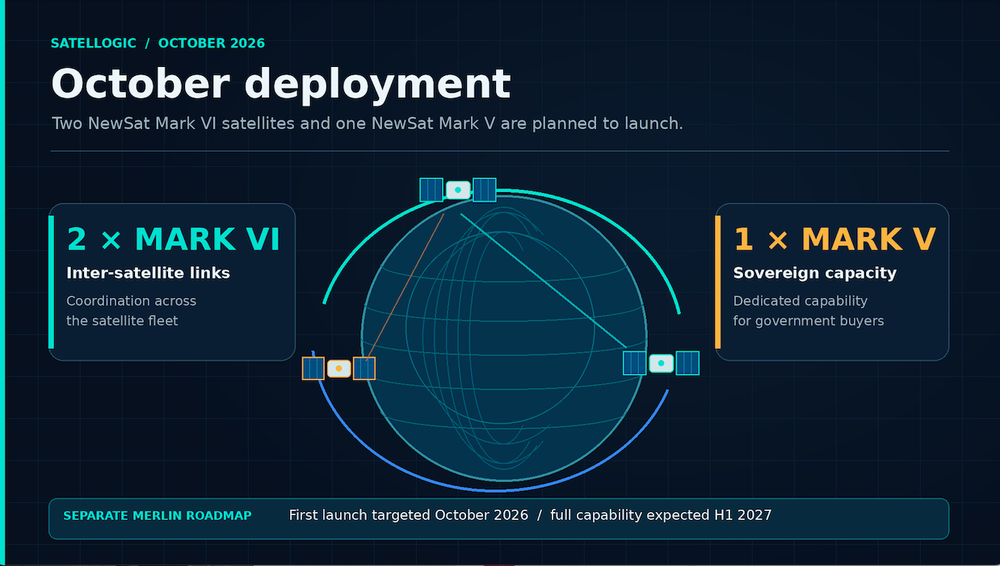
October also marks the planned first launch of Merlin, a separate constellation designed for broad, frequent observation. Satellogic says Merlin aims to remap the planet daily at roughly one-meter resolution once the system is fully built. Investors should distinguish that long-term design goal from the capability of an initial satellite: the company currently expects full operational capability in the first half of 2027.
Turning coverage into a service
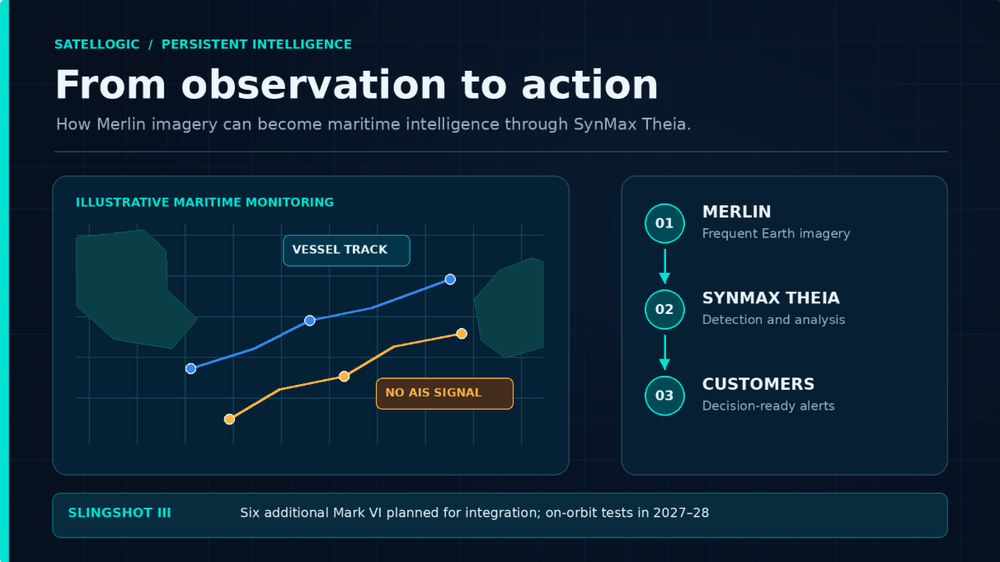
The investment case gets more interesting when satellites, software, and customers come together. In September, Satellogic announced that SynMax’s Theia platform would be the exclusive channel for maritime intelligence derived from Merlin. The proposed uses include vessel detection, tracking ships that are not broadcasting their identity, monitoring sanctions evasion, and identifying illegal fishing. In each case, the customer is buying awareness of what changed and where to investigate, rather than a one-off picture.
The arrangement gives Satellogic a specialist route to maritime customers without requiring it to build every analytic workflow itself. It does not, on the information disclosed, establish how much revenue Merlin will generate, what share each partner will receive, or when the product will reach scale. Those details will matter as the constellation grows. A partnership announcement is a distribution step; repeat customer spending would be the stronger proof of demand.
There is an additional defense angle. Satellogic also announced expanded work with Innovative Defense Technologies in support of the U.S. Office of Naval Research’s Slingshot III program. The plan covers on-orbit tests in 2027 and 2028 and supports the integration of six more Mark VI satellites over the following 18 months. The work could demonstrate faster tracking and more autonomous tasking, but the company did not disclose a contract value in that announcement. Investors should treat it as evidence of technical engagement, not assume an immediate revenue windfall.
Financial progress gives the story a firmer base
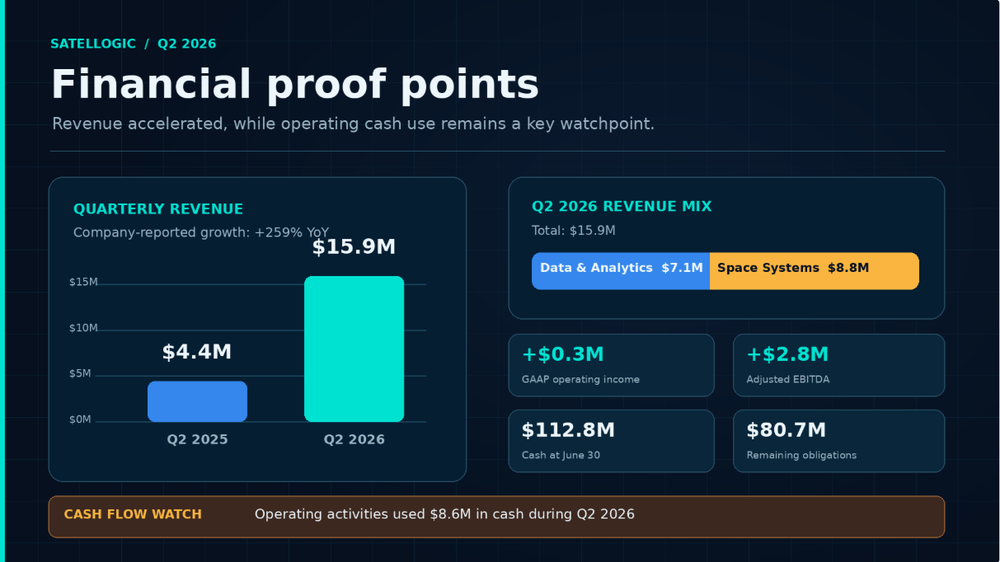
Satellogic’s second quarter showed that this strategy is developing alongside substantial current business. Revenue reached $15.9 million, up 259% from $4.4 million a year earlier. GAAP operating income was $0.3 million, its first positive quarter on that measure, and adjusted EBITDA was positive $2.8 million. The company ended June with $112.8 million in cash and $80.7 million in remaining performance obligations, of which $45.8 million was expected to become revenue within a year.
The composition matters. Space Systems supplied $8.8 million of quarterly revenue, compared with $0.5 million a year earlier, while Data & Analytics, including constellation services, supplied $7.1 million, up from $4.0 million. Both grew, but hardware-related deliveries drove most of the year-over-year increase. A stronger investment case would emerge if monitoring and analytics revenue also compounds as the new capacity comes online.
Profitability deserves the same care. Satellogic reported a $20.0 million GAAP net loss, largely affected by a $19.7 million noncash fair-value charge on financial instruments. More directly relevant to funding, operating activities used $8.6 million in cash during the quarter. The company also issued 10 million shares when a noteholder converted $12 million of convertible-note principal. Its cash balance provides room to execute, while cash use and potential dilution remain important for shareholders.
What would confirm the upside?
The next checkpoints are concrete: successful launches and commissioning, reliable inter-satellite coordination, progress toward Merlin’s 2027 operating target, and growth in repeat monitoring contracts. Subsequent results should show whether Data & Analytics revenue grows steadily and whether operating cash flow improves as contracted work is delivered. Remaining performance obligations provide visibility, but they are not the same as cash already collected or profit earned.
Bottom line
Satellogic has a credible opportunity to turn its growing satellite fleet into a more valuable intelligence business. Its signed customer work, improving operating results, and October launch plans make the next phase worth watching closely. The decisive evidence will come after deployment: repeat data and analytics revenue, reliable service, and improving cash flow. If those follow, the investment case could strengthen substantially; if they do not, successful launches alone will be insufficient to justify the upside investors expect.
The author holds SATL shares as of publication; holdings may change without notice. This article is for information and education only and is not a recommendation or investment advice. Satellogic is a speculative, volatile stock. Launches, commissioning, customer adoption, profitability, and cash flow may differ materially from company plans. Contract obligations are not guarantees of collection or margins, and future financing may dilute shareholders. Readers should do their own research and consider their circumstances before investing.

Marc has been involved in the Stock Market Media Industry for the last +5 years. After obtaining a college degree in engineering in France, he moved to Canada, where he created Money,eh?, a personal finance website.