Bloom Energy has become one of the market’s biggest artificial-intelligence infrastructure winners.
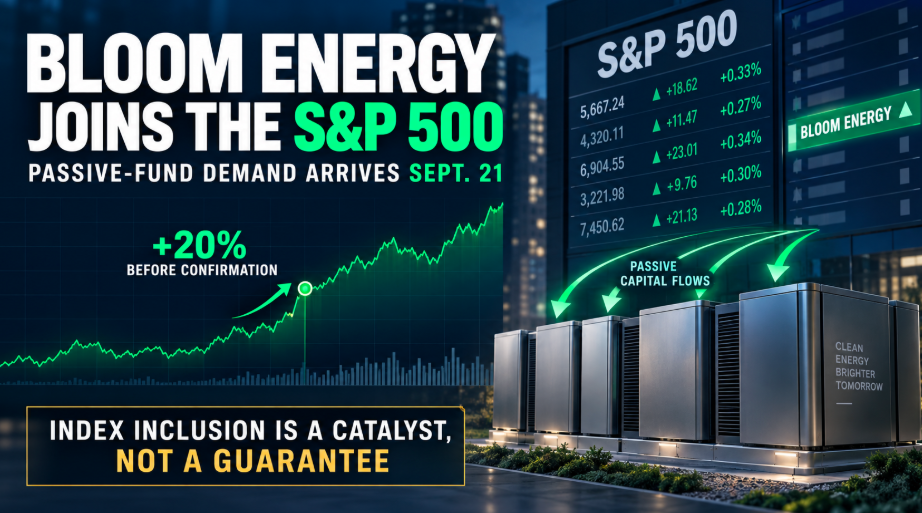
Shares had risen approximately 190% in 2026 by the September 4 close, lifting the fuel-cell company’s market value to roughly $74.5 billion. The rally received another boost when S&P Dow Jones Indices announced that Bloom Energy would join the S&P 500 before trading begins on September 21.
The inclusion is an important milestone. It confirms that Bloom has evolved from a speculative clean-energy company into a large and increasingly profitable infrastructure business. However, after such a dramatic rally, investors must decide whether the announcement begins another chapter of growth or creates a classic sell-the-news setup.
- S&P 500 inclusion should generate passive-fund demand, but Bloom’s sharp pre-announcement rally suggests some investors anticipated the news.
- The underlying business is accelerating, with second-quarter revenue up 166%, improving margins and positive operating cash flow.
- AI power demand offers a powerful long-term opportunity, although Bloom’s premium valuation and customer concentration leave little room for execution problems.
What S&P 500 inclusion changes
Bloom Energy will replace Molson Coors Beverage in the S&P 500 as part of the index’s September quarterly rebalancing. Funds designed to track the index will consequently need exposure to Bloom, creating mechanical demand around the September 21 effective date.
That can provide near-term support, but inclusion does not automatically produce lasting gains. Passive buying is largely a one-time event. Once the rebalance is complete, the share price will again depend on revenue growth, profitability and expectations for future orders.
The timing also deserves attention. Bloom climbed roughly 20% during the five trading sessions preceding confirmation, according to a calculation being widely discussed by investors on Reddit. That does not prove the announcement leaked or was completely priced in, but it illustrates how aggressively traders had already positioned for a positive catalyst.
The retail debate has therefore shifted. Investors are no longer asking whether Bloom has a compelling story. They are asking how much of that story is already reflected in the share price.
Bloom’s fundamentals are catching up with the excitement
This rally is not based solely on index speculation.
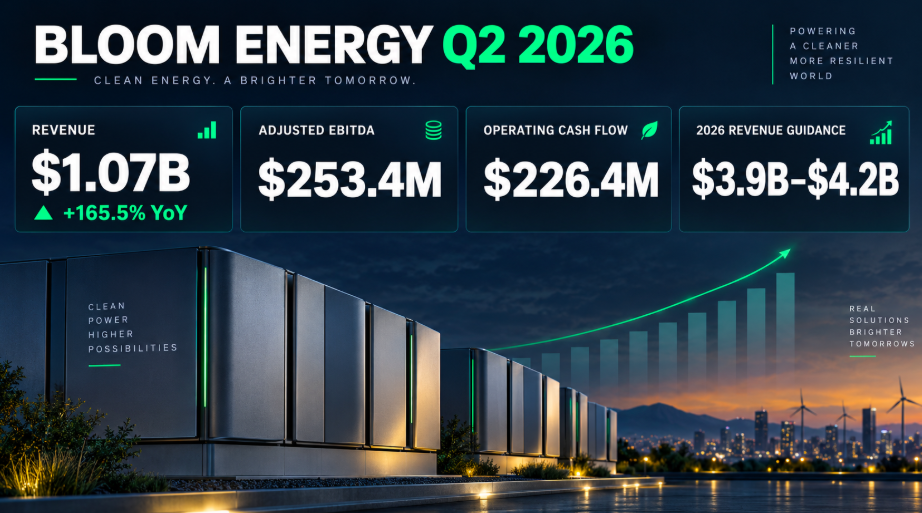
Bloom reported second-quarter revenue of $1.07 billion, an increase of 165.5% from the previous year. Product revenue rose more than 215%, while GAAP gross margin improved from 26.7% to 33.4%.
Operating performance also changed dramatically. Bloom generated $182.2 million of GAAP operating income, compared with a $3.5 million loss one year earlier. Adjusted EBITDA reached $253.4 million, while operating cash flow improved from a $213.1 million outflow to a $226.4 million inflow.
Management subsequently raised its full-year outlook. Bloom now expects 2026 revenue between $3.9 billion and $4.2 billion, with non-GAAP operating income of $800 million to $900 million and adjusted earnings of $2.55 to $2.85 per share.
Those numbers help explain why the market is treating Bloom differently from many earlier clean-energy companies. It is no longer promising that profitability will eventually arrive. It is producing earnings and cash while raising guidance.
AI’s power shortage is Bloom’s biggest opportunity
Bloom’s Energy Servers generate electricity directly at customer sites using solid oxide fuel cells. The systems are modular and can be installed without waiting years for new transmission lines or large grid upgrades.
That matters because electricity availability is becoming a limiting factor for AI data-centre expansion. A company may secure land, processors and construction permits, but those assets are useless without reliable power.
Bloom says its solutions have now been validated or approved by every major US hyperscaler, along with more than a dozen AI laboratories, cloud operators and data-centre companies.
The Oracle relationship illustrates the potential scale. Oracle intends to deploy up to 2.8 gigawatts of Bloom capacity under an expanded agreement, with an initial 1.2 gigawatts contracted and deployment underway. Bloom previously completed an Oracle installation in 55 days, demonstrating the speed that makes onsite generation attractive.
Brookfield has also expanded its AI infrastructure partnership with Bloom from $5 billion to as much as $25 billion. Importantly, that figure represents a financing framework for eligible projects, not guaranteed Bloom revenue. Even so, the arrangement could remove a major financing obstacle for customers seeking large power deployments.
Bloom has also introduced its Power Connect platform, which the company says can reduce onsite installation time by more than 40%. If that improvement holds at scale, it could help the company convert AI demand into revenue more quickly.
The valuation already assumes exceptional execution
The difficult part of the investment case is valuation.
Using Bloom’s September 4 market value and the midpoint of its current revenue guidance, the shares were valued at approximately 18 times expected 2026 sales. At the September 4 closing price of $252.87, the stock traded near 94 times the midpoint of adjusted earnings guidance.
These are simple calculations rather than analyst consensus estimates, but they show how much future success investors are already expecting.
Customer concentration adds another risk. Bloom’s latest SEC filing showed that two customers generated approximately 44% and 21% of second-quarter revenue. One customer represented about 73% of revenue during the first half of 2026.
Large infrastructure contracts naturally create uneven quarterly results. However, when so much revenue depends on a small number of customers, delayed deliveries or modified project schedules can have an outsized effect.
Bloom’s balance sheet provides some protection. The company finished June with approximately $2.67 billion in cash and cash equivalents, compared with roughly $2.48 billion in debt. Nevertheless, investors must continue monitoring convertible-note dilution, manufacturing capacity and the working capital required to support rapid expansion.
There is also an environmental nuance. Bloom’s systems can produce fewer emissions than some grid alternatives and avoid conventional combustion, but installations using natural gas are not carbon-free. The near-term investment thesis is therefore based primarily on reliability, speed and lower local pollutants, rather than completely eliminating carbon emissions.
What investors should watch next
The September 21 index rebalance could create elevated volume and volatility, but quarterly execution will matter more than passive flows.
Investors should watch whether Bloom can:
- Convert its major partnerships into firm orders and recognized revenue
- Maintain gross margins near the company’s 34% target
- Continue producing positive operating cash flow
- Reduce its dependence on a handful of customers
- Expand production without sacrificing delivery quality
- Provide evidence that current AI projects will support growth beyond 2026
Strong progress in those areas could justify part of Bloom’s premium and keep the AI power trade moving higher. Any slowdown in deployments or margin expansion could instead produce a sharp valuation reset.
The bottom line
Bloom Energy’s S&P 500 inclusion is genuine validation of the company’s transformation. Revenue is accelerating, profitability has improved and the shortage of reliable power for AI infrastructure creates a substantial addressable market.
Still, index membership is not free upside. At its current valuation, Bloom must deliver more than strong growth. It must execute at an exceptional level for several years.
The long-term opportunity remains attractive, but the stock is no longer priced like an overlooked clean-energy turnaround. It is priced like a leading AI infrastructure company. For investors, the next phase will be determined less by headlines and more by whether Bloom’s expanding partnerships translate into diversified, profitable and sustainable revenue.
Disclaimer: This article is for informational purposes only and does not constitute financial advice. Investors should conduct their own research and consider their objectives, time horizon and risk tolerance before buying or selling any security.

Marc has been involved in the Stock Market Media Industry for the last +5 years. After obtaining a college degree in engineering in France, he moved to Canada, where he created Money,eh?, a personal finance website.