Chip demand is still breaking records. The harder question is who can supply the electricity, grid equipment and financing required to turn AI plans into operating data centers.
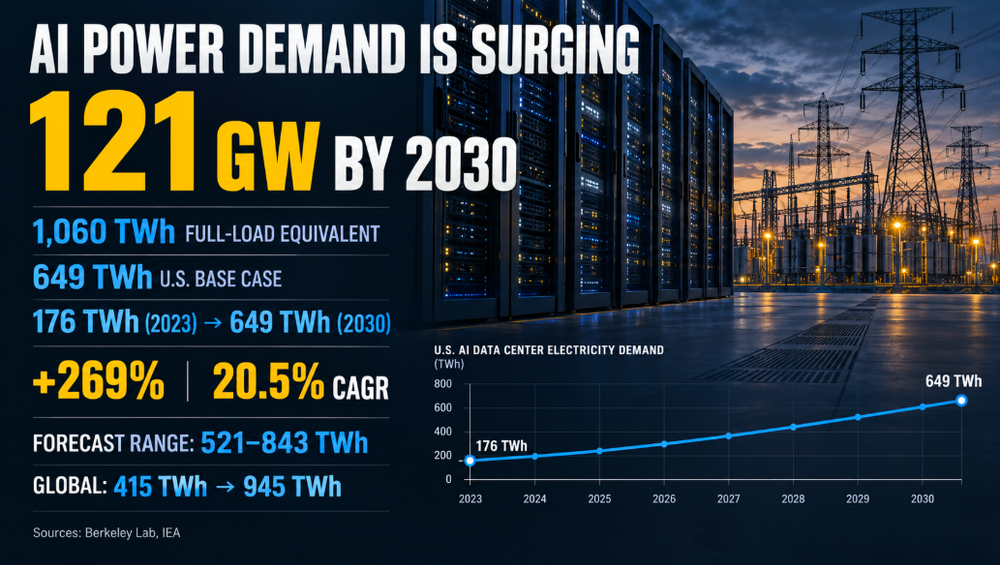
- U.S. data-center IT demand could reach 121 gigawatts by 2030. At full utilization, that would represent roughly 1,060 terawatt-hours of annual IT electricity use before cooling and other facility overhead.
- Berkeley Lab’s reference case puts total U.S. data-center electricity consumption at 649 TWh in 2030, up 269% from 176 TWh in 2023. Its forecast range is 521 to 843 TWh, or 9.5% to 15.3% of U.S. electricity use.
- The investment opportunity extends from power generation to turbines, transformers, switchgear, cooling and optical links, but much of the obvious basket already trades at demanding valuations. Execution and price now matter as much as demand.
Taiwan Semiconductor Manufacturing reported August revenue of NT$514.8 billion, roughly $16.3 billion and 53% growth from a year earlier. Yet its U.S.-listed shares slipped in premarket trading. Investors no longer need to be convinced that demand for advanced computing exists. They want to know whether infrastructure and financial returns can keep pace.
That question is moving through investor forums. Fresh discussions on WallStreetBets and r/investing focus on electricity, turbines, nuclear power, cooling and grid constraints. The latter starts with McKinsey’s projection that U.S. data-center IT demand could reach 121 GW by 2030. Forum activity is not proof, but it shows attention shifting from GPUs ordered to megawatts energized.
The scale behind 121 gigawatts
One gigawatt running continuously for a year consumes 8.76 TWh, so 121 GW equals about 1,060 TWh. That is roughly 26% of the 4,135 billion kWh of total U.S. electricity sales forecast for 2026. Facilities will not run every machine at maximum load every hour, and the figure covers IT rather than cooling and other overhead. It still shows why power can determine when an AI campus opens.
Berkeley Lab’s bottom-up model offers a more conservative estimate. Its reference case reaches 649 TWh in 2030, compared with 176 TWh in 2023. That is 3.69 times as much, or annual growth of about 20.5%. The forecast spans 521 to 843 TWh, equal to 9.5% to 15.3% of U.S. electricity, with 11.8% as the central estimate.
Globally, the International Energy Agency estimates data centers consumed 415 TWh in 2024, or 1.5% of electricity. It expects about 945 TWh by 2030, an increase of 530 TWh or 128%. Data-center investment reached roughly $500 billion in 2024. A typical AI facility can use as much electricity as 100,000 households, while the largest projects can use 20 times that amount.
The AI buildout is becoming a financing story
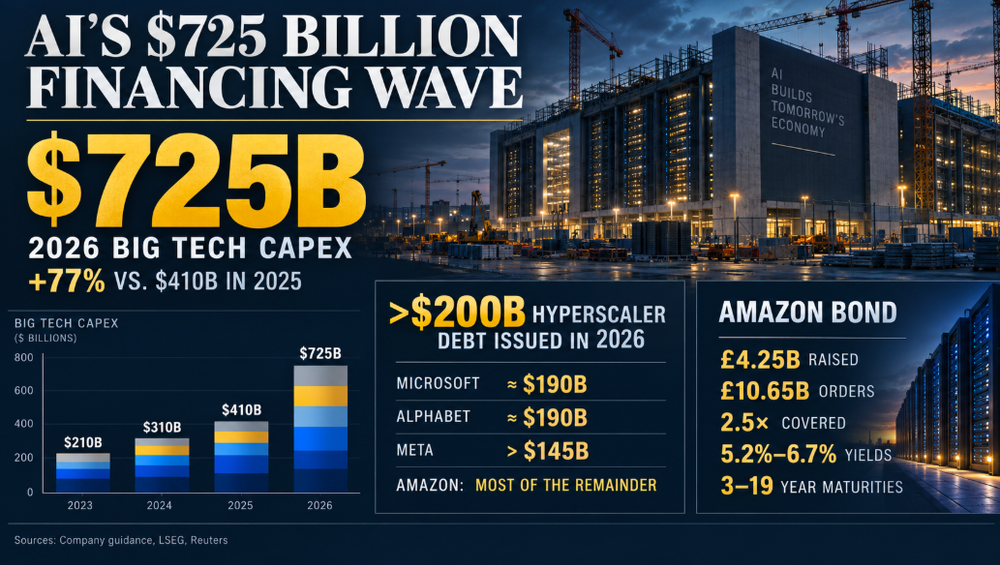
Estimates compiled from company guidance put combined 2026 capital spending by Amazon, Alphabet, Microsoft and Meta near $725 billion, up about 77% from $410 billion in 2025. Alphabet and Microsoft are each around $190 billion, Meta is above $145 billion, and Amazon accounts for most of the remainder.
On September 9, Amazon raised £4.25 billion, or $5.76 billion, in its first sterling bond sale. Orders reached £10.65 billion, about 2.5 times the amount issued. Maturities ranged from three to 19 years, with yields from 5.2% to 6.7%. Hyperscalers have issued more than $200 billion of debt in 2026, over twice the 2025 total. Amazon’s order coverage was only half the five-times demand attracted by Alphabet in February. Reuters
A data center financed at 6% has a higher return threshold than one funded from excess cash. If AI revenue takes longer to arrive, depreciation, interest expense and underused capacity can pressure earnings.
Electricity demand is already moving national forecasts
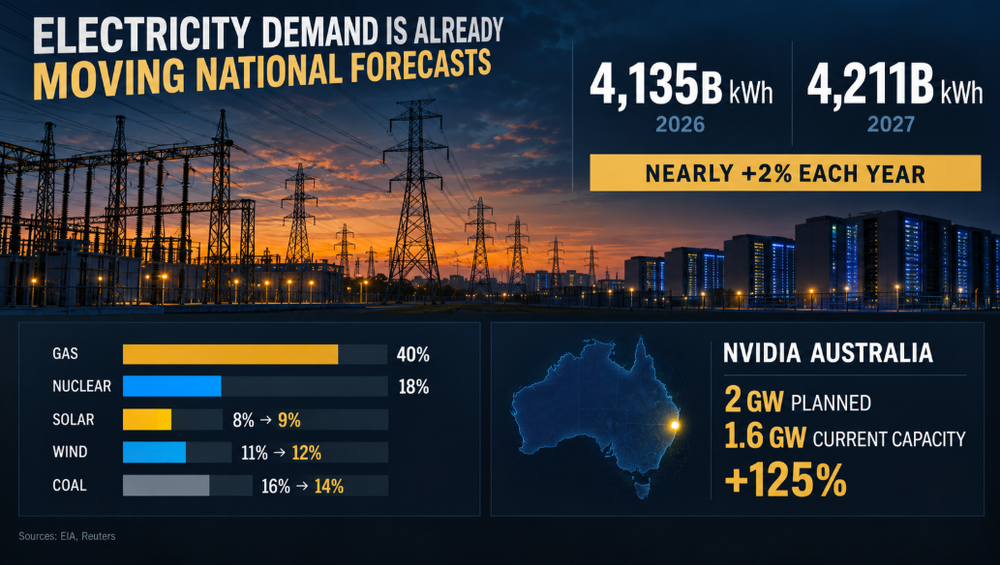
The U.S. Energy Information Administration expects electricity sales to reach a record 4,135 billion kWh in 2026 and 4,211 billion kWh in 2027, increases of almost 2% each year. Commercial customers account for 63% and 56% of the respective increases; industrial demand contributes 22% and 36%.
Natural gas is forecast at 40% of generation in both years, nuclear at 18%, solar rises from 8% to 9%, wind from 11% to 12%, and coal falls from 16% to 14%.
New projects keep making the forecast tangible. Nvidia and its Australian partners are targeting up to 2 GW of AI capacity by 2027. Australia currently has only 1.6 GW of computing capacity, so the planned addition equals 125% of today’s installed base.
Where the revenue can flow
The first layer is generation. Constellation Energy and Vistra offer existing nuclear and gas fleets, while Oklo offers longer-dated nuclear optionality. GE Vernova, Eaton and Quanta Services supply turbines, switchgear, transformers and grid construction. Inside the facility, Vertiv supplies power and cooling systems while semiconductor companies provide optical links and power conversion.
STMicroelectronics offers a useful example of how revenue is spreading beyond processors. Management expects more than $2 billion of AI data-center revenue in 2027, with approximately 80% coming from optical data links and the remaining 20% from cooling and power-conversion chips. That implies more than $1.6 billion from optics and roughly $400 million from the other two categories.
Valuation is the difficulty. At a market snapshot around 11:40 UTC on September 10, Constellation and Vistra traded near 25.9 and 25.5 times trailing earnings, GE Vernova near 27.3 times, Eaton near 42 times and Vertiv near 59.5 times. Investors need growth and cash conversion strong enough to support those multiples.
The risk hiding inside the opportunity
The IEA estimates that about 20% of planned data-center projects could be delayed if grid risks are not resolved. New transmission lines can take four to eight years in advanced economies, while waiting times for transformers and cables have doubled in three years. Gas-turbine delivery slots can extend beyond 2030.
Efficiency could also reduce demand. In the IEA’s high-efficiency case, data-center electricity use in 2035 is 20% below its base case.
That leaves investors with a more demanding question than whether AI will consume more power. The key is which companies can turn shortages into profitable revenue before new capacity, better chips or more efficient models weaken pricing.
The figures to watch are energized megawatts, backlog conversion, delivery times, operating margins, free cash flow and customer financing. The hottest AI trade may now sit outside the GPU, but the winners will still be decided by returns on capital.
Disclosure: The author may hold positions in securities mentioned in this article. This material is provided for informational purposes only and does not constitute financial advice or a recommendation to buy or sell any security. Investors should conduct their own research and consider their objectives and risk tolerance.

Marc has been involved in the Stock Market Media Industry for the last +5 years. After obtaining a college degree in engineering in France, he moved to Canada, where he created Money,eh?, a personal finance website.