The United States and China are building competing artificial-intelligence ecosystems, but their companies, investors and supply chains remain deeply connected. This week’s summit may determine whether that rivalry stays manageable or becomes a much more disruptive technology conflict. When Chinese President Xi Jinping arrives in Washington this week, tariffs, rare-earth exports, agricultural purchases, Taiwan and Iran are all expected to feature in talks with President Donald Trump. For investors, AI connects many of these issues.
Advanced chips require specialised equipment and critical minerals, while data centres need enormous amounts of electricity. Washington wants to protect its AI lead without causing a supply-chain shock. Beijing wants access to advanced technology while pursuing self-sufficiency.
- The most realistic positive outcome is managed competition, including an extended trade truce, steadier rare-earth supplies and a limited AI-risk communication system.
- U.S. restrictions may slow China’s access to advanced technology, but they are also accelerating investment in Chinese chips, models and data centres.
- Nvidia, AMD, Apple, Tesla, Alibaba, semiconductor-equipment companies and rare-earth producers could all react to the summit, but for very different reasons.
AI Has Become a Supply-Chain Contest
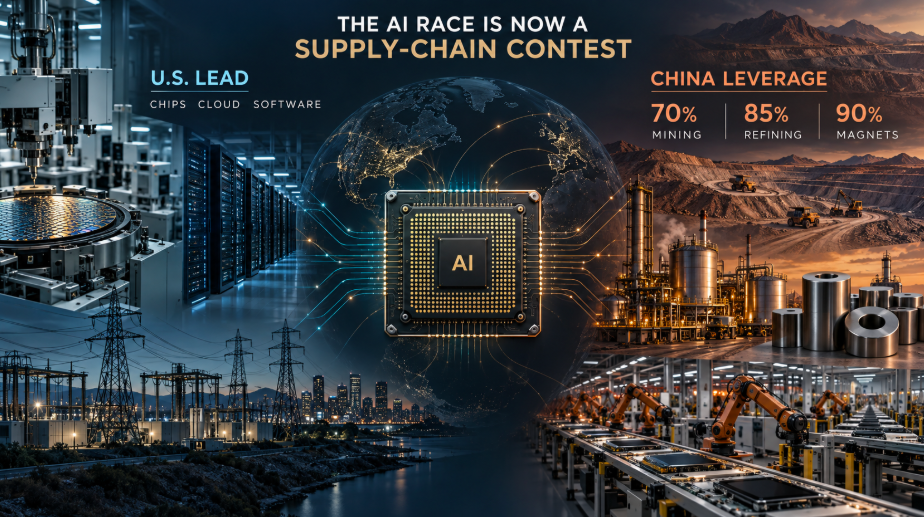
The first AI investment cycle focused on software models and advanced processors. The next phase is becoming a contest over the entire technology stack, including minerals, fabrication equipment, networking, electricity and cloud infrastructure.
The United States still controls many of the highest-value parts of that stack through companies such as Nvidia, AMD, Broadcom, Microsoft, Alphabet and Amazon. It is also building a network of allied countries through its Pax Silica initiative, which aims to secure the supply chains supporting semiconductors and AI infrastructure.
China offers enormous manufacturing capacity, a large domestic market and significant control over critical minerals. Estimates cited ahead of the summit indicate that China controls around 70% of rare-earth mining, 85% of refining capacity and about 90% of alloy and magnet production. That gives Beijing leverage over electronics, electric vehicles, aerospace and defense.
Export Controls Are Creating Two AI Ecosystems
Washington restricts China’s access to advanced chips and chipmaking technologies. The Commerce Department reviews exports of processors such as Nvidia’s H200 and AMD’s MI325X individually, while tighter controls apply elsewhere. The intention is to preserve the U.S. lead, but the policy may also accelerate Chinese substitution.
Alibaba illustrated that point this week with its Zhenwu V900 AI processor, which it says delivers three times the performance of its predecessor. The company also plans to expand data-centre capacity beyond 20 gigawatts by 2032 and develop a model with up to 10 trillion parameters.
Alibaba shares rose after the announcement. The market’s reaction showed that investors increasingly view Chinese AI self-sufficiency as an investable theme rather than only a response to sanctions.
The likely result is two increasingly independent systems, each with its own chips, cloud providers, models and strategic partners.
Capital Is Still Crossing the Divide
The financial relationship is more interconnected than the political rhetoric suggests.
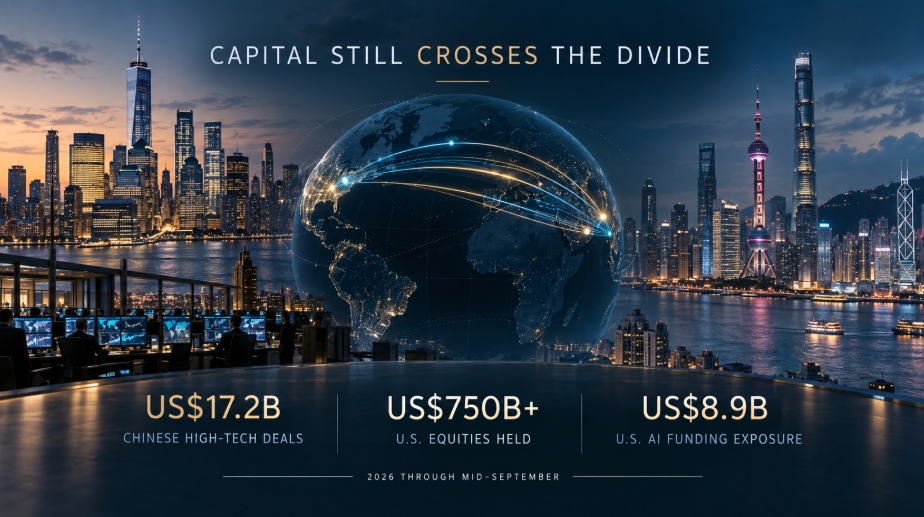
Wall Street banks have acted as bookrunners on 19 Chinese high-technology equity deals worth US$17.2 billion in 2026, nearly 30% of the sector’s issuance. Meanwhile, U.S. equities held by investors in mainland China and Hong Kong have risen 23% in value to more than US$750 billion.
Chinese exposure can also be found in AMD, Micron, Lam Research and Applied Materials. U.S. AI funding rounds involving investors from China or Hong Kong reportedly increased from US$436 million in 2023 to US$8.9 billion through mid-September 2026.
The governments are building separate strategic systems while investors allocate capital to both. That connection may discourage a sudden breakdown, but it could also transmit any deterioration through global portfolios.
What Trump and Xi Each Want
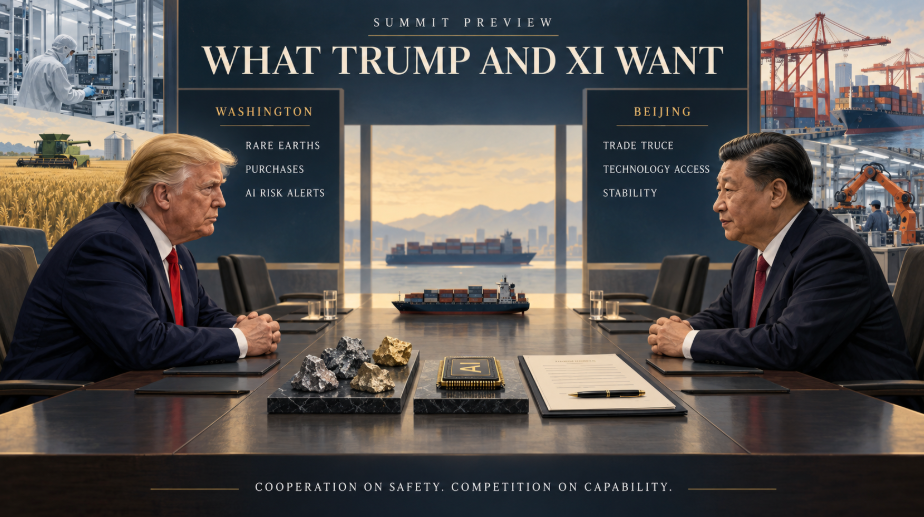
Trump enters the meeting seeking visible economic agreements. The tariff truce expires on November 10 after stopping a confrontation in which threatened duties exceeded 100%. An extension would reduce uncertainty for manufacturers and technology companies.
Washington also wants improved rare-earth shipments, agricultural purchases and possibly additional aircraft orders. On AI, the two sides have discussed a notification system for common threats and serious incidents.
Xi wants the truce extended, fewer restrictions on Chinese technology companies and greater certainty around access to Western products. He is unlikely to accept an agreement permanently limiting China’s AI infrastructure.
Both leaders may therefore support narrow cooperation on AI safety while continuing to compete aggressively on commercial capability.
The Companies Most Exposed
Nvidia and AMD would benefit from more predictable licensing, although Washington is unlikely to remove its broader security restrictions. Applied Materials and Lam Research face similar uncertainty because Chinese demand remains important.
Apple generated more than US$64 billion in Greater China revenue last year and still relies heavily on Chinese manufacturing. Tesla generated nearly US$21 billion there and operates its major Shanghai factory.
Alibaba represents the other side of the trade. Restrictions on U.S. technology create short-term challenges, but they also strengthen demand for domestic Chinese chips, cloud infrastructure and AI models.
Rare-earth companies could move in the opposite direction. Stable Chinese exports may reduce scarcity fears, while renewed confrontation could increase interest in non-Chinese producers. Many alternatives remain early-stage and highly speculative.
Three Possible Market Outcomes
| Summit outcome | What it could include | Likely market reaction |
|---|---|---|
| Managed competition | Trade-truce extension, steadier mineral exports and an AI-risk notification system | Positive for semiconductors, industrial companies and broader risk sentiment |
| Symbolic agreement | Friendly language but few changes to export controls or trade commitments | Initial relief followed by renewed focus on company earnings and AI spending |
| Renewed confrontation | Tighter chip controls, weaker mineral flows or escalation over Taiwan | Pressure on technology and manufacturing, with support for domestic supply-chain and rare-earth themes |
Managed competition appears to be the most realistic outcome. Neither government is likely to abandon its strategic goals, but both have strong reasons to prevent the competition from becoming economically destructive. This is an inference based on their stated desire for stability and the continuing financial connections between the two economies.
What Investors Should Watch
The summit should not be judged by whether Trump and Xi declare it successful. Investors should focus on the details.
The most important signals will be the length of any tariff-truce extension, the language surrounding advanced-chip licences, concrete commitments on rare-earth exports and whether the proposed AI notification system becomes operational.
A constructive summit could lower the geopolitical risk attached to technology stocks. It would not end the rivalry. The United States and China will continue building competing ecosystems while preserving enough trade to avoid destabilising the global economy.
The winners may not be limited to one country. Opportunities could emerge among companies supplying both ecosystems, replacing restricted imports or securing the minerals, energy and infrastructure that AI requires.
Disclaimer
This article is for informational and educational purposes only and is not investment advice, a recommendation or an offer to buy or sell securities. The author may hold or may initiate positions in companies or securities discussed.
Political negotiations, export controls and trade policies can change rapidly. Investors should review current company disclosures and conduct their own due diligence.

Marc has been involved in the Stock Market Media Industry for the last +5 years. After obtaining a college degree in engineering in France, he moved to Canada, where he created Money,eh?, a personal finance website.