With SekurOne approaching launch, government procurement access and a high-level defense network in place, the company has built its clearest path toward recurring revenue.
After a year of repositioning, Sekur Private Data Ltd. (OTCQB: SWISF; CSE: SKUR) is entering the phase investors have been waiting for: paid beta onboarding in September and the commercial launch of SekurOne in October.
- SekurOne enters monetization with paid beta onboarding in September and an October launch at US$300 per month.
- GSA access, Elyon, DoDIIS and high-level advisers have created a credible government sales engine.
- At roughly US$0.03 per share, successful contract conversion could materially reshape SWISF’s revenue base and valuation.
The defense pivot is becoming a real sales platform
Sekur’s latest shareholder update suggests its move into government and defense markets is advancing from strategy to commercial execution. Through i3ICS, SekurOne is positioned for sales through the U.S. General Services Administration framework. Its relationship with Elyon International adds another government-contracting channel, while participation in the December 2026 DoDIIS Worldwide Conference should put Sekur before defense and intelligence decision-makers.
The company has also assembled advisers with backgrounds spanning the CIA, Pentagon, U.S. Special Operations and State Department. That network strengthens credibility, sharpens the product’s fit for sensitive users and may help turn introductions into contract opportunities.
SekurOne could transform the revenue model
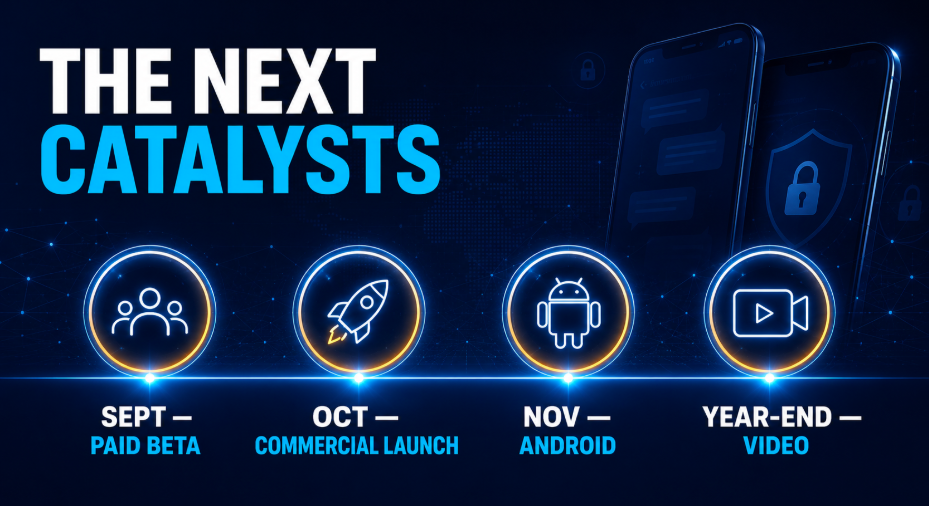
SekurOne combines encrypted messaging, email, VPN, password management and file sharing in one Swiss-hosted platform. Paid beta begins in September, followed by iOS and web access in early October, Android in early November and video conferencing by year-end.
At US$300 per user per month, every customer matters. Management estimates that approximately 200 subscribers would generate US$60,000 in monthly recurring revenue, or US$720,000 annually, and could bring the company to profitability. At an exchange rate near C$1.385 per U.S. dollar, that equals roughly C$1.0 million in annual recurring revenue.
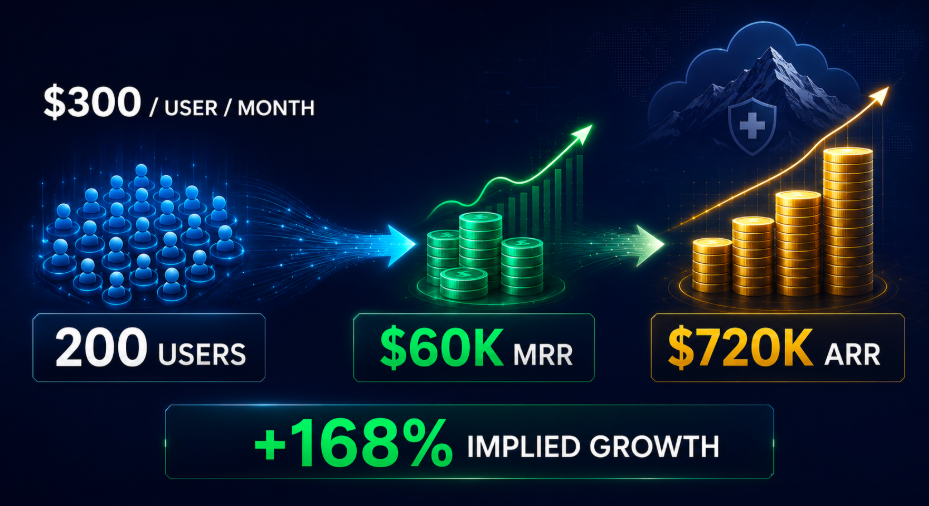
The implied growth is substantial. Sekur reported C$185,828 of revenue in the first half of 2026, an annualized pace of about C$372,000. The 200-user SekurOne case alone would therefore equal roughly 2.7 times that run-rate—an increase of approximately 168%. If the legacy business stabilizes near its first-half pace, combined annualized revenue could approach C$1.37 million, more than triple FY2025 revenue of C$408,707 and implying growth of about 235%. This is illustrative arithmetic based on management’s subscriber target, not company guidance.
A stronger financial foundation
Sekur finished June with C$1.53 million in cash, C$1.57 million in working capital and only C$244,632 in total liabilities. That balance sheet gives management room to complete the product rollout and pursue contracts without carrying a heavy debt burden.
The financial statements still show an early-stage company: first-half revenue declined and the net loss was C$2.18 million. However, a meaningful portion reflected share-based compensation and shares issued for consulting services. Management also reported a 25% July increase in average revenue per user and highlighted six months of insider buying with no insider sales—an encouraging alignment signal.
SWISF’s small valuation creates asymmetric potential
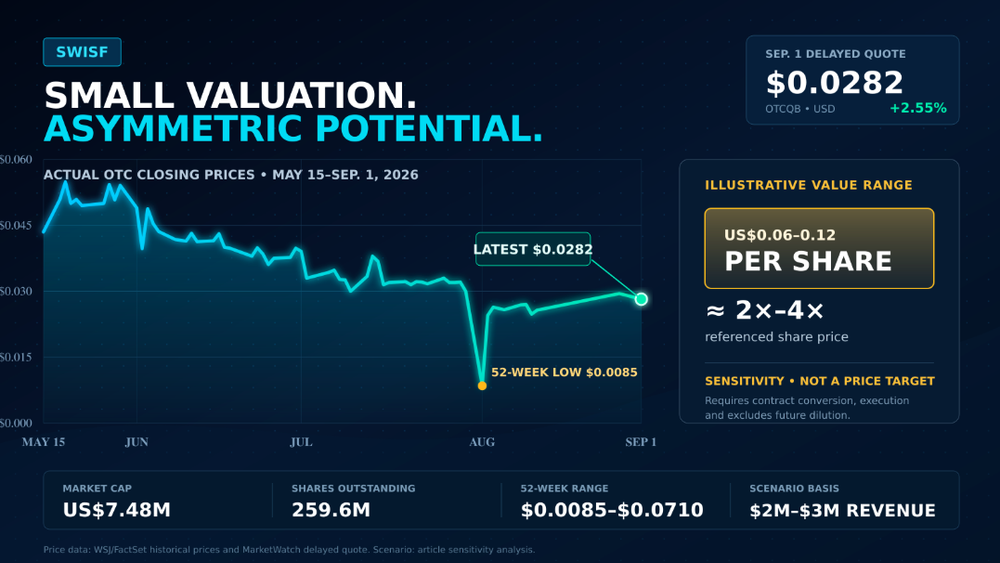
Using the last confirmed OTC close of approximately US$0.0295 and about 259.6 million shares outstanding, SWISF carried an equity value of roughly US$7.5–8 million. That modest base means successful prospect conversion could have an outsized effect. If Sekur’s U.S. government, defense and African opportunities eventually build recurring revenue to US$2–3 million, the business would be producing roughly seven to ten times its FY2025 revenue in U.S.-dollar terms.
Applying an illustrative 8–10 times forward recurring-revenue multiple would imply an equity value of US$16–30 million, or approximately US$0.06–0.12 per share before future dilution—roughly two to four times the referenced share price. This is a sensitivity analysis, not a price target: it requires strong execution, durable contracts and renewed investor confidence, and it does not account for additional financing or dilution.
Africa could add another growth layer
The opportunity is not limited to the United States. Sekur said discussions in Angola could lead to an exclusive nationwide agreement, while a senior adviser in the Democratic Republic of Congo has given the product a positive recommendation. Neither opportunity should be treated as booked revenue, but both could become meaningful catalysts.
A government deployment covering hundreds or thousands of users would move the company well beyond the 200-subscriber profitability case and demonstrate that SekurOne can scale across jurisdictions where secure communications are a strategic priority.
The next catalysts are close
Investors now have a clear sequence to watch: paid beta onboarding in September, the first commercial launch in October, Android availability in November, video conferencing by year-end and, most importantly, the conversion of the government and international pipeline into named, revenue-producing contracts.
Sekur remains a speculative microcap, but the opportunity is becoming easier to quantify. A differentiated Swiss-hosted product, premium pricing, federal procurement access, credible defense relationships and a relatively clean balance sheet have created the company’s strongest commercial setup to date.
If management converts even a portion of its pipeline, 2027 could mark the point when Sekur’s ambitious security strategy begins showing up decisively in revenue—and potentially in the share price.
Disclaimer
This article is for informational and educational purposes only and is not investment advice, a recommendation or an offer to buy or sell securities. Sekur Private Data is a speculative microcap company with operating losses and significant execution, liquidity, financing and dilution risks. The valuation examples are illustrative sensitivities—not forecasts or price targets—and actual results may differ materially. Investors should review the company’s regulatory filings and conduct their own due diligence.

Marc has been involved in the Stock Market Media Industry for the last +5 years. After obtaining a college degree in engineering in France, he moved to Canada, where he created Money,eh?, a personal finance website.