Washington says the new duties will punish unfair Canadian trade practices. Investors should ask a different question: when two economies share factories, suppliers and consumers, can either side impose pain without importing some of it back?
After negotiations collapsed, the United States activated 50% tariffs on approximately $20 billion of Canadian goods. Canada immediately promised a dollar-for-dollar response, while President Donald Trump threatened to extend the 50% rate to all Canadian cars, trucks and automotive parts from January 1.
The immediate package is narrower than the headline suggests. The escalation risk is not.
- The new 50% tariffs cover roughly $20 billion of Canadian imports—about 5.2% of the goods the U.S. imported from Canada in 2025—not all Canadian trade.
- The duties are collected from U.S. importers, and New York Fed research found that nearly 90% of the economic burden from America’s 2025 tariffs fell on U.S. firms and consumers.
- The greater market risk is retaliation and contagion: Canada’s countertariffs begin September 8, while a threatened 50% auto tariff could disrupt production on both sides of the border.
What actually happened
The duties took effect on August 22 after a three-day extension failed to produce an agreement. They apply to selected dairy products, alcoholic beverages and a broad list of goods including furniture, electronics, building materials, clothing, sporting goods and agricultural products. Despite one list being associated with “motor vehicles,” it contains no finished cars. This is not a blanket 50% tariff on every Canadian product.
The White House says the measures respond to Canadian discrimination against U.S. dairy, alcohol and vehicle exports. The administration invoked Section 338 of the Tariff Act of 1930, an authority allowing tariffs of up to 50% against countries judged to discriminate against American commerce. Reuters described this as the law’s first known use in nearly a century.
The most consequential detail is that covered goods lose preferential treatment even when they comply with the United States-Mexico-Canada Agreement. Energy, potash, critical minerals, fish and products already subject to separate Section 232 tariffs are excluded.
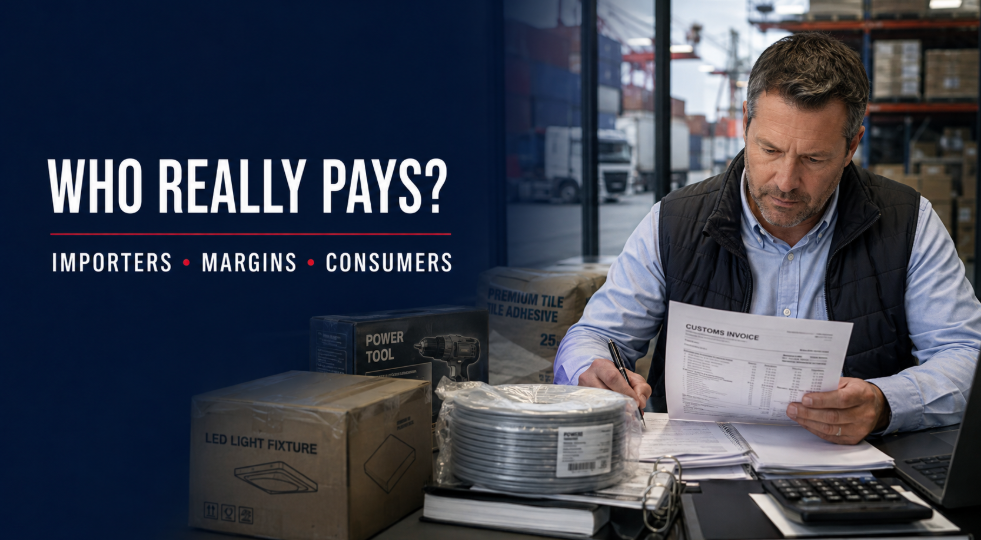
Who really pays a tariff?
Politicians often speak as if the foreign country writes the tariff check. It does not.
The legal payment is made by the importer bringing the product into the United States. The Canadian producer can cut its price, the American importer can accept a smaller margin, or the retailer can charge customers more. In practice, the burden is divided—but much of it remains inside the United States.
Researchers at the Federal Reserve Bank of New York found that nearly 90% of the economic burden from the 2025 U.S. tariffs fell on American firms and consumers. Separate New York Fed surveys found that about 80% of affected firms passed at least part of their higher import costs to customers, while roughly 60% also absorbed some through their margins.
If targeted imports continued unchanged, the gross annual tariff bill could theoretically approach $10 billion. Actual collections will be lower if trade volumes fall or buyers switch suppliers. But that adjustment can still mean higher prices, disrupted contracts, lower profits and lost sales.
Why Canada is not just another supplier
Canada is deeply embedded in American production. U.S. goods and services trade with Canada totaled an estimated $872.3 billion in 2025, including $715.5 billion in goods trade. Canada was also the leading destination for U.S. exports in 2024.
Tariffs on finished goods can protect a competing domestic producer, but tariffs on inputs raise that producer’s own costs. New York Fed research on the previous U.S.-China trade war found that input tariffs weakened many American companies and that tariff announcements broadly reduced U.S. equity valuations.
That logic matters most in autos. On August 24, Trump threatened 50% tariffs on all Canadian cars, trucks and automotive parts beginning January 1. The measure has not taken effect and may be intended to restart talks. But penalizing Canadian components could raise costs—or interrupt assembly—at U.S. plants that depend on them.
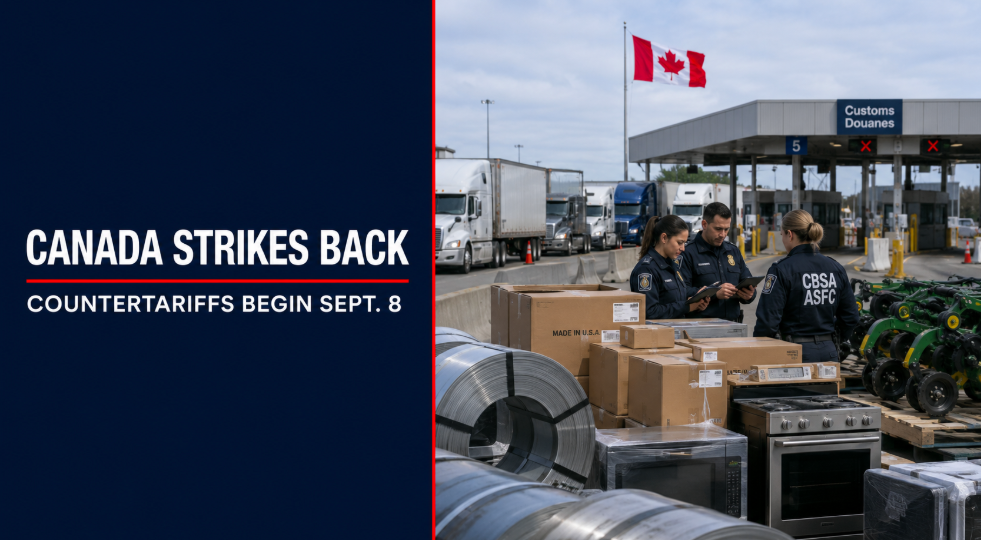
Canada is preparing to strike back
Prime Minister Mark Carney suspended negotiations and announced that Canadian countertariffs will begin September 8. Ottawa says its response will target U.S. steel, dairy, appliances, agricultural equipment, pulp and paper, electronics and other goods.
The initial U.S. package covers only a small portion of bilateral trade, but retaliation exposes American exporters and uncertainty can delay investment. Investors should monitor importers with limited pricing power, construction supply chains, manufacturers using Canadian inputs, automakers and U.S. companies with significant Canadian sales.
Domestic producers may gain where substitutes are available—but protection becomes less valuable when their own inputs are taxed.
The political gamble
The bullish case is that short-term pain creates long-term leverage: a 50% wall may force Canada back to the table, protect sensitive industries and encourage U.S. production.
The bearish case is that factories cannot be recreated as quickly as duties can be imposed. Location decisions take years; tariffs raise costs immediately. If Canada responds in kind, both governments may claim toughness while companies and households absorb the bill.
This is less a $20 billion trade story than a test of whether USMCA still provides dependable rules for North American investment.
The bottom line
The current tariffs alone are too targeted to break either economy. But they establish a dangerous precedent: even compliant goods from America’s closest trading partner can lose preferential treatment when negotiations fail.
If the dispute remains contained, the damage may stay concentrated. If auto tariffs and Canadian retaliation expand, investors may discover that a trade war between neighbors is not fought at the border—it travels through factories, margins and consumer prices on both sides.
Washington may have imposed the tariff on Canada. That does not mean Canada will be the only country paying for it.
This article is provided for informational and educational purposes only and does not constitute investment, financial, legal or tax advice, or a recommendation to buy or sell any security. The author may hold positions in companies or sectors mentioned in this article. Opinions are current only as of publication and may change without notice. Readers should conduct their own research and consider their objectives, risk tolerance and financial circumstances before making investment decisions. Past performance is not indicative of future results.

Marc has been involved in the Stock Market Media Industry for the last +5 years. After obtaining a college degree in engineering in France, he moved to Canada, where he created Money,eh?, a personal finance website.