Nvidia is expected to nearly double quarterly revenue, yet its valuation has fallen toward pre-boom levels. Wednesday’s report will test more than one stock: it could determine whether investors keep funding the entire AI trade.
Nvidia enters its fiscal second-quarter earnings report in an unusual position. Its business is growing at a pace almost without precedent for a company worth roughly $5 trillion, while its shares have fallen for seven consecutive sessions and its forward valuation has compressed to around 23–25 times earnings.
That looks cheap beside Nvidia’s growth rate—and even beside slower semiconductor companies. But the discount may contain a warning: investors increasingly doubt whether today’s extraordinary earnings estimates can survive the next stage of the AI investment cycle.
- Wall Street expects approximately $92 billion in revenue and $2.09 in adjusted earnings per share, both nearly double the previous year.
- Nvidia’s forward P/E has fallen into the low-to-mid 20s because earnings estimates have risen much faster than the stock—not necessarily because risk has disappeared.
- The decisive number may be Nvidia’s next-quarter guidance, because the entire AI ecosystem is trading on the assumption that demand will continue beyond $100 billion per quarter.
The expectations are already enormous
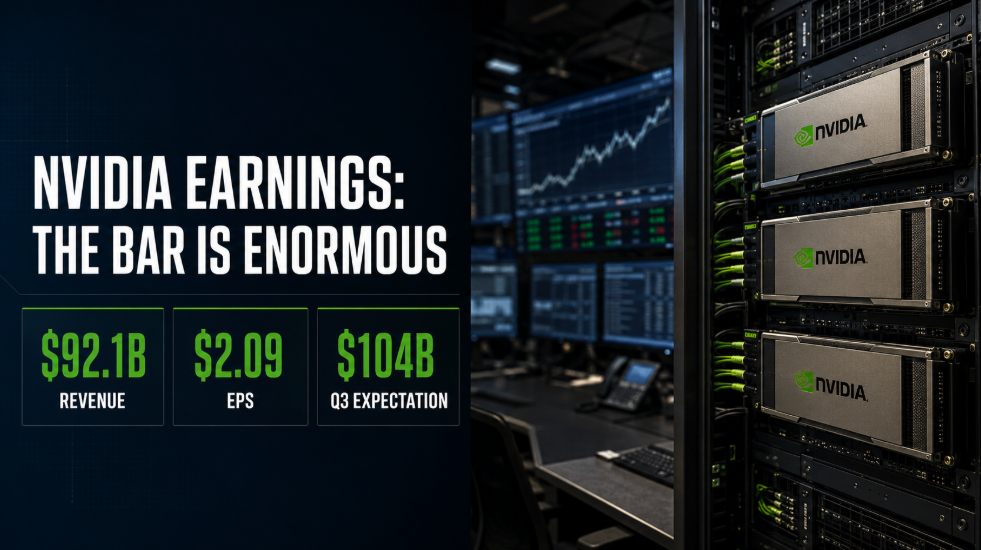
Nvidia reports after the market closes on Wednesday, August 26. Consensus estimates point to approximately $92.1 billion in revenue and $2.09 in adjusted EPS. Analysts expect data-center revenue near $86 billion, meaning a single division could generate almost twice Nvidia’s total company revenue from the same quarter one year earlier.
Management previously guided to $91 billion, plus or minus 2%, while assuming no data-center compute revenue from China. It also projected an adjusted gross margin of approximately 75%.
The headline numbers are important, but the October-quarter outlook matters more. Wall Street expects roughly $104 billion in Q3 revenue. Nvidia therefore needs to demonstrate that it can add another $12 billion of quarterly sales while navigating the Vera Rubin transition, expensive memory components, supply constraints and an uncertain Chinese market.
A modest Q2 beat accompanied by cautious guidance may no longer be enough.
Why Nvidia suddenly looks cheap
At approximately $208, Nvidia trades at around 23–25 times forward earnings. That multiple appears remarkably modest for a company whose first-quarter revenue rose 85% and whose data-center revenue expanded 92%.
But a forward P/E contains two variables: price and expected earnings. Nvidia looks inexpensive partly because analysts are forecasting a huge increase in future profits. If those estimates are accurate, the stock may genuinely be undervalued. If AI spending slows, the denominator falls and the apparent bargain can disappear quickly.
The market is effectively saying that current profitability is exceptional—but may not deserve an exceptional multiple forever.
The de-risking has already started
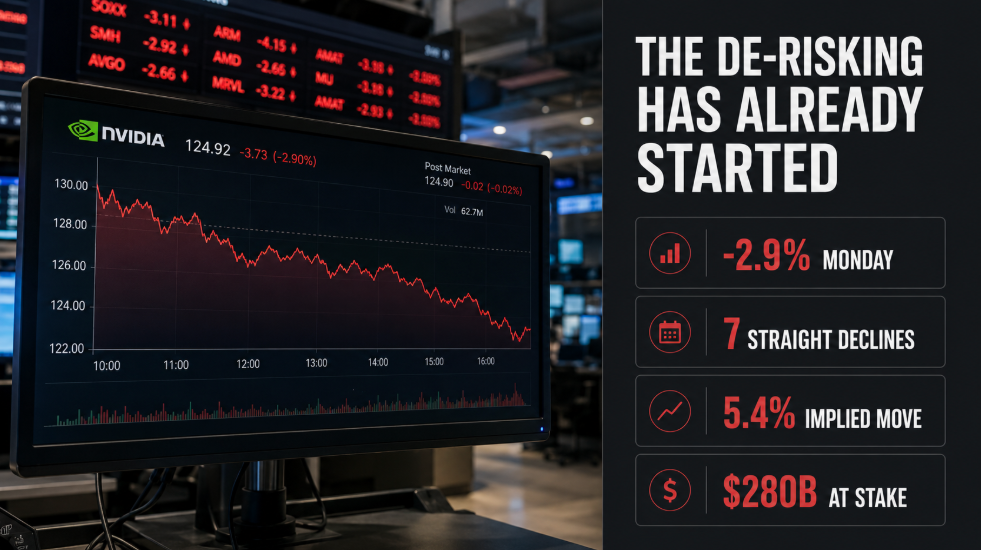
Nvidia fell 2.9% on Monday, completing its seventh consecutive decline, while semiconductor and high-beta AI stocks sold off more aggressively. The retreat has spread into names such as Nebius, Palantir and Innodata because investors are reducing exposure before the industry’s most important earnings event.
Options markets imply an approximately 5.4% post-earnings move, equivalent to nearly $280 billion of market value. Interestingly, that is below Nvidia’s historical earnings-day average. Investors expect volatility, but fewer appear to expect the spectacular upside surprises that characterized the early AI boom.
This explains the apparent contradiction: Nvidia can be operationally dominant and still struggle as an investment if expectations have reached their ceiling.
Nvidia is the AI market’s economic report card
Nvidia no longer trades like an isolated chipmaker. Its order book is a real-time indicator of whether Microsoft, Amazon, Alphabet, Meta, sovereign governments and AI laboratories are continuing to build infrastructure.
A strong outlook would support the entire supply chain: advanced semiconductors, networking, optical components, memory, servers, data centers and AI-data providers. A weak outlook would raise immediate questions about companies whose valuations depend on Nvidia-powered capacity, including neoclouds and smaller AI service providers.
The concern is no longer simply demand. Investors want to know how that demand is financed and whether customers can earn adequate returns. Nvidia recently partnered with major financial institutions to mobilize more than $500 billion for AI infrastructure.
That could expand the market dramatically—but it also intensifies questions about leverage and circular financing.
What investors should watch
The clean bullish outcome would combine a meaningful revenue beat, Q3 guidance above approximately $104 billion, gross margins holding near 75%, an on-time Rubin ramp and evidence that Chinese H200 shipments represent additional demand rather than displaced sales.
The bearish outcome is subtler than an earnings miss. Nvidia could beat Q2 expectations but signal slower sequential growth, weaker margins or more cautious customer spending. That would tell investors that the AI boom remains real, but its most explosive phase may be ending.
The bottom line
Nvidia’s valuation looks cheap because the company has grown into its share price. It may also look cheap because the market no longer believes that near-doubling revenue can continue indefinitely.
Wednesday’s report will decide which interpretation is closer to reality. If Nvidia proves that another $100 billion-plus quarter is only the beginning, the recent AI selloff could become a reset and buying opportunity. If guidance disappoints, the market may conclude that Nvidia was not undervalued—it was pricing in peak expectations before analysts recognized them.
Either way, Nvidia will not move alone. The company has become the earnings report for the entire AI economy.
This article is provided for informational and educational purposes only and does not constitute investment, financial, legal or tax advice, or a recommendation to buy or sell any security. The author may hold positions in companies or sectors mentioned. Opinions are current only as of publication and may change without notice. Readers should conduct their own research and consider their objectives, risk tolerance and financial circumstances before making investment decisions. Past performance is not indicative of future results.

Marc has been involved in the Stock Market Media Industry for the last +5 years. After obtaining a college degree in engineering in France, he moved to Canada, where he created Money,eh?, a personal finance website.