Moderna’s personalized cancer vaccine sent its shares soaring. The bigger story may be that artificial intelligence is beginning to move from generating digital content to designing treatments for individual patients.
For years, the AI investment boom centered on chips, data centers and cloud computing. Investors rewarded almost anything connected to rising compute demand. Then Moderna’s stock more than doubled in a single session. The catalyst was a positive Phase 3 trial for an experimental personalized mRNA cancer therapy—and AI helped design it.
- Moderna and Merck produced the first positive Phase 3 result for an individualized neoantigen therapy and an mRNA-based cancer treatment.
- Moderna uses AI algorithms to analyze each patient’s tumor and blood data and select up to 34 mutations most likely to provoke an immune response.
- The result strengthens the AI-biotech thesis, but Moderna’s extraordinary rally already assumes success extending beyond melanoma.
What Moderna actually proved
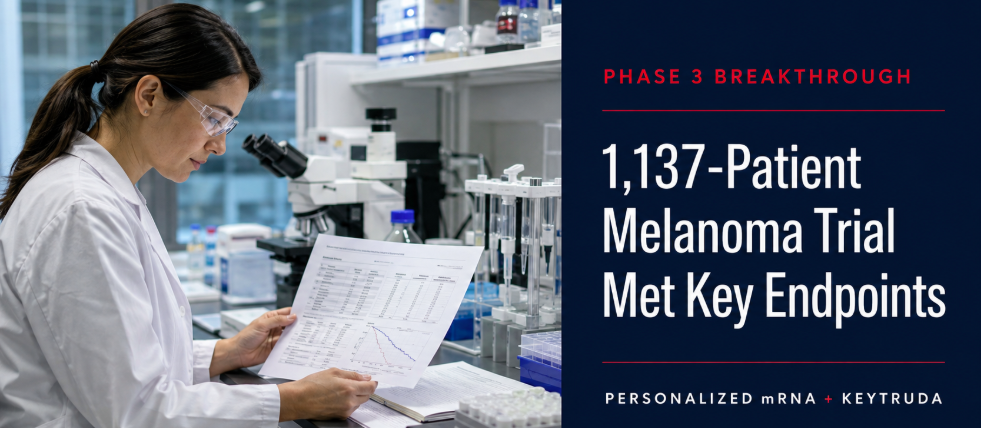
On August 19, Moderna and Merck announced that intismeran autogene, used alongside Merck’s Keytruda, met the primary endpoint of recurrence-free survival and a key secondary endpoint measuring distant metastasis-free survival in patients whose high-risk melanoma had been surgically removed.
The 1,137-patient Phase 3 trial produced statistically significant and clinically meaningful improvements over Keytruda alone, according to the companies, without revealing a new safety signal. The study will continue to evaluate overall survival, while detailed data will be presented at an upcoming medical meeting and shared with regulators.
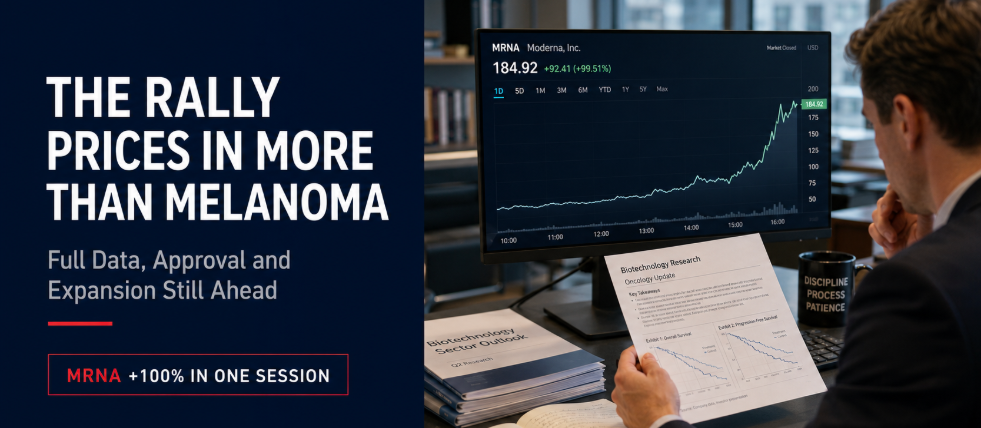
The announcement sent Moderna shares up more than 100%, adding approximately $30 billion to its market value.
Investors were pricing in more than melanoma: the possibility that Moderna’s platform could become a repeatable engine for personalized cancer treatments.
This is where AI becomes more than a buzzword
Intismeran is not a conventional vaccine manufactured identically for millions of people. Every dose is designed around the unique mutations found in one patient’s tumor.
According to Moderna, integrated AI algorithms analyze next-generation sequencing data from tumor and blood samples, examine genetic mutations and predict up to 34 neoantigens most likely to trigger an immune response. Those selections are then encoded into a personalized strand of synthetic mRNA intended to teach the immune system to recognize the patient’s cancer.
AI also coordinates separate production schedules, quality controls and delivery deadlines for thousands of individualized batches. Here, AI is embedded in the therapy’s design and production.
That distinction is crucial for investors. The first phase of the AI boom monetized computation. AI-biotech could monetize improved medical outcomes.
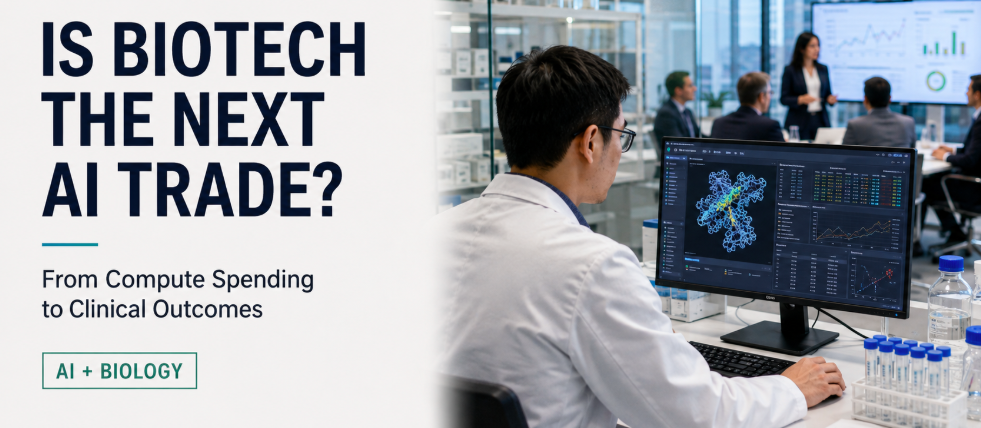
Could biotech become the next major AI trade?
Large pharmaceutical companies are already committing serious capital. Eli Lilly expanded its AI-drug-discovery partnership with Insilico Medicine in a deal worth up to $2.75 billion. Other companies are using machine learning to identify drug targets, design molecules, predict protein interactions, select patients and improve clinical trials.
AI does not need to eliminate a decade of development to create value. Modestly improving success rates—or terminating failed programs earlier—could save pharmaceutical companies years of spending.
The likely winners may not be those marketing “AI” most aggressively. They will combine proprietary biological data, clinical validation, strong partnerships, sufficient cash and scalable manufacturing.
Moderna’s rally also carries a warning
The complete Phase 3 data are not yet public, overall-survival analysis continues, and regulatory approval is not guaranteed.
Moderna also remains a loss-making company. It reported only $145 million of second-quarter revenue, a net loss of approximately $782 million and $6.9 billion in cash and investments before the trial announcement.
Its valuation now assumes intismeran can expand well beyond melanoma. Reuters Breakingviews estimated that the roughly $30 billion one-day increase implied around $13 billion in eventual annual sales, despite Moderna sharing profits with Merck and commercialization still being years away.
The rally is not necessarily irrational: Moderna and Merck are studying the platform across lung, bladder, kidney and other cancers. But investors are paying today for victories that have not happened yet.
The bottom line
Moderna has demonstrated that AI-assisted design can contribute to a product that survives biotechnology’s hardest test: a large, late-stage clinical trial.
The next AI trade may indeed be biotech. But this market will not ultimately reward models, computing power or impressive partnerships alone. It will reward companies that turn data into therapies, therapies into clinical results and clinical results into durable revenue.
Moderna may have given investors the first glimpse of that transition.
This article is provided for informational and educational purposes only and does not constitute investment, financial, medical, legal or tax advice, or a recommendation to buy or sell any security. The author may hold positions in companies or sectors mentioned in this article. Opinions are current only as of publication and may change without notice. Readers should conduct their own research and consider their objectives, risk tolerance and financial circumstances before making investment decisions. Past performance is not indicative of future results.

Marc has been involved in the Stock Market Media Industry for the last +5 years. After obtaining a college degree in engineering in France, he moved to Canada, where he created Money,eh?, a personal finance website.