The latest market decline has created a frustrating contradiction for investors. Companies continue to report growing revenue, improving profitability and stronger order pipelines—yet their share prices keep falling.
In many cases, the explanation has less to do with individual company performance and more to do with a broader repricing of risk. Rising oil prices, renewed inflation concerns and higher bond yields are creating an increasingly difficult environment for technology stocks and smaller companies.
One Stop Systems offers a useful case study. Its stock has fallen sharply even though revenue, bookings and institutional ownership data have generally moved in a positive direction.
- Oil and bond yields are driving a wider risk-off movement.
- Small caps are absorbing more pressure than large companies.
- OSS shows why business execution and share-price performance can temporarily diverge.
Oil Is Bringing Inflation Back Into Focus
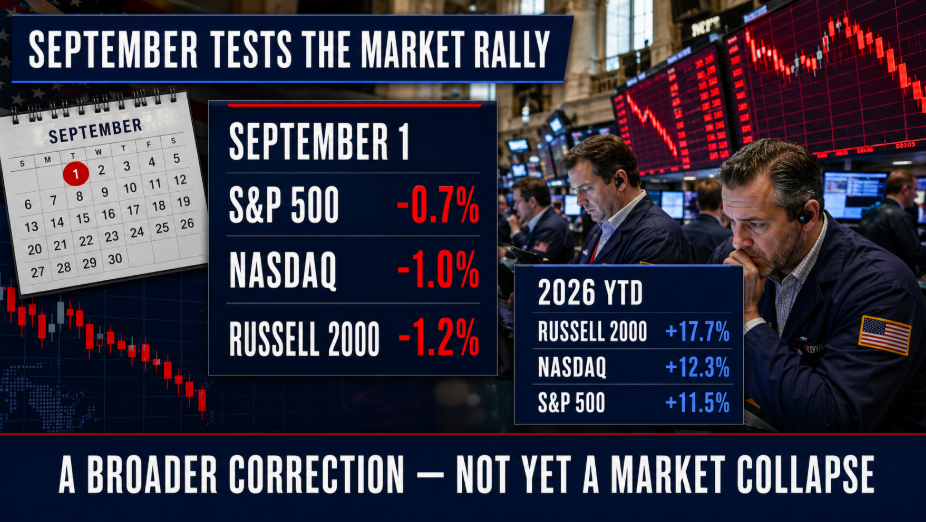
On September 1, the S&P 500 declined 0.7%, the Nasdaq fell 1% and the Dow Jones Industrial Average lost 419 points, or 0.8%.
The Russell 2000, which tracks smaller U.S. companies, fell even further, declining 1.2%. This matters because it shows that the weakness was not limited to a few speculative AI stocks. Investors were reducing risk across multiple areas of the market, with small caps suffering the most.
The immediate catalyst was a sharp increase in oil prices following renewed tensions involving the United States and Iran. Brent crude climbed 4.6%, while U.S. oil closed above $90 per barrel.

Oil affects far more than energy companies. Higher fuel prices increase transportation, logistics, manufacturing and agricultural costs. Businesses can either absorb those additional expenses, reducing their margins, or pass them on to customers, contributing to higher inflation.
That creates a difficult situation for the Federal Reserve. If inflation remains elevated, policymakers have less flexibility to cut interest rates. If oil prices stay high for an extended period, the market may even begin considering the possibility that monetary policy will remain restrictive considerably longer than previously expected.
Bond Yields Are Repricing the Market
The inflation concerns caused by higher oil prices quickly spread into the bond market. The U.S. 10-year Treasury yield rose to 4.79%, increasing pressure on equity valuations.
When government bonds offer investors close to 5% with substantially less risk than stocks, the return required from equities also rises. Investors become less willing to pay aggressive valuations for businesses whose future earnings remain uncertain.
This dynamic is particularly damaging for technology and growth stocks. Much of their valuation is based on cash flows expected several years into the future. Higher interest rates reduce the present value of those future earnings, meaning a company’s share price can fall even when analysts have not reduced their revenue forecasts.
The market is therefore not necessarily saying that every technology company has become weaker. It may simply be demanding a lower valuation because the alternative return available from bonds has become more attractive.
Why the Russell 2000 Is Falling Faster
Small-cap companies are usually more sensitive to changes in interest rates than established large-cap businesses.
Smaller companies often have less predictable earnings, weaker access to financing and fewer sources of revenue. Some depend on capital markets to fund their expansion, making higher borrowing costs a direct threat to future growth.
Trading liquidity also plays an important role. A relatively small amount of selling can create a disproportionately large share-price movement in a micro-cap stock. When funds reduce exposure to small-cap ETFs or quantitative strategies automatically lower risk, individual companies can fall without any new business-specific development.
This helps explain why the Russell 2000 declined more than the S&P 500 and why some individual small caps experienced considerably larger losses. During risk-off periods, investors frequently sell the most volatile assets first and examine the fundamentals later.
September Adds Another Layer of Uncertainty
September has historically been one of the most challenging months for U.S. equities. While seasonal patterns do not determine what will happen in any individual year, they can influence positioning and investor psychology.
Portfolio managers returning from the summer often rebalance positions, secure profits and prepare for year-end. After a strong rally, any unexpected macroeconomic development—such as an oil-price shock—can provide the catalyst for a wider correction.
However, the current decline should still be placed in context. Through September 1, the Russell 2000 remained up 17.7% for 2026. The Nasdaq was up 12.3%, the S&P 500 had gained 11.5% and the Dow was 9.8% higher.
The market may therefore be digesting substantial gains rather than signaling an immediate economic collapse. Corrections can be uncomfortable, but they are also a normal part of a bull market—especially when valuations and investor expectations have risen quickly.
The OSS Case Study
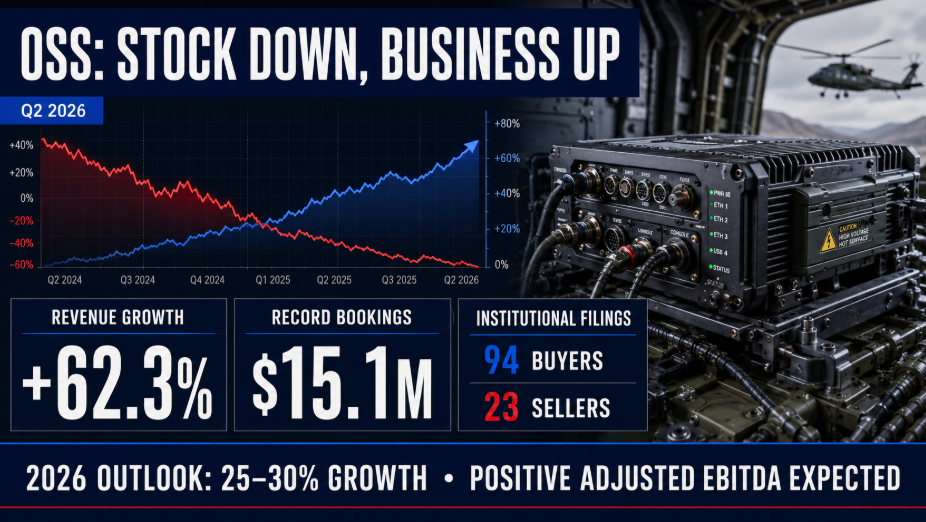
One Stop Systems illustrates how the market environment can temporarily overwhelm improving company fundamentals. OSS trades near $10 after reaching a 52-week high of $20.88 in June. Part of that decline reflects the broader pressure on micro-cap technology stocks, while part is a correction following a rapid rally that pushed expectations and valuation significantly higher.
Operationally, the company continues to progress. Q2 revenue increased 62.3% year over year to $9.3 million, while quarterly bookings reached a record $15.1 million. Its 1.6 book-to-bill ratio indicates that new orders arrived substantially faster than recognized revenue. Management subsequently raised its full-year revenue-growth guidance from 20%–25% to 25%–30%.
OSS is not yet adjusted-EBITDA positive on a quarterly basis. Its Q2 adjusted EBITDA loss was approximately $346,000, but that improved dramatically from a $1.85 million loss one year earlier. Management continues to expect positive EBITDA and adjusted EBITDA for the full year, alongside an approximately 40% gross margin. The company also ended June with $31.4 million in cash and short-term investments.
Institutional filings add another constructive signal. Fintel’s latest filing-based data showed 94 institutional buyers against 23 sellers, with reported institutional positions increasing by approximately 2.21 million shares. These filings are delayed and do not prove that institutions are buying at today’s price, but they suggest growing professional interest in the company.
Analyst coverage remains limited, meaning price targets should be treated cautiously. Nevertheless, Roth MKM’s $18 target and Lake Street’s $21 target imply significant potential upside from current levels if OSS converts its bookings into revenue and reaches sustainable profitability.
What Happens Next?
The market’s next direction will depend heavily on oil prices, inflation expectations and Treasury yields.
If geopolitical tensions ease, oil stabilizes and bond yields retreat, the pressure on small-cap and growth stocks could moderate quickly. These companies are currently experiencing the greatest valuation compression, which also means they could react strongly to an improvement in macroeconomic conditions.
But lower yields alone will not be enough to create lasting gains. Companies must still turn orders into revenue, maintain healthy margins and demonstrate that growth can eventually produce sustainable profits.
That is the distinction investors need to make during a correction. Some stocks are falling because their original valuations were unrealistic or their fundamentals are deteriorating. Others are falling because the market is temporarily treating risk avoidance as more important than company-specific progress.
OSS does not prove that every falling small cap is undervalued. It demonstrates why investors should separate the movement of a stock from the development of the business behind it.
Disclaimer: This article is for informational purposes only and does not constitute financial advice. Small-cap stocks can be highly volatile. Investors should conduct their own research before making investment decisions.

Marc has been involved in the Stock Market Media Industry for the last +5 years. After obtaining a college degree in engineering in France, he moved to Canada, where he created Money,eh?, a personal finance website.