Sekur Private Data (OTCQB: SWISF) has launched a Portuguese-language version of Sekur.com as it prepares to expand in Angola. The company has also begun adapting its onboarding and workflows for local partners. This is a practical step in a broader plan: make its secure communications products easier to introduce, sell and deploy in a market where it expects to sign an exclusive partnership in the coming weeks.
- SWISF closed at US$0.0242 on September 25, putting its market value near US$6.3 million based on 259.6 million shares outstanding at June 30.
- Sekur’s Portuguese site is live, and the company is preparing local onboarding ahead of a prospective exclusive partnership in Angola.
- At US$300 per month for SekurOne, a relatively small premium customer base could have a meaningful effect on Sekur’s revenue and create room for SWISF to re-rate.
Building a local route to customers
For an international technology company, language is part of the sales process. Government and enterprise buyers need to review a product, enroll users and manage support in a way their teams can use every day. Sekur’s September 22 announcement says the Portuguese website is available now, while translation of workflows and onboarding has begun. The site gives prospective customers and partners a direct introduction to Sekur’s products in Angola’s official language.
That work could become valuable beyond one country. Sekur specifically identified Mozambique as another Portuguese-speaking market that the localized platform could serve. Each new market would require its own distribution and customer wins, but reusable language and onboarding tools could make the next launch more efficient. The company already operates a Spanish-language site, showing how its international sales materials can be adapted market by market.
The products have a clear intended audience. Sekur offers Swiss-hosted encrypted email, messaging and VPN services alongside SekurOne, its integrated voice and communications platform. It markets these tools to government, defense, enterprise and executive users who want greater control over sensitive communications. The company also offers deployment options aimed at organizations with data sovereignty requirements. In Angola, a local partner could connect that product suite with buyers that Sekur would find difficult to reach through its website alone.
Angola could open more than one sales channel
Sekur’s September 1 shareholder letter described discussions about a possible nationwide exclusive partnership in Angola. Its September 22 release says an exclusive agreement is expected in the coming weeks. The proposed partnership has not yet been announced as signed, and its commercial terms have not been disclosed. A signed agreement identifying the partner and its responsibilities would be an important next milestone.
The potential customer base extends beyond one type of buyer. A partner with relationships in government, telecommunications or large enterprises could introduce Sekur’s tools to teams that need secure email, private messaging or encrypted calls. An initial deployment could give Sekur local user feedback and a reference for further sales. If the relationship works, a single distribution channel may support multiple products and recurring subscriptions over time.
There is regional optionality, too. Sekur has reported interest in the Democratic Republic of Congo, where it said a government security body had given its solution a positive recommendation. That is an early stage development, not a paid order. Together with the Portuguese launch, it shows a company assembling several routes into African markets.
Premium subscriptions could change the revenue picture
The timing of the Angola push matters because SekurOne is nearing its planned commercial launch. Management expects iOS and web availability in early October at US$300 per user per month, followed by Android in November and video conferencing by year-end. In the same shareholder update, management estimated that approximately 200 SekurOne subscribers, generating US$60,000 in gross monthly recurring revenue, could bring the company to profitability.
Here is the arithmetic at the stated list price across SekurOne markets:
| Illustrative paying users | Gross monthly revenue | Gross annual recurring revenue |
|---|---|---|
| 200 | US$60,000 | US$720,000 |
| 500 | US$150,000 | US$1.8 million |
| 1,000 | US$300,000 | US$3.6 million |
These are full-year, full-price examples, not an Angola sales forecast or announced contracts. Enterprise pricing, distributor terms and customer retention will determine the revenue Sekur actually earns. The sensitivity is useful because the company’s reported first-half 2026 revenue was C$185,828. A few hundred premium subscribers, whether won in the United States, Angola or other markets, would represent a substantial addition to its current sales base.
What the opportunity could mean for SWISF
SWISF’s small valuation makes commercial progress especially relevant. Using the September 25 US$0.0242 close and June’s 259.6 million shares outstanding gives an equity value of about US$6.3 million. If Sekur eventually reached 1,000 full-price SekurOne users, the illustrative gross annual recurring revenue would be US$3.6 million. Applying a hypothetical four-times multiple to that revenue would imply US$14.4 million of equity value, or roughly US$0.055 per share on the June share count. That is about 129% above the reference price. This is an illustrative calculation from the quoted price, share count and announced subscription price.
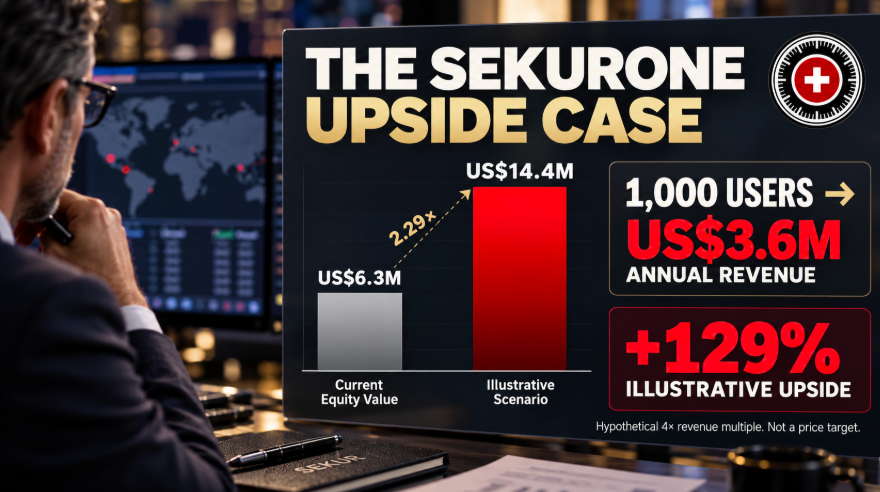
The calculation illustrates potential upside rather than predicting a stock price. It assumes subscribers are paying throughout the year and does not model discounts, partner shares of revenue, cash, liabilities, costs or additional shares. Sekur’s financing needs and future dilution matter to the eventual per-share result. Still, the exercise shows why a signed partner, the SekurOne release and the first material premium sales could draw attention to a company valued at approximately US$6.3 million at the September 25 close.
The milestones to follow are close together: confirmation and terms of the Angolan partnership, progress on local onboarding, SekurOne’s October commercial rollout and subsequent disclosures of paid users or contract revenue. Each one would help investors measure how the company’s product development and international relationships are converting into business.
Sekur has now put a visible piece of its Angola strategy in place. If the company follows its Portuguese launch with a productive local partnership and recurring customer sales, Angola could become a meaningful new growth channel. Combined with SekurOne’s premium pricing and opportunities in other markets, that gives SWISF a route to revenue growth from a small starting valuation.
This article is for information and education only, not investment advice or a recommendation to buy or sell securities. The author may hold or trade SWISF. Sekur is a speculative, potentially illiquid microcap with operating losses and execution, financing and dilution risks. The subscriber and valuation scenarios are illustrative assumptions, not company forecasts or price targets. Readers should review the company’s filings and make their own investment decisions.

Marc has been involved in the Stock Market Media Industry for the last +5 years. After obtaining a college degree in engineering in France, he moved to Canada, where he created Money,eh?, a personal finance website.