The latest Middle East escalation is forcing investors to reassess the Fed, bond yields, and the durability of the 2026 stock-market rally.
By Marc Zerbola Challande
Updated: September 9, 2026
Three Key Takeaways
- Brent crude has crossed $100 as renewed conflict threatens Gulf supply, reviving one of the market’s biggest inflation risks.
- Persistent energy inflation could pressure consumers, corporate margins, and high-beta stocks while limiting the Federal Reserve’s options.
- Energy companies may benefit, but the broader market outcome depends on whether $100 oil lasts for days or months.
The Market’s Biggest Macro Risk Is Back
Wall Street is no longer treating the Middle East conflict as a distant geopolitical story.
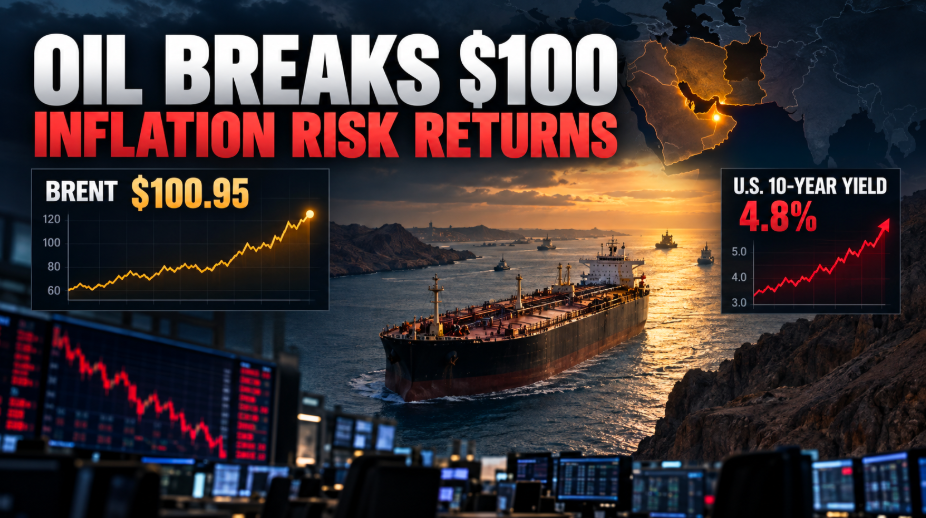
Brent crude climbed as high as $100.95 per barrel on Wednesday, crossing $100 for the first time since July 24. West Texas Intermediate approached $96 as attacks involving the United States and Iran renewed fears of further disruption to Gulf oil shipments.
Stocks moved lower as the pressure spread across global markets. U.S. indexes were heading toward a third consecutive negative session, while European stocks suffered their steepest decline in around two months. Energy shares were among the few clear beneficiaries.
The important point is not simply that oil reached a round number. It is what $100 oil could do to inflation, bond yields, interest-rate expectations, and corporate earnings if it remains elevated.
As Reuters reported, the U.S. 10-year Treasury yield was already near 4.8%, leaving investors with little room for another inflation surprise.
This Is More Than a Geopolitical Premium
Oil prices often spike when conflict escalates and then fall once the immediate fear passes. This time, however, the shock is hitting a market where physical supplies and transportation routes are already under pressure.
The Strait of Hormuz normally handles approximately 20 million barrels of oil per day, equivalent to around 20% of global petroleum liquids consumption. Available pipeline capacity can replace only a fraction of those shipments, according to the U.S. Energy Information Administration.
The International Energy Agency’s August report estimated that global oil supply was still 6.3 million barrels per day below its year-earlier level in July. It now expects total supply to decline by an average of 4.3 million barrels per day in 2026.
Global observed inventories have also fallen by approximately 410 million barrels since the beginning of the conflict. The IEA expects a third-quarter supply deficit of 1.8 million barrels per day, more than double its previous estimate.
That means today’s geopolitical premium is sitting on top of an already tight physical market. Read the full IEA Oil Market Report.
The Real Threat Comes From Fuel Prices
Consumers do not buy barrels of Brent crude. They buy gasoline, airline tickets, groceries, and products delivered by truck.
That is why diesel and refined-product prices may matter more to the economy than the oil headline itself. Diesel is used throughout transportation, agriculture, construction, and industrial activity. When diesel rises, the additional expense moves through supply chains and eventually reaches businesses and consumers.
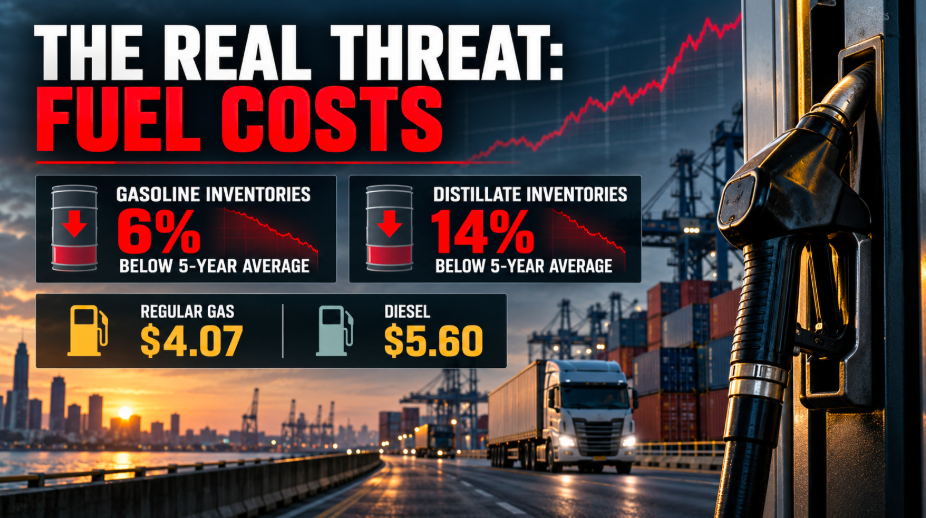
For the week ending August 28, U.S. gasoline inventories were 6% below their five-year average, while distillate inventories were 14% below average. Regular gasoline averaged $4.07 per gallon and diesel stood at $5.60, according to the EIA’s latest weekly data.
A short-lived move above $100 would be manageable. A prolonged period at these levels would be more damaging. Airlines, transportation companies, chemical producers, manufacturers, and consumer-facing businesses could face higher costs just as households absorb another increase in everyday expenses.
The Federal Reserve’s Decision Just Became Harder
The oil surge has arrived at an uncomfortable moment for the Federal Reserve.
The next U.S. consumer inflation report will be released on September 11, followed by the Fed’s policy decision on September 16. Today’s latest oil spike cannot appear in the August inflation data, but it can influence future inflation expectations immediately.
A Reuters survey found that around 70% of economists expect the Fed to keep rates at 3.50% to 3.75% next week. That is down from 90% in August. The remaining economists expect a quarter-point increase, while financial markets have started pricing in two hikes by March.
Economists expect August consumer prices to have risen 0.4% from the previous month and 3.4% from a year earlier. A hotter report, combined with persistent $100 oil, could make the Fed considerably more hawkish.
That is particularly important for high-beta and small-cap stocks. These companies do not necessarily need to report weaker earnings for their shares to fall. A higher discount rate can compress valuations on its own, especially for businesses whose expected cash flows remain several years away.
The Winners and the Vulnerable Sectors
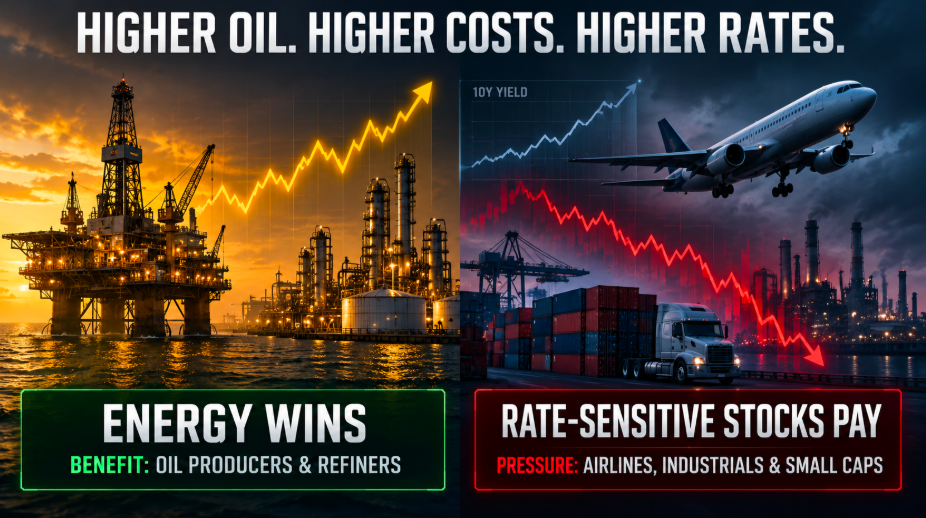
Oil producers are the most obvious beneficiaries. Higher crude prices can improve cash flow for companies such as Exxon Mobil and Chevron, as well as selected exploration, production, and oilfield-services businesses.
Refiners may also benefit from strong margins when supplies of gasoline, diesel, and jet fuel remain tight. However, the relationship is not automatic. Feedstock costs, refinery availability, political intervention, hedging, and a sudden ceasefire can all change the equation quickly.
On the vulnerable side are airlines, freight companies, chemicals, industrials, and consumer-discretionary businesses. Small companies with limited pricing power are especially exposed because they may struggle to pass higher costs to customers.
Technology companies are less directly dependent on oil, but they remain sensitive to the interest-rate reaction. Profitable, cash-rich technology leaders should generally be more resilient than speculative companies dependent on future financing.
Three Scenarios Investors Should Consider
The first scenario is rapid de-escalation. Gulf shipments recover, Brent falls back below $90, bond yields retreat, and beaten-down growth stocks stage a relief rally.
The second is a sustained $95 to $110 oil environment. Energy remains relatively strong, corporate margins come under pressure, and the Fed keeps policy restrictive. This would probably produce a divided market rather than an immediate crash.
The third is another major disruption to shipping or energy infrastructure. Oil could move materially higher, inflation expectations could accelerate, and markets would have to price a genuine stagflation risk involving weaker growth and higher interest rates.
These are scenarios, not predictions. The direction of the conflict remains extremely difficult to forecast.
What Matters Next
Investors should watch whether Brent can remain above $100, changes in tanker traffic through Hormuz, diesel prices, the 10-year Treasury yield, and the relative performance of energy versus small-cap stocks.
The next immediate catalysts are the EIA petroleum report on September 10, the official U.S. inflation release on September 11, and the Federal Reserve decision on September 16.
10x Alerts Takeaway
The $100 level is psychologically important, but duration is what will determine the market impact.
If the latest surge fades quickly, the current weakness could become another temporary risk-off episode. If oil remains near or above $100 for several months, analysts may need to lower margin forecasts while investors apply higher discount rates to equities.
Energy strength can provide a hedge, but one positive session does not make every oil stock attractive. At the same time, falling growth stocks are not automatically bargains if bond yields and inflation expectations continue rising.
The market is not yet pricing a full economic crisis. It is warning that the path toward lower inflation and easier monetary policy has become considerably narrower.
Disclaimer: This article is for informational purposes only and is not financial advice. Oil, energy stocks, and high-beta equities can experience substantial volatility due to geopolitical developments, commodity prices, monetary policy, and changing market expectations.

Marc has been involved in the Stock Market Media Industry for the last +5 years. After obtaining a college degree in engineering in France, he moved to Canada, where he created Money,eh?, a personal finance website.