Washington wants to reduce America’s dependence on foreign semiconductor supply chains. But if the next tariff package makes data centers more expensive before domestic production is ready, the policy could tax the very AI expansion it is supposed to protect.
Only hours after Nvidia reported that quarterly data-center revenue had more than doubled, a new risk appeared: Washington is reportedly considering tariffs not only on imported semiconductors, but also on products containing them—including data-center servers.
The apparent contradiction is difficult to ignore. The United States wants to win the global AI race, attract chip factories and build enormous computing clusters. Yet it may raise the price of the hardware required to do all three.
- No new server tariff has been officially announced. The reported framework remains preliminary and could change substantially.
- Broader semiconductor tariffs were already promised in January, but the existing 25% measure explicitly exempts chips imported for use in U.S. data centers.
- If complete AI servers lose that protection, much of the cost may fall on American cloud companies, AI laboratories and their customers—not foreign manufacturers.
What is actually being considered
On August 27, Reuters reported that the Trump administration was discussing a new round of semiconductor tariffs, citing an earlier Politico report based on eight people familiar with the deliberations.
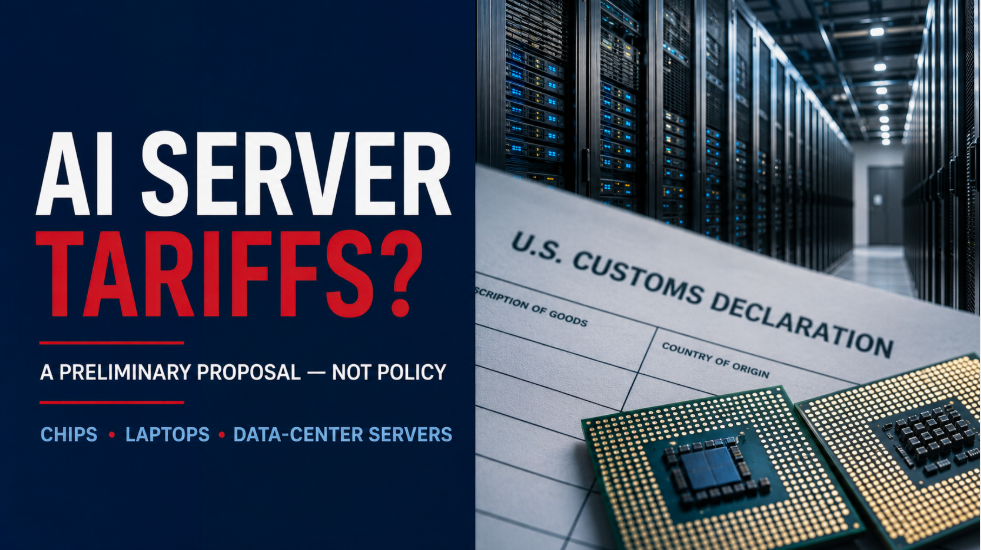
The potential measure could cover individual chips and products containing them, including laptops, gaming consoles and data-center servers. Commerce Secretary Howard Lutnick reportedly favors linking tariff relief to U.S. semiconductor investment, with officials considering a phased implementation.
However, this is not yet policy. Reuters said it could not independently verify the report, and a White House official warned that tariff reporting should be treated as speculation until formally announced. No definitive rate, product list, exemption structure or implementation date has been published. Reuters’ August 27 report
Investors should therefore analyze the possibility without treating every imported server as newly tariffed.
The second phase was hiding in plain sight
The proposal did not appear from nowhere.
On January 14, President Trump imposed a 25% tariff on a narrow category of advanced computing chips, including products such as Nvidia’s H200 and AMD’s MI325X. Crucially, the proclamation exempted chips imported for U.S. data centers, research, startups, repairs, public-sector applications and other uses supporting the domestic technology supply chain.
The same proclamation also outlined a two-phase strategy. After negotiations with foreign suppliers, the administration could impose “significant” broader tariffs on semiconductors, manufacturing equipment and derivative products, combined with tariff offsets for companies investing in American production. Official White House proclamation
Today’s reported discussions therefore appear to concern the second phase—not an entirely new policy reversal.
The national-security argument is real
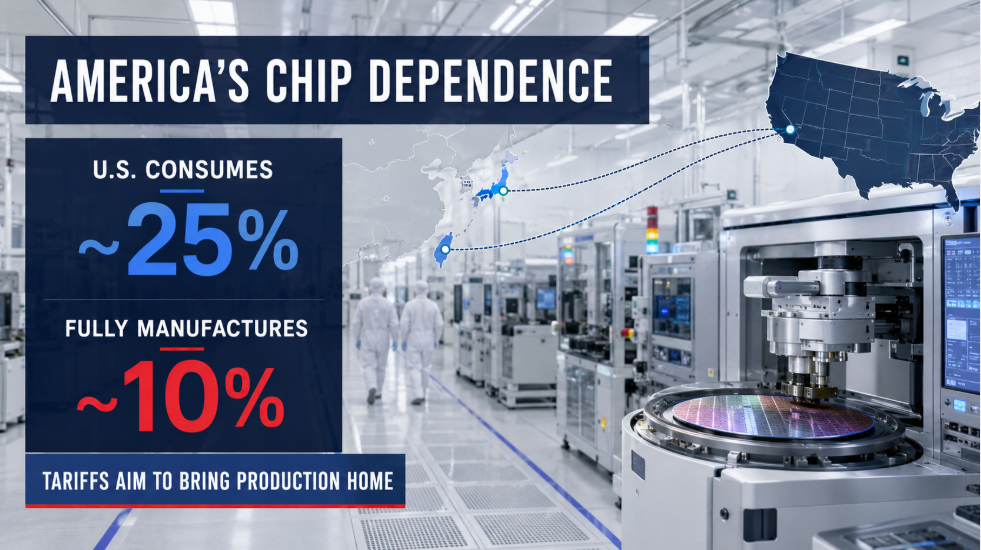
America’s dependence on foreign chip manufacturing is difficult to dismiss. The White House’s Section 232 findings said the United States consumes roughly one-quarter of the world’s semiconductors but fully manufactures only about 10% of the chips it requires.
That leaves the AI economy reliant on a geographically concentrated supply chain spanning Taiwanese fabrication, Korean memory, overseas packaging and assembly, and specialized foreign manufacturing equipment.
Tariffs can be used as leverage rather than merely as a wall. TSMC announced an additional $100 billion investment in Arizona, while Nvidia committed to producing up to $500 billion of AI infrastructure in the United States.
The U.S.–Taiwan trade agreement also promises preferential treatment under semiconductor tariffs while encouraging Taiwanese investment in American semiconductor supply chains and AI-related electronics manufacturing. Official USTR fact sheet
Washington’s message is simple: companies manufacturing the future in America should receive better market access.
The danger of taxing the buildout before replacing the supply chain
The economic problem is timing.
Semiconductor factories take years to construct, equip, qualify and scale. AI demand is expanding now. Nvidia just reported $89 billion in quarterly data-center revenue, up 117% year over year, and guided total next-quarter revenue to $108 billion.
A server assembled overseas can contain American-designed processors, Taiwanese-made silicon and Korean memory. Taxing the finished system may raise the capital expenditure of the American hyperscaler installing it rather than punish a foreign competitor.
Federal Reserve researchers describe high-bandwidth memory as a binding constraint and warn that input costs influence how quickly AI becomes cost-competitive with labor. High-tech imports have also largely remained tariff-exempt. Federal Reserve analysis
Removing that protection could force cloud providers and AI laboratories to accept lower returns, delay deployments or charge more for computing. It would also complicate neocloud economics, which depend on rapid installation and high accelerator utilization.
Who would really pay?
The foreign supplier does not automatically absorb a tariff. The American importer legally pays it, then decides whether to negotiate a lower purchase price, accept a smaller margin or pass the cost onward.
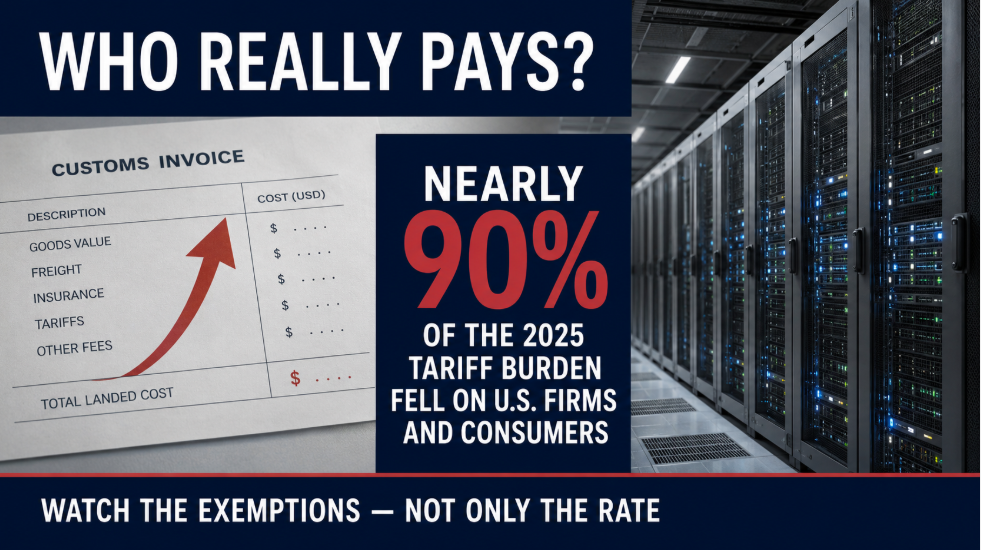
New York Fed researchers found that nearly 90% of the economic burden from the 2025 tariffs fell on U.S. firms and consumers. Semiconductor pricing and contracts differ, but the warning remains.
Potential beneficiaries include domestic foundries, packaging facilities and manufacturers qualifying for investment-linked offsets. Intel and the U.S. operations of TSMC and Samsung could become strategically more valuable.
The risk sits with cloud providers, AI labs, server manufacturers and infrastructure operators if exemptions prove narrow. Nvidia and AMD could also face delayed orders if customers postpone deployments, even though both companies support expanding American production.
What investors should watch
The headline tariff rate may be less important than the exemptions beneath it.
Investors should watch the covered customs classifications; whether the data-center exemption survives; whether relief requires announced investment or actual production; which countries receive preferential treatment; and whether implementation is immediate or phased.
A carefully designed system could protect near-term AI deployment while rewarding companies that build American capacity. A blunt tariff on complete servers could do the opposite—raising costs immediately in exchange for manufacturing capacity that may not arrive for years.
The bottom line
America can pursue both a resilient semiconductor industry and a globally competitive AI sector. The contradiction emerges if computing becomes materially more expensive before sufficient capacity exists at home.
Tariffs may successfully push more factories, packaging plants and server assembly into the United States. But industrial policy is ultimately judged by sequencing. If Washington preserves data-center exemptions while rewarding genuine domestic investment, the proposal could strengthen the American AI supply chain.
If it taxes imported AI servers before substitutes exist, the United States may discover that it has not charged foreign countries for access to the AI boom. It has charged American companies for building it.
Disclosure
This article is provided for informational and educational purposes only and does not constitute investment, financial, legal or tax advice, or a recommendation to buy or sell any security. The author may hold positions in companies or sectors mentioned. Opinions are current only as of publication and may change without notice. Readers should conduct their own research and consider their objectives, risk tolerance and financial circumstances before making investment decisions. Past performance is not indicative of future results.

Marc has been involved in the Stock Market Media Industry for the last +5 years. After obtaining a college degree in engineering in France, he moved to Canada, where he created Money,eh?, a personal finance website.