AI investment is showing up across the stock market. Cloud providers are building data centers, chipmakers are shipping processors, and smaller companies are supplying the equipment that connects and tests them. The spending is real. What is less clear is who will earn the best return from it.
That distinction matters for investors. A supplier can record revenue when it delivers a product. Its customer must then put that equipment to work, attract users and generate enough cash to recover the cost. The latest results from Meta, Alphabet, Amazon and their suppliers show both sides of that equation.
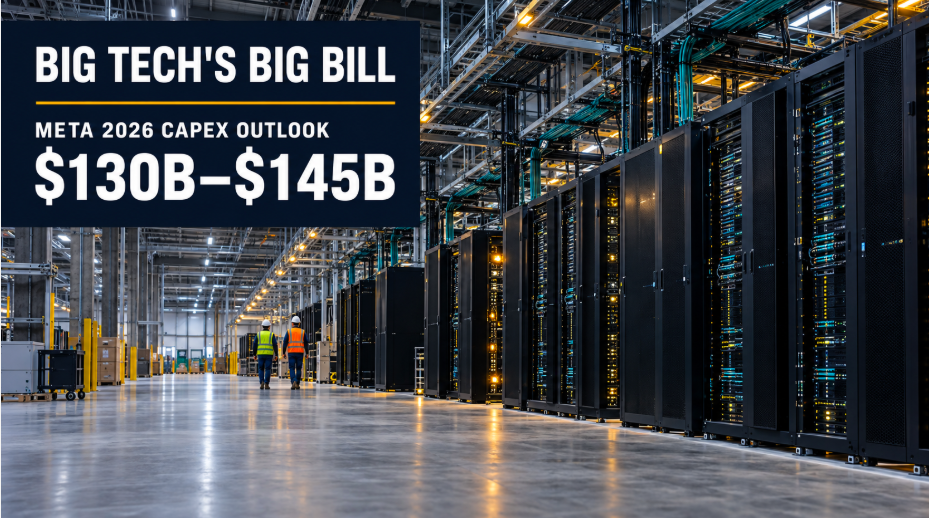
- Meta expects $130 billion to $145 billion of capital spending in 2026, including principal payments on finance leases, while its second-quarter free cash flow fell to $784 million.
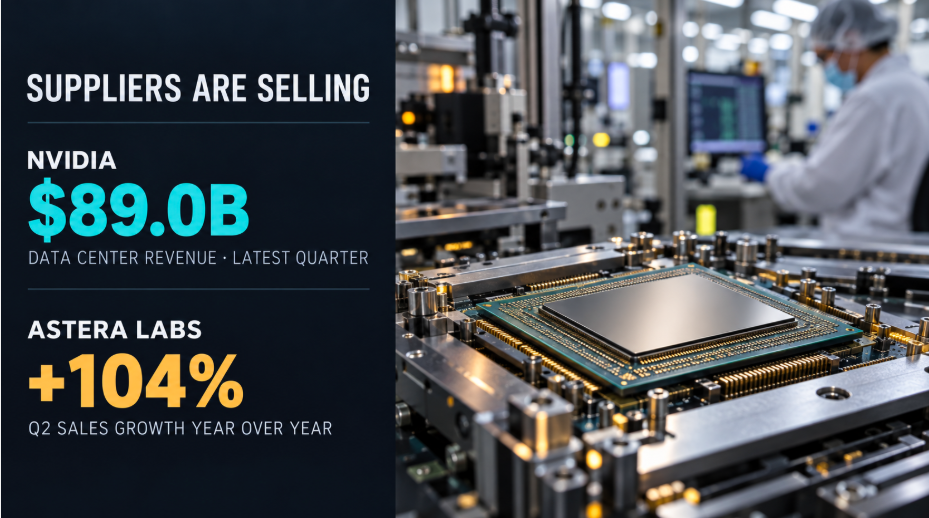
- Suppliers are reporting substantial growth: Nvidia’s latest quarterly data-center revenue reached $89.0 billion, and Astera Labs’ second-quarter sales rose 104% year over year.
- Cloud revenue is growing, but investors still need to compare that growth with the cash spent on new infrastructure and the prices they pay for AI stocks.
Big Tech is spending heavily, even as revenue grows
Meta is one of the clearest examples of the trade-off. Its second-quarter revenue rose 28% to $60.8 billion, driven largely by advertising. In the same quarter, it spent $31.08 billion on capital expenditures, including principal payments on finance leases. Free cash flow came to $784 million, compared with $8.55 billion a year earlier. Management expects that measure of capital spending to reach $130 billion to $145 billion for the full year. Meta’s advertising business is still generating cash, but the company is committing a much larger share of it to future capacity.
Alphabet’s Google Cloud business offers a stronger sign of near-term monetization. Second-quarter cloud revenue rose 82% to $24.8 billion, and the segment generated $8.8 billion of operating income. Alphabet also spent $80.6 billion on property and equipment in the first half of 2026, roughly double the amount a year earlier. Its free cash flow was negative $5.9 billion for the second quarter, although it remained positive $53.3 billion over the trailing twelve months. The question is whether cloud profits can keep rising quickly enough to support the pace of investment.
Amazon faces a similar test. AWS revenue grew 37% to $42.2 billion in the second quarter, with operating income of $16.6 billion. Yet Amazon’s companywide free cash flow over the trailing twelve months shifted from positive $18.2 billion a year earlier to negative $7.6 billion. The company said the increase in property-and-equipment purchases primarily reflected AI investments. Its total spending also supports other parts of Amazon’s business, so it should not all be counted as AI spending.
These results do not mean the investments are failing. Meta, Alphabet and Amazon are building capacity they expect to use for years. They do show how much cash is required before the full return becomes visible.
Suppliers can already point to sales
Nvidia is receiving a large share of that spending. In the quarter ended July 26, its data-center revenue reached $89.0 billion, up 117% from a year earlier. Its companywide gross margin was 75.0%. Those are realized results, not estimates of a future market. Nvidia shares closed at $225.51 on September 23. The risk is that today’s pace of orders may be difficult to maintain if customers slow their expansion or develop alternatives.
Astera Labs sells connectivity products that help move data through AI systems. Its second-quarter revenue rose 104% to $392.4 million, with a GAAP gross margin of 73.3%. Management expects $540 million to $560 million of revenue in the third quarter, though that remains a forecast. At its September 23 closing price of $360.46, Astera’s market value exceeded $60 billion. Investors are paying for continued growth well beyond the latest reported quarter, which makes execution on new product ramps important.
Aehr Test Systems presents a smaller, earlier-stage version of the same opportunity. It reported $50.0 million of revenue and a $7.1 million GAAP net loss for fiscal 2026. Management expects fiscal 2027 revenue of $130 million to $150 million. Its $100.6 million effective backlog includes $80.6 million of orders at fiscal year-end plus orders booked afterward. At $97.38 a share on September 23, Aehr was worth about $3.2 billion, or roughly 64 times its last fiscal year’s sales. That valuation puts considerable weight on its forecast becoming delivered revenue.
One Stop Systems shows why it is worth looking past an AI label. Second-quarter revenue grew 62.3% to $9.3 million, and bookings reached $15.1 million. But the company identified medical imaging, military systems and autonomous industrial equipment among its sales drivers. Its rugged edge-computing business is exposed to different customers than a large data-center chipmaker. With OSS shares closing at $9.18 on September 23, the key test is whether those bookings become profitable shipments.
What would prove the investment is paying off?
Capital spending uses cash when equipment is purchased. Depreciation then spreads its accounting cost across later years; it is not another cash payment. The economic question is whether the equipment produces enough additional cash before it needs to be replaced.
For the cloud giants, that means watching cloud sales and operating profit alongside capital expenditures and free cash flow over several quarters. For Meta, it also means seeing whether AI improves its advertising business enough to support the larger budget. One weak cash-flow quarter cannot answer either question.
For suppliers, watch whether orders continue, whether gross margins hold up and whether customers become more diversified. Backlog at Aehr or bookings at OSS matter most when they turn into revenue and operating cash. For a fast-growing stock such as Astera, valuation adds another hurdle: strong results may still disappoint investors if the share price already assumes even faster growth.

Bottom line
The AI boom has produced real sales for equipment suppliers and rapid growth in cloud services. It has also required unusually large cash commitments from the companies building the infrastructure. Both developments can be true at once. Over the next few years, the stocks that reward investors will depend on how much lasting cash these businesses generate, and how much investors pay for that potential today.
Disclosure: This article is for information and discussion, not personalized investment advice. The author may hold positions in securities mentioned. Company figures are from the latest cited reports available on September 24, 2026. Share prices are September 23 U.S. closes and may have changed.

Marc has been involved in the Stock Market Media Industry for the last +5 years. After obtaining a college degree in engineering in France, he moved to Canada, where he created Money,eh?, a personal finance website.