On Monday, the S&P 500 fell 0.48% to 7,619.94, the Nasdaq declined 0.56% to 26,186.41 and the Dow lost 0.29% to finish at 52,421.17. Tuesday’s early signals remained negative, with Dow futures down 0.39%, S&P 500 futures off 0.28% and Nasdaq 100 futures lower by 0.25% before the opening bell.
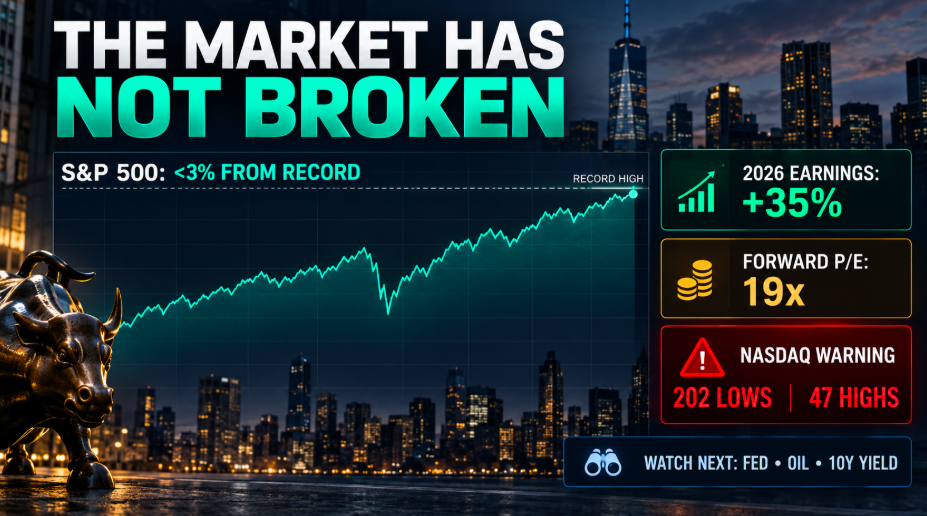
Those moves are not enormous. The S&P 500 remains less than 3% below its August 13 record. What matters is the combination of forces behind them: Brent crude above $107 per barrel, the 10-year Treasury yield above 5%, a near-certain Federal Reserve rate hike and an abrupt selloff in AI semiconductor stocks.
- Brent crude reached $107.35 as damage to Saudi Arabia’s East-West pipeline threatened as much as 4% of global oil supply. Goldman Sachs sees a path above $120, while a prolonged shutdown could push prices toward $130.
- The 10-year Treasury yield climbed to 5.0286%, its highest level since 2007, while markets assigned roughly a 92.5% probability to a 25-basis-point Fed hike. Higher yields directly reduce the value investors place on distant corporate profits.
- The AI trade did not collapse evenly. Nvidia fell 3.4%, the chip index dropped 5.9%, and Micron lost more than 5%, but cybersecurity and software stocks surged as investors rotated toward companies that could benefit from stricter AI oversight.
Oil Is No Longer Just an Energy Story
Brent crude rose 1.58% to $107.35 on Tuesday morning, while U.S. West Texas Intermediate climbed 2.11% to $103.53. The immediate cause was damage to Saudi Arabia’s East-West pipeline, a route that lets exports bypass the Strait of Hormuz.
The damaged pipeline could affect up to 4% of global supply. Around one-fifth of the world’s oil previously passed through Hormuz, but commodity-vessel traffic fell to four ships on Monday from 10 one day earlier. Repairs could take up to eight weeks, while roughly 2 million barrels per day of recent exports through Yanbu may be at risk. Half of Russia’s six largest diesel-producing refineries have also reduced or stopped output after drone damage.
The shock reaches far beyond ExxonMobil or Chevron because energy affects transport, manufacturing and food distribution. In August, U.S. inflation rose 0.4% month over month and 3.4% year over year. Gasoline increased 3.9% in one month, other motor fuels jumped 9.6% and airline fares rose 2.7%. Diesel moved above $6 per gallon.
Oil therefore creates a difficult chain reaction: higher fuel costs lift inflation, stronger inflation pushes interest rates upward, and higher rates reduce the prices investors are willing to pay for stocks.
Why a 5% Treasury Yield Changes the Math
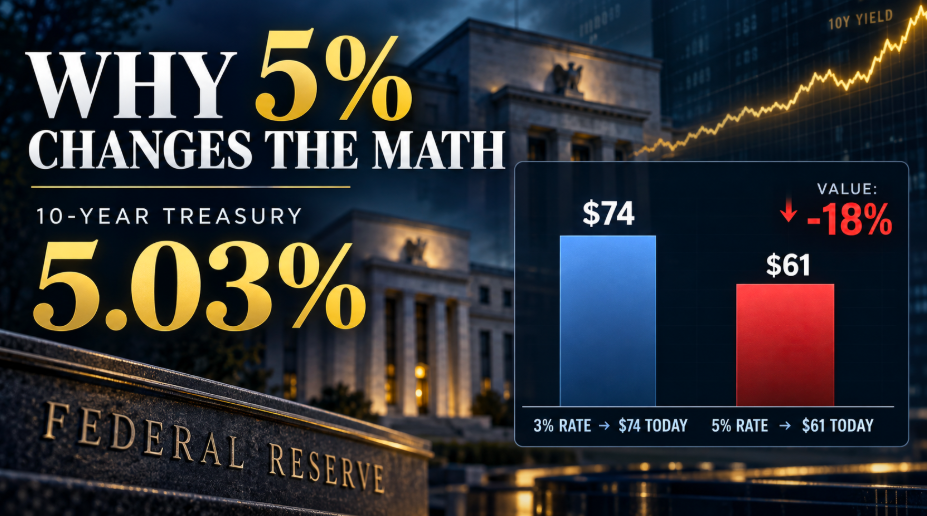
The benchmark 10-year Treasury yield reached 5.0286%, the highest since 2007. At the same time, traders raised the probability of a quarter-point Fed hike to approximately 92.5%, up from around 70% before the latest inflation data. The Fed’s current target range is 3.50% to 3.75%.
Goldman Sachs, JPMorgan, HSBC and Deutsche Bank now expect a September hike. Morgan Stanley expects another 25-basis-point increase in December, reversing earlier expectations that the Fed could remain on hold throughout 2026.
The impact on stocks can be explained simply. At a 3% discount rate, $100 received 10 years from now is worth about $74 today. At 5%, it is worth only about $61. Nothing changed about the future $100, but its present value fell roughly 18%. This is why high-growth companies, whose valuations depend heavily on profits expected years from now, are especially sensitive to bond yields.
The pressure is visible outside technology. Bank of America fell 5.1% after warning that third-quarter investment-banking fees could decline by at least 10%. Dave & Buster’s dropped roughly 11.2% before Tuesday’s open after a revenue miss. Bitcoin’s nearly 3% decline pulled Coinbase and Strategy down more than 3% each.
AI Hardware Fell, but Software Found New Buyers
Leaders at Anthropic, OpenAI and xAI supported slowing frontier-model development to allow more safety testing. Investors questioned whether slower development could also mean slower spending on chips and data centers.
Nvidia fell 3.4% on Monday. Micron dropped more than 5%, while Broadcom and AMD each lost more than 4%. The Philadelphia Semiconductor Index sank 5.9% in one session. Even after that fall, however, the index remained up 57% in 2026, showing how much optimism was already embedded in AI hardware valuations.
The same news produced winners. ServiceNow, Adobe and Workday gained between 4% and 7.4%. CrowdStrike rose about 15%, Palo Alto Networks gained roughly 14%, and Zscaler and SailPoint each advanced around 16%. The iShares Expanded Tech-Software Sector ETF climbed 5.2%.
If AI faces more oversight, spending could shift toward cybersecurity, monitoring and compliance. That does not prove semiconductor demand has peaked. It shows investors are beginning to separate different kinds of AI exposure.
Why the Market Has Not Broken
Despite oil above $107 and yields above 5%, the S&P 500 remains within 3% of its record. The main support is earnings. Second-quarter profits for S&P 500 companies are estimated to have risen 53% from a year earlier, or 49.5% excluding energy. Full-year 2026 earnings are expected to grow 35%, compared with 14% in 2025. Alphabet and Amazon have also continued to report strong cloud growth linked to AI demand.
The S&P 500 now trades near 19 times expected earnings, its lowest forward multiple since April 2025. Advancing S&P 500 stocks outnumbered decliners by 1.3 to one on Monday, even though eight of 11 sectors finished lower.
There are still warning signs. The Nasdaq recorded 202 new lows against only 47 new highs, and trading volume reached 15.3 billion shares versus a 20-day average of 14.8 billion. The market is not panicking, but weakness beneath the headline indexes is becoming harder to ignore.
What Investors Should Watch Next
First comes Wednesday’s Fed decision. A 25-basis-point hike is largely priced in, so investors will focus on whether Chair Kevin Warsh signals further tightening.
Second is oil. A quick pipeline repair could relieve inflation pressure. A prolonged disruption could move Brent toward $120 to $130 and squeeze consumers and corporate margins.
Third is the 10-year yield. A sustained move above 5% would make bonds more competitive and place the greatest pressure on expensive, unprofitable and highly leveraged companies.
The market’s direction is therefore not being decided by one headline. It is being decided by whether earnings growth can outrun higher energy costs and higher discount rates. For now, profits are keeping the bull case alive. If oil and yields remain elevated, however, investors will demand stronger numbers and punish weaker companies much faster.
Disclaimer
This article is for informational and educational purposes only. It does not constitute investment advice, a recommendation or an offer to buy or sell any security. Market prices and probabilities can change quickly, and investors should conduct their own research and consider their risk tolerance before making investment decisions.

Marc has been involved in the Stock Market Media Industry for the last +5 years. After obtaining a college degree in engineering in France, he moved to Canada, where he created Money,eh?, a personal finance website.