America appears to be living in two economies.
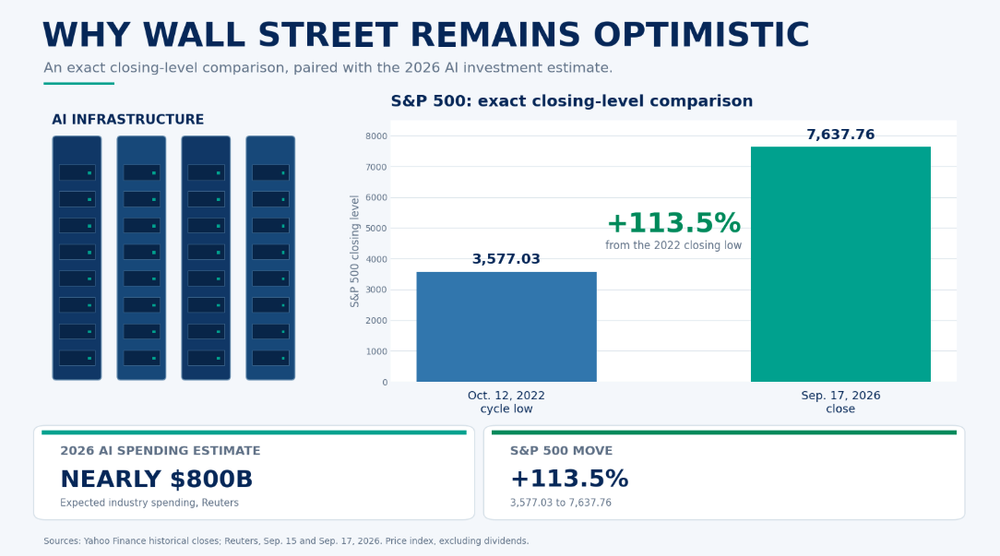
The S&P 500 has more than doubled since the current bull market began in October 2022. Artificial-intelligence spending, one of the rally’s main engines, could approach $800 billion in 2026.
Meanwhile, consumer sentiment fell from 51.7 in August to 47.8 in early September. That is a 7.5% drop in one month.
These numbers are not contradictory. Wall Street prices future corporate profits. Consumers judge the economy through today’s grocery bills, mortgage payments and credit-card balances.
- Wall Street is being driven by future profits. AI investment could reach nearly $800 billion this year, benefiting chipmakers, cloud providers, utilities and data-center suppliers.
- Consumers are dealing with current costs. Inflation remains above the Federal Reserve’s target, oil is above $100 a barrel and mortgage rates are approaching 7%.
- Employment is holding the two economies together. Consumers may feel pessimistic, but most are still working and spending. A weaker labor market could change that quickly.
Why Wall Street remains optimistic
The stock market is not a direct measurement of the average household.
Large technology companies earn money worldwide. They can also benefit from business spending even when consumers reduce restaurant visits, delay buying cars or choose cheaper groceries.
AI illustrates the difference. Expected spending of nearly $800 billion includes chips, servers, data centers, electricity and cloud services. That money becomes revenue for companies throughout the AI supply chain. It helps explain why the S&P 500 has more than doubled since October 2022.
The S&P 500 is also weighted by company size. When a small number of enormous businesses perform well, they can lift the index even if smaller companies and consumer-facing businesses struggle.
The household numbers look very different
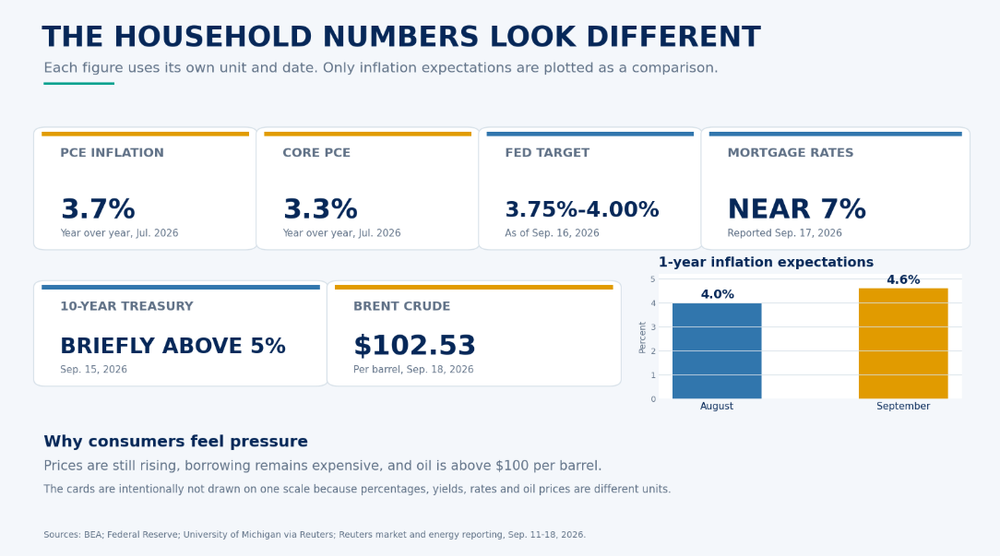
The Federal Reserve’s preferred inflation measure rose 3.7% over the year through July. Even after removing food and energy, prices increased 3.3%. Both figures remain above the Fed’s 2% goal.
Consumers expect more pressure. One-year inflation expectations jumped from 4.0% in August to 4.6% in September. Longer-term expectations reached 3.4%.
Borrowing is not providing much relief. On September 16, the Fed raised its target interest rate by 0.25 percentage point, to 3.75%–4.00%. The 10-year Treasury yield briefly crossed 5%, while mortgage rates moved close to 7%.
Energy is another concern. On September 18, Brent crude traded at $102.53 a barrel and US oil at $100.04. Oil above $100 can raise gasoline, transportation and manufacturing costs.
Consumers have less room for error
Americans saved 3.0% of their disposable income in July, up slightly from 2.7% in June. Personal income grew 0.4%, but consumer spending increased just 0.2%. After inflation, spending grew by less than 0.1%.
Household debt provides more context. In the first quarter, Americans owed $18.794 trillion, including:
- $13.191 trillion in mortgages
- $1.685 trillion in auto loans
- $1.658 trillion in student loans
- $1.252 trillion on credit cards
About 4.8% of outstanding debt was in some stage of delinquency. The annualized share of balances becoming at least 90 days late rose from 2.45% a year earlier to 2.83%. For credit cards, the figure was 7.10%.
Housing also shows the strain. Single-family building permits fell 1.8% in August. Pending home sales increased 0.3% from July but remained 4.7% below the previous year. Residential investment has contracted in five of the past six quarters.
Why spending has not collapsed
The answer is employment.
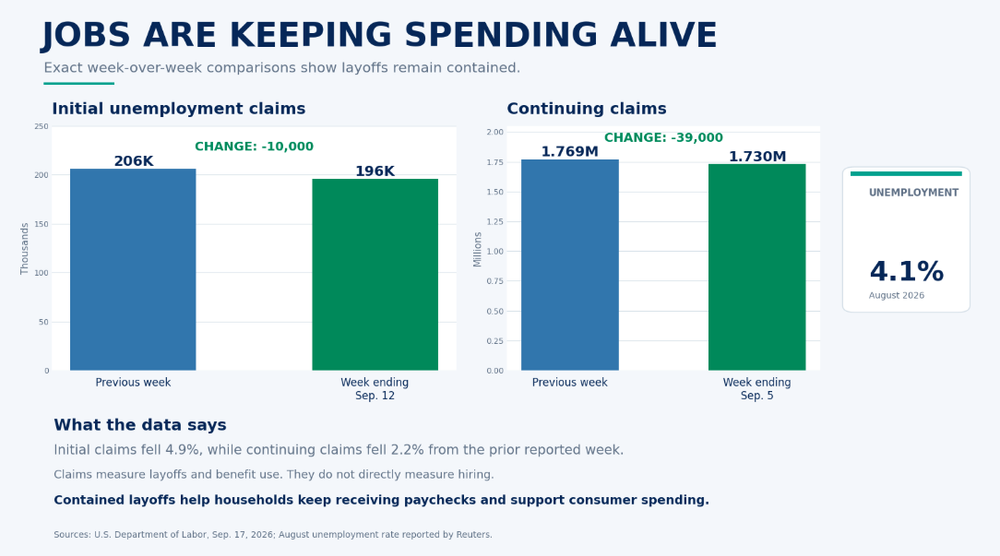
Initial unemployment claims were only 196,000 in the week ending September 12, down 10,000 from the previous week. Continuing claims fell by 39,000 to 1.73 million, while the unemployment rate was 4.1%.
As long as people keep receiving paychecks, many can continue spending despite feeling unhappy about prices. That explains how consumer confidence can fall while the economy continues growing.
What investors should watch
The current divide can continue, but probably not forever. Investors should monitor five numbers:
- Unemployment claims, currently 196,000.
- The unemployment rate, currently 4.1%.
- The personal saving rate, currently 3.0%.
- Oil prices, currently above $100.
- Credit-card serious-delinquency flows, currently 7.10%.
If employment remains stable and corporate profits grow, stocks could stay strong despite weak sentiment. If layoffs rise while savings fall and delinquencies increase, worried consumers may become consumers who stop spending.
That is when Wall Street’s boom would face a much harder test.
Disclosure: The author may hold or initiate positions in securities mentioned in this article. This content is for informational purposes only and is not financial advice.

Marc has been involved in the Stock Market Media Industry for the last +5 years. After obtaining a college degree in engineering in France, he moved to Canada, where he created Money,eh?, a personal finance website.