On June 17, 2026, 2CRSi shares closed at €44.60, valuing the French AI-server manufacturer at approximately €1 billion. One day later, Grizzly Research published a highly critical report while holding a short position in the company.
The reaction was immediate. 2CRSi’s share price fell 43.05% to €25.40, reducing its market capitalization to roughly €574 million. More than €430 million of stock-market value disappeared in a single session. Trading was subsequently suspended before resuming on June 22. Reuters reported that the allegations also triggered declines across several other French technology stocks.
Three months later, 2CRSi is rebuilding its credibility. The latest independent finding supports one of its most important transactions, but the recovery remains incomplete.
- A short report can reduce market capitalization almost instantly, even though no money directly leaves the company’s bank account.
- An independent expert has confirmed the existence, payment and accounting of 2CRSi’s €110 million German server transaction.
- The complete investigation and October 29 annual results will determine whether the company can recover the valuation lost since June.
How short selling works
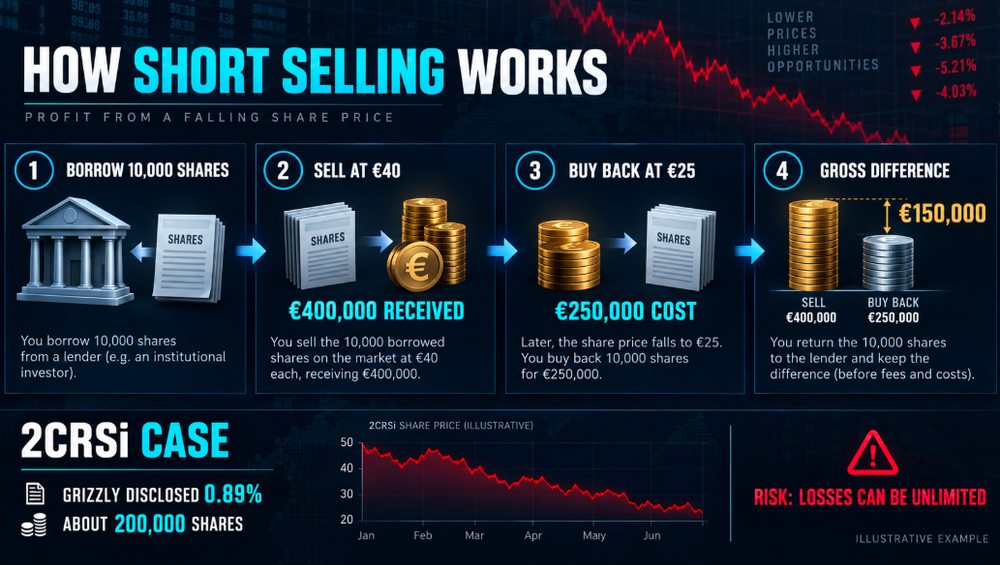
A short seller borrows shares and immediately sells them, hoping to repurchase them later at a lower price.
Imagine an investor borrowing 10,000 shares at €40. The shares are sold for €400,000. If the price later falls to €25, the investor can buy them back for €250,000, return them to the lender and generate a gross gain of €150,000 before borrowing costs and fees.
The risk works in both directions. If the price rises to €60, closing the position would cost €600,000, producing a €200,000 loss. Since a share price can theoretically rise without limit, potential short-selling losses are also theoretically unlimited.
Before releasing its report, Grizzly Capital Management had disclosed a net short position equal to 0.89% of 2CRSi’s capital, approximately 200,000 shares, according to 2CRSi’s response.
For illustration only, selling 200,000 shares at €44.60 and repurchasing them at €25.40 would create a gross difference of approximately €3.84 million. Grizzly’s actual transaction prices, profits and current exposure are not publicly known.
The latest disclosed short position is different. Qube Research & Technologies reported a 0.66% position as of September 8, representing approximately 149,000 shares. Public data remains incomplete because the AMF only publishes individual net short positions of at least 0.5%.
Why a falling market cap can hurt the underlying company
Market capitalization is simply the share price multiplied by the number of outstanding shares. A falling market cap does not remove cash from the balance sheet, but it can create serious indirect consequences.
Consider a company trying to raise €50 million. At €44.60 per share, it would need to issue approximately 1.12 million new shares. At €25.40, it would need around 1.97 million shares, before fees or discounts. Existing shareholders would therefore face roughly 76% more dilution.
A lower valuation can also weaken the company’s acquisition currency, reduce the value of employee stock compensation, affect collateral arrangements and make customers or suppliers question its financial stability. A sharp decline can therefore become a self-reinforcing problem, particularly for a smaller company with limited trading liquidity.
How 2CRSi is trying to recover
Grizzly questioned 2CRSi’s revenue, counterparties, operating sites and the credibility of major announced contracts, including a $610 million framework agreement and a separate €110 million sale of 194 Godì Blackwell Ultra servers to a German customer. 2CRSi strongly rejected the allegations and published a detailed point-by-point response.
The company then appointed an independent firm to examine three financial years, its most significant contracts, the 21 third parties named by Grizzly and the traceability of commercial, banking and accounting documents.
The first major result arrived on September 15. According to 2CRSi’s regulatory release, the independent expert confirmed:
- The German customer placed the 194-server order on May 7, 2026.
- The corresponding supplier purchase existed.
- 2CRSi received the full sales price before delivery.
- The supplier was also paid in full before delivery.
- The transaction was recorded in FY2025/26.
This is a meaningful result because it directly contradicts doubts surrounding that specific €110 million transaction. However, it is not a complete exoneration. The work was commissioned by 2CRSi’s board, does not constitute a statutory audit and covers only one transaction so far. The remaining allegations are still being examined.
At approximately €27.54 on the morning of September 16, the stock had recovered about 8% from its June 18 close but remained roughly 38% below the €44.60 pre-report price. Its market capitalization stood near €630 million. The market is acknowledging progress, but it has not restored its previous level of confidence.
The next four catalysts
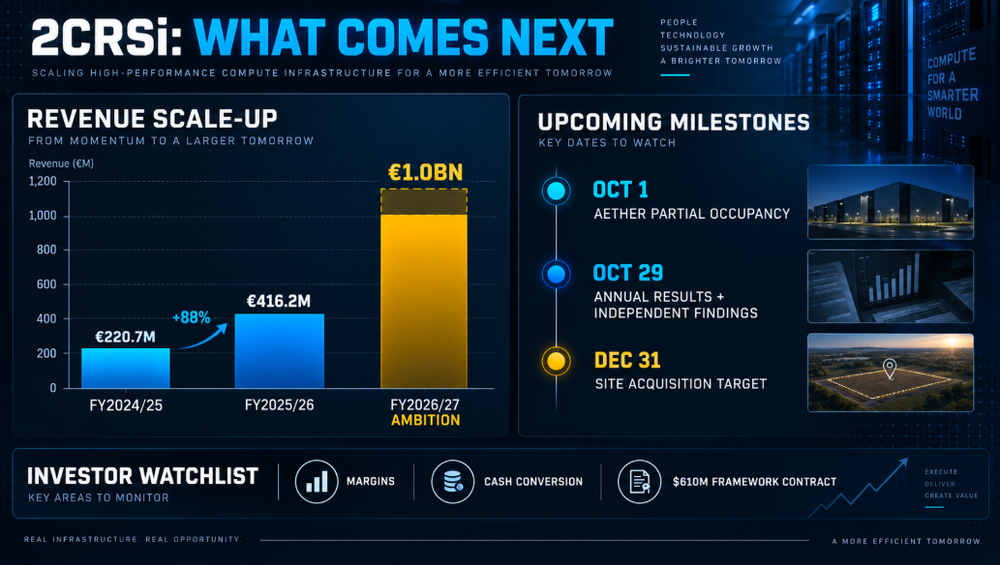
First, the full independent findings are expected no later than the publication of FY2025/26 results on October 29. Investors will want conclusions on the $610 million framework agreement, related-party concerns, geographic revenue reporting and the other counterparties named in the report.
Second, profitability will matter as much as revenue. 2CRSi generated €416.2 million in FY2025/26 revenue, up 88%. Cash reached €14.4 million, compared with negative €0.2 million one year earlier. However, investors still need audited information on gross margin, operating profit, working capital, receivables and cash conversion.
Third, management is targeting €1 billion in FY2026/27 revenue. That would require approximately 140% growth from the latest year. Services revenue nearly tripled to €24.7 million, but it still represented only about 6% of total revenue. Expanding this higher-margin activity could be essential.
Finally, execution of the AETHER project will be watched closely. One Strasbourg site offers 25 MW of power, with partial occupancy expected from October 1 and final acquisition targeted by December 31. Investors will need evidence of financing, customer commitments and actual computing-capacity deployment. 2CRSi has published the project’s ownership and timetable.
Companies that recovered, and companies that did not
Shopify provides one example of a successful recovery. A 2017 Citron Research report caused the shares to fall 11.6% and erased approximately $1.5 billion in market value. Shopify’s 2017 revenue was only $673 million. By 2025, it had reached approximately $11.6 billion. The company eventually defeated the short thesis through sustained operating growth.
Herbalife survived an even more aggressive campaign. Bill Ackman placed a $1 billion bet that the company would fall to zero. Instead, the stock rose from approximately $45 in 2012 to nearly $96 when he exited in 2018. However, Herbalife also paid $200 million and restructured its business under an FTC settlement. A rising share price did not mean every criticism was baseless.
Other short reports correctly identified fundamental problems. Wirecard dismissed years of allegations before admitting that €1.9 billion in reported cash probably never existed. The company entered insolvency in 2020 owing creditors nearly $4 billion.
Nikola followed a similar path after Hindenburg Research questioned its technology in 2020. The stock fell from more than $60 to below $1, its founder was convicted of fraud, and the company ultimately filed for Chapter 11 bankruptcy in February 2025.
What the 2CRSi case teaches investors
Short sellers can accelerate a collapse in confidence, but they cannot determine a company’s long-term value by themselves. Shopify recovered because its numbers and execution became stronger. Wirecard failed because the evidence eventually confirmed the core concerns.
For 2CRSi, the independent confirmation of the German transaction removes one major uncertainty. It does not resolve the entire case. A durable recovery will require a complete investigation, audited profitability, strong cash conversion and successful delivery of the company’s ambitious €1 billion growth plan.
The stock is no longer priced as if every allegation must be correct. It is also far from the valuation it commanded before the report. The next evidence, not the loudest narrative, will decide which side of that gap is justified.
Disclosure: The author may hold shares in 2CRSi and other companies mentioned in this article. This content is for informational purposes only and does not constitute financial advice.

Marc has been involved in the Stock Market Media Industry for the last +5 years. After obtaining a college degree in engineering in France, he moved to Canada, where he created Money,eh?, a personal finance website.