The pressure on stocks is becoming easier to measure. The U.S. 10-year Treasury yield stood near 5.21% during the European morning, following a climb to its highest level since 2007. Investors must now assess whether corporate earnings, particularly from artificial intelligence, can justify equity valuations when government bonds offer yields above 5%. For companies financing expansion, even a small increase in borrowing costs can translate into millions of dollars in additional annual expenses.
Key Takeaways
- Treasury yields above 5% are testing stock valuations.
- AI hyperscalers have issued roughly $250 billion of debt this year.
- Markets await PCE inflation forecasts of 3.7% headline and 3.3% core.
Treasury Yields Reach Levels Last Seen Before the Financial Crisis
On September 29, the 10-year Treasury yield briefly reached 5.293%, its highest level since June 2007. The 30-year yield touched 5.6206%, a level last seen in June 2002. By early Wednesday, the 10-year had eased to approximately 5.21%, while the two-year stood near 4.87%.
The move has been substantial over the quarter. Reuters’ early September 30 briefing put the increase in the 10-year yield at approximately 81 basis points, or 0.81 percentage points, during July through September. That would mark its largest quarterly rise since 2022.
Stocks have absorbed that pressure with relatively modest losses. Tuesday’s closing figures illustrate the gap between the sharp change in financing conditions and the smaller response in major equity indexes.
| U.S. index | September 29 close | Daily change |
|---|---|---|
| Dow Jones Industrial Average | 51,349.92 | −0.26% |
| S&P 500 | 7,670.84 | −0.17% |
| Nasdaq Composite | 26,797.54 | −0.09% |
The small declines suggest investors have not abandoned earnings growth expectations. They also leave an important question unresolved: how much further can borrowing costs rise before companies reduce investment or investors demand lower share prices?
How 20% Earnings Growth Can Still Produce a Falling Stock
Higher interest rates affect the price investors are willing to pay for future profits. A business can deliver strong operating results while its share price falls if investors reduce its valuation multiple.
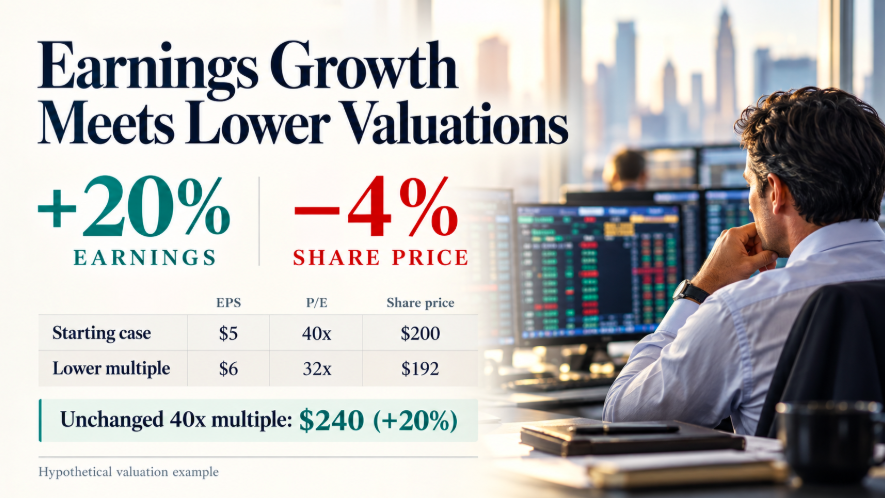
Consider a hypothetical company earning $5 per share and trading at 40 times earnings. Its share price would be $200. If earnings increase by 20% to $6, but the market values those profits at 32 times earnings, the share price becomes $192. Earnings have grown substantially, yet the stock has fallen 4%.
This is an illustration, not a forecast for a particular company. It shows why earnings growth and investment returns can diverge. A 20% reduction in the valuation multiple can more than offset 20% growth in earnings.
The same example also shows the potential upside. If earnings reach $6 and the multiple remains at 40, the share price becomes $240, a 20% increase. The outcome depends on both business performance and the valuation investors accept.
AI’s Borrowing Bill Is Already Measured in Hundreds of Billions
A September 29 Reuters column reported that hyperscalers had issued roughly $250 billion of debt this year. It also highlighted $27 billion of Beignet Investor bonds connected to Meta’s Hyperion project. Those notes carry a 6.581% coupon and mature in 2049. On September 28, they traded around 91 cents on the dollar, with yields reaching approximately 7.55%.
The distinction between coupon and market yield matters. A falling bond price increases the yield available to a new buyer; it does not automatically raise the issuer’s fixed coupon payments. However, it can signal that investors will demand more compensation when similar projects seek new financing.
SoftBank provides another example of the scale involved. On September 24, Reuters reported an $11.1 billion bond sale supporting its OpenAI investment plans. That followed a separate ¥1 trillion retail bond issue, equivalent to approximately $6.3 billion. Two euro tranches in the newer transaction, each worth €500 million, offered yields of 7.125% and 8%.
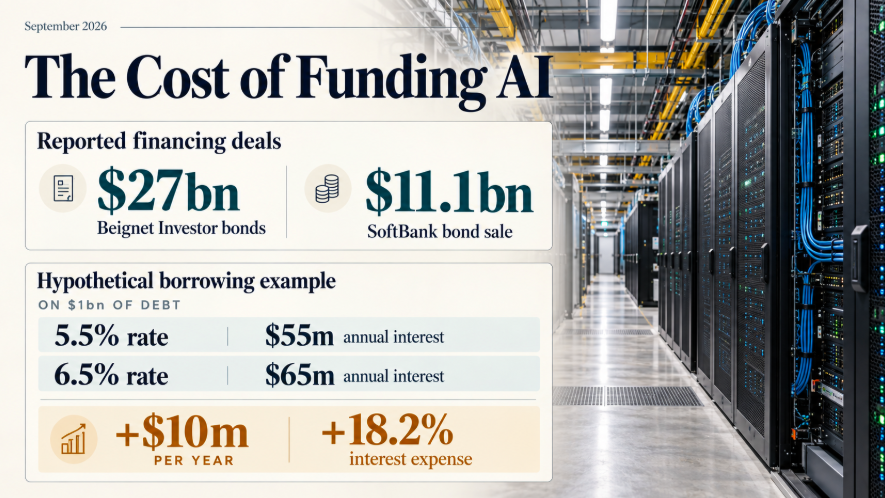
These transactions show that funding remains available, but its price matters. As a separate hypothetical example, $1 billion of debt costing 5.5% requires $55 million in annual interest. At 6.5%, that becomes $65 million: an additional $10 million each year, or an 18.2% increase in interest expense.
For an expanding business, that extra expense competes with spending on equipment, employees, and research. Companies generating enough cash internally have more flexibility than those that must regularly refinance debt or issue new shares.
Today’s Inflation Numbers Could Shift Expectations
The next scheduled checkpoint is the August personal income and outlays report at 8:30 a.m. Eastern, or 14:30 in Paris. The release was still pending when this article was prepared. Consensus forecasts point to the following figures.
| PCE inflation measure | August forecast |
|---|---|
| Headline, monthly change | +0.4% |
| Headline, annual change | +3.7% |
| Core, monthly change | +0.3% |
| Core, annual change | +3.3% |
Headline inflation of 3.7% would remain 1.7 percentage points above the Federal Reserve’s 2% objective. The monthly forecasts also imply an acceleration from July’s 0.2% increases in both headline and core PCE.
This release includes statistical updates, so revisions to earlier readings will matter alongside the new August figures. A lower published annual rate would need to be assessed for both underlying price changes and measurement effects.
Employment data add context. The Bureau of Labor Statistics reported approximately 7.1 million job openings in August, 5.2 million hires, and 1.6 million layoffs and discharges. It described openings and hires as little changed. Those figures support a more measured assessment than assuming that high borrowing costs have already caused a collapse in employment.
What Could Support Further Gains
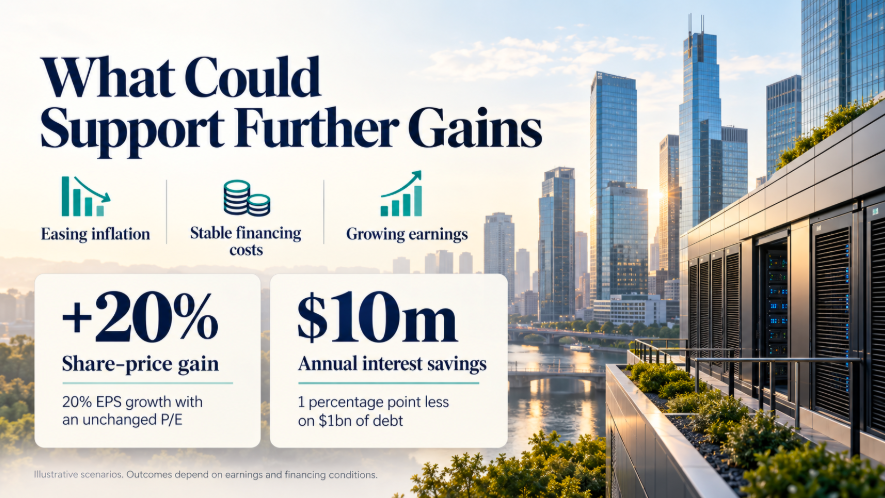
The most supportive combination would be easing inflation, stable financing costs, and continued earnings growth. That could allow investors to retain higher valuation multiples while companies increase profits.
The numerical examples show why this matters. A company delivering 20% earnings growth can produce a 20% share-price gain at an unchanged multiple. A borrower securing financing one percentage point more cheaply can save $10 million annually on $1 billion of debt. These are conditional examples, but they explain how modest changes in financial conditions can materially influence shareholder returns.
Investors should therefore watch earnings guidance, interest expense, and cash generation together. Growing sales are more useful when a business can fund the investment needed to deliver them.
Bottom Line
Treasury yields near 5.2%, substantial AI borrowing, and inflation forecasts above 3% create a demanding environment for stocks. The opportunity remains meaningful if companies turn investment into sustained earnings growth. But the arithmetic is less forgiving: higher financing costs reduce profits, and lower valuation multiples can offset business growth. The stronger investment cases will be those where expected earnings, funding needs, and the price paid for the shares make sense together.
This article is for informational purposes and does not constitute investment advice. Numerical company examples are hypothetical and are not price targets.

Marc has been involved in the Stock Market Media Industry for the last +5 years. After obtaining a college degree in engineering in France, he moved to Canada, where he created Money,eh?, a personal finance website.