Space stocks have fresh reasons to attract attention. Repeat launch orders, government awards and satellite deployments are putting measurable progress behind some of the sector’s ambitions. Rocket Lab and Satellogic have delivered the strongest recent share-price gains among the five companies examined here, while AST SpaceMobile is building a substantial contracted revenue base.
The evidence supports renewed interest, with an uneven recovery in share prices. The investment question is how effectively each company can turn its commitments and expanding capabilities into revenue, cash flow and shareholder returns.
- Rocket Lab and Satellogic led this group’s recent rebound, gaining 12.7% and 17.8% from September 1 to October 1.
- Commercial launch orders, defense awards and sovereign satellite programs are strengthening revenue visibility across several space businesses.
- Analyst targets suggest substantial potential upside, while delivery schedules, funding and cash flow will determine whether that upside materializes.
Share Prices Show an Uneven Recovery
The market snapshot gives the momentum story some perspective:
| Stock | Oct. 1 close | Change since Sept. 1 | 52-week range | Average 12-month target | Implied upside |
|---|---|---|---|---|---|
| Rocket Lab (RKLB) | $70.46 | +12.7% | $37.57–$151.00 | $109.37 | +55.2% |
| AST SpaceMobile (ASTS) | $57.04 | +2.2% | $49.31–$133.86 | $79.61 | +39.6% |
| Satellogic (SATL) | $5.42 | +17.8% | $1.26–$12.00 | $10.20 | +88.2% |
| Planet Labs (PL) | $16.14 | −16.2% | $10.52–$51.76 | $33.40 | +106.9% |
| BlackSky (BKSY) | $21.15 | −1.4% | $12.41–$52.88 | $38.42 | +81.7% |
All prices are in U.S. dollars. Changes compare September 1 and October 1 closing prices. Consensus targets were retrieved October 2 and reflect analyst reports issued on different dates. Implied upside equals target divided by closing price, minus one; it is not a forecast of realized returns.
Rocket Lab Wins Repeat Launch Orders
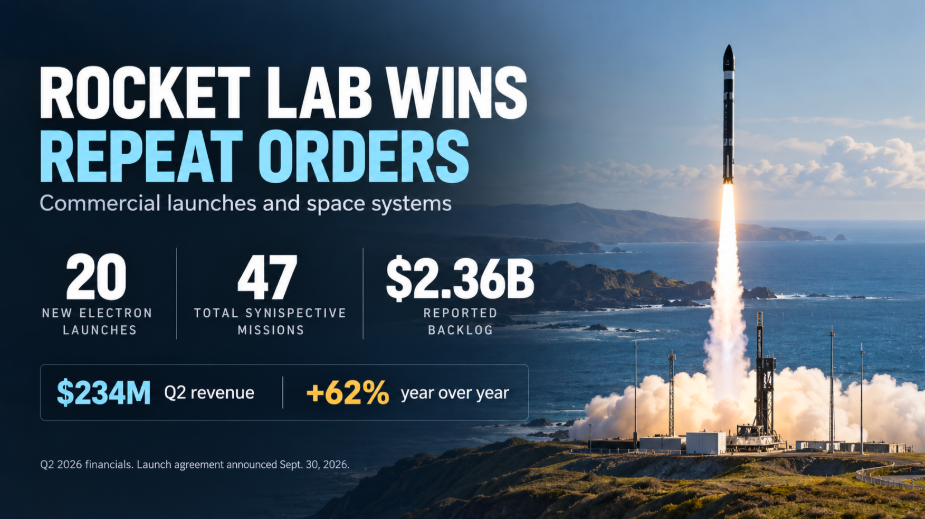
Rocket Lab provides a clear example of customers returning with larger orders. On September 30, it announced a 20-launch Electron agreement with Japan’s Synspective, taking that customer’s total contracted missions to 47. The new missions are scheduled for 2028–2031. Financial terms were undisclosed, but the agreement pushed Rocket Lab’s launch queue beyond 100 missions.
Its June-quarter results also showed record revenue of $234 million, up 62% year over year, and a $2.36 billion backlog, up 137%. The update disclosed a $397 million Space Force contract for spacecraft and launches supporting airborne-threat monitoring, with that value including options. Management guided September-quarter revenue to $250 million–$265 million. Together, these figures show demand across both launch services and space systems. The next test is delivering those orders while funding Neutron’s development and improving profitability.
AST SpaceMobile Builds Its Commercial and Government Revenue Base
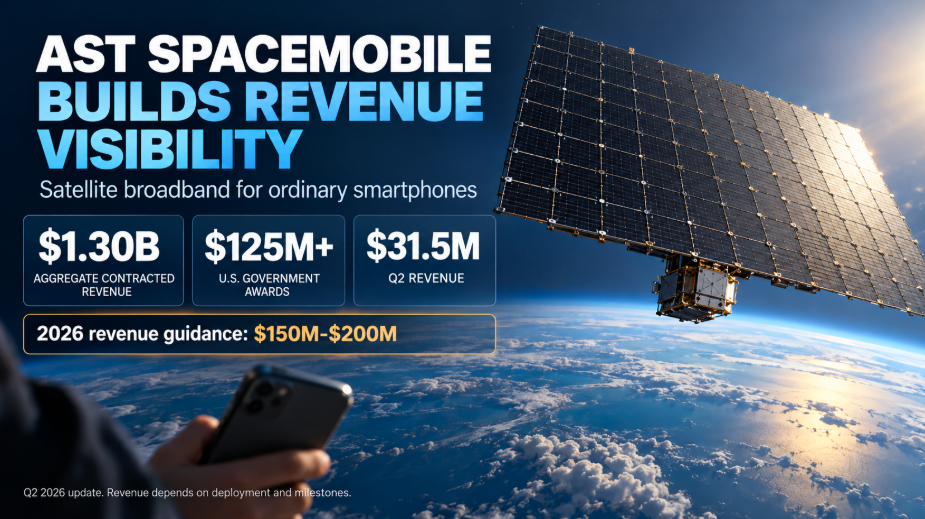
AST SpaceMobile offers exposure to a different market: satellite broadband that connects directly to ordinary smartphones. In its August update, AST reported approximately $1.30 billion in aggregate contracted revenue from commercial partners and U.S. government awards. Government awards exceeded $125 million, adding national-security applications to the commercial connectivity opportunity. June-quarter revenue was $31.5 million, with full-year guidance of $150 million–$200 million.
That contracted base provides visibility over future business, although revenue depends on deployment and performance milestones. AST also reported more than $3.7 billion in pro forma cash and restricted cash after its July financing. The remaining challenge is turning satellite capacity into a dependable service and scaling customer usage. Analyst sentiment captures some of that uncertainty: the average target is $79.61, while the aggregate rating remains Hold. A positive target gap does not represent unanimous conviction.
Satellogic Reaches Its First Positive Adjusted EBITDA Quarter
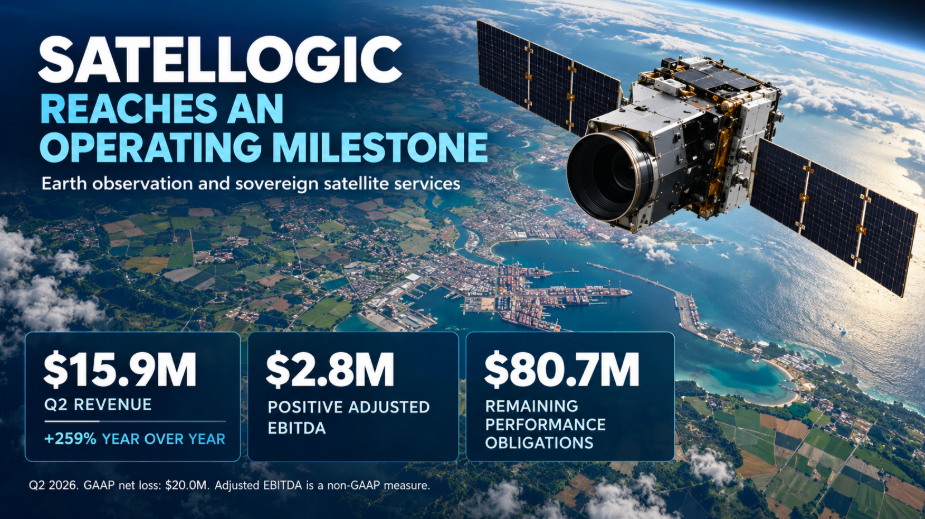
Satellogic’s appeal rests on a sharper operating improvement from a smaller revenue base. June-quarter sales rose 259% to $15.9 million. The company recorded its first positive adjusted EBITDA quarter at $2.8 million, alongside $0.3 million of operating income. It still reported a $20 million net loss, including a $19.7 million non-cash financial-instrument remeasurement charge. The operating milestone therefore deserves attention without being mistaken for sustained net profitability.
Its remaining performance obligations reached $80.7 million at June 30, with $45.8 million expected to become revenue within one year. Recent wins included a one-year defense imagery agreement worth more than $18 million and a $12 million sale of an operational satellite to a sovereign defense customer. These contracts give the growth story a firmer commercial basis, although satellite deliveries can make quarterly results uneven.
September brought expanded Slingshot III work with Innovative Defense Technologies supporting the U.S. Office of Naval Research. The agreement supports integration of six additional satellites over 18 months and testing in 2027–2028. Faster onboard processing and communications between satellites could make its intelligence services more useful to defense customers. Financial terms were not disclosed. Satellogic’s customer-funded Merlin program provides another potential route into daily global monitoring.
Planet Labs Expands Government Contracts and Satellite Capacity
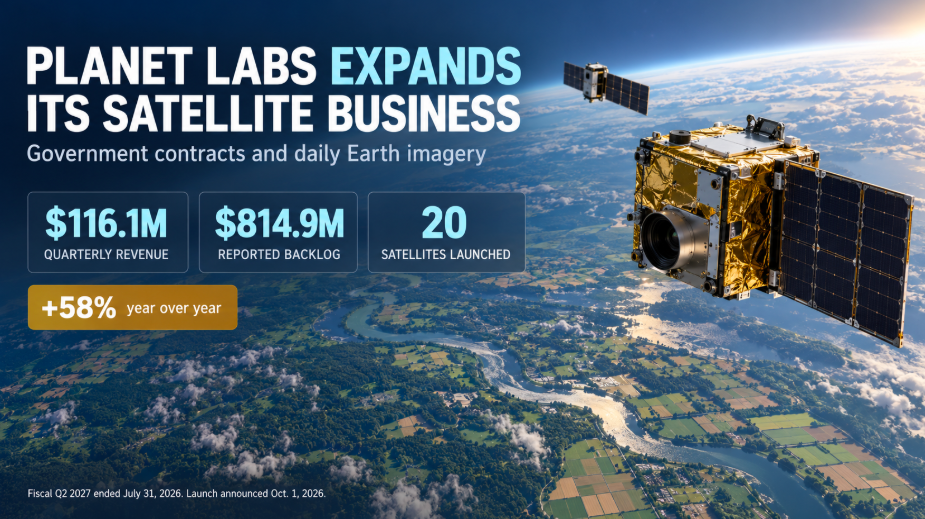
Planet Labs broadens the comparison beyond the strongest recent share-price performers. For its fiscal second quarter, ended July 31, revenue increased 58% to $116.1 million. Backlog stood at $814.9 million, including $753.1 million of remaining performance obligations. Planet expects roughly half the backlog to convert into revenue within twelve months. Recent awards included $8 million from the National Geospatial-Intelligence Agency and a German government tender with a maximum value of €25 million over five years, including options.
On October 1, Planet also announced the launch of 20 satellites, including Tanager-2, 18 SuperDoves and a prototype for Google’s Project Suncatcher. Commissioning had begun, with further SuperDove deployments expected from an orbital transfer vehicle. The Google project tests computing hardware in space and remains experimental. These developments add operating catalysts even as Planet’s shares have declined over the comparison period.
BlackSky Grows Its Defense Intelligence Business
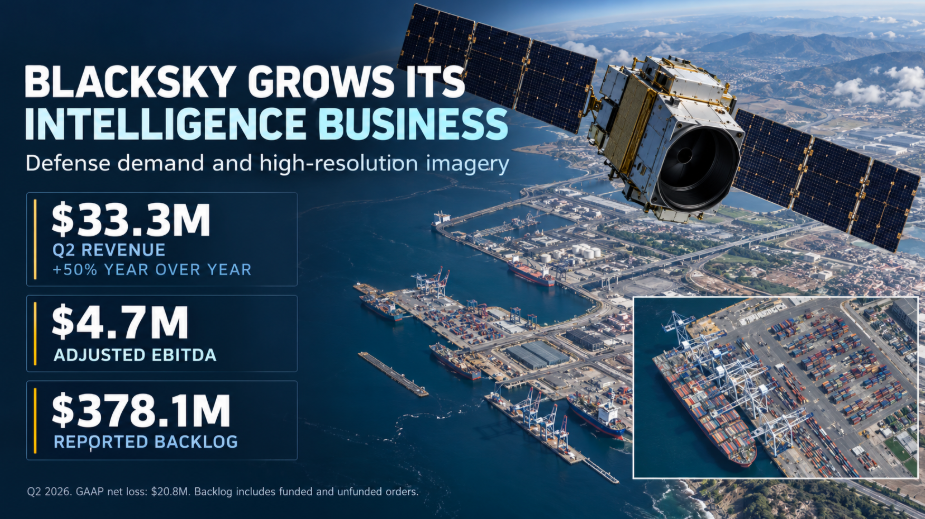
BlackSky gives the sector another defense intelligence business with measurable growth. June-quarter revenue increased 50% to $33.3 million, and adjusted EBITDA reached $4.7 million, alongside a $20.8 million net loss. Awards included an eight-figure National Reconnaissance Office contract for its AROS mapping system and seven-figure NGA renewals.
Its June 30 filing disclosed $378.1 million of backlog, including funded and unfunded orders but excluding unexercised options. It expected to recognize $76.2 million during the second half of 2026 and $72.6 million in 2027. That provides a useful delivery timetable and shows why investors should examine when contracted work becomes revenue.
What Backlogs and Analyst Targets Tell Investors
Backlog quality matters throughout this comparison. Planet’s broader backlog includes cancelable contract amounts, while Satellogic reports accounting-based remaining performance obligations. Some government award values include options. These measures describe different levels of commitment and should be assessed alongside delivery costs, funding requirements and customer concentration. Targets also depend on assumptions: Satellogic’s consensus covers five analysts, compared with 20 for Rocket Lab.
Bottom Line
Space stocks have earned a fresh look through stronger customer commitments and operating progress. Rocket Lab and Satellogic show the clearest recent price rebound in this group; AST offers a large connectivity opportunity, and Planet and BlackSky add growing intelligence businesses. A durable sector recovery will require more companies to convert demand into repeat revenue and cash generation. The latest awards strengthen the business case, while uneven price performance leaves a broad stock-market recovery unproven.
Disclosure: This article is for information and discussion, not personalized investment advice. Analyst targets and company guidance are estimates, and forward-looking outcomes may differ materially.

Marc has been involved in the Stock Market Media Industry for the last +5 years. After obtaining a college degree in engineering in France, he moved to Canada, where he created Money,eh?, a personal finance website.