France’s budget problems are moving beyond Paris. They are influencing European bond markets and the value of the euro.
On October 7, the euro fell 0.6% to $1.1199 during trading, according to Reuters. For European investors, that movement changes more than the cost of an American holiday. It changes the euro value of US investments, even when their dollar prices remain unchanged.
France’s weak growth and fiscal uncertainty help explain the pressure. Higher US interest rates and renewed energy tensions strengthen the dollar’s appeal.
- France combines weak growth with rising debt, increasing pressure on its budget and borrowing costs.
- Dollar strength reflects French fiscal anxiety, higher US policy rates and renewed energy pressure.
- Euro-based investors should separate investment performance from currency gains when assessing their US exposure.
France has little room to absorb another shock
France’s economy contracted 0.2% in the first quarter and stagnated in the second, according to Eurostat’s September estimates. The Banque de France now forecasts just 0.4% growth for 2026. Its September projection cut the previous estimate by 0.1 percentage point.
The government’s October forecast is slightly higher, at 0.5%. Meanwhile, public debt reached approximately €3.60 trillion at the end of June. That represented 119.0% of GDP, according to INSEE.
The government’s latest projections illustrate the constraint:
| French public finances | 2026 forecast | 2027 forecast |
|---|---|---|
| Real GDP growth | 0.5% | 1.0% |
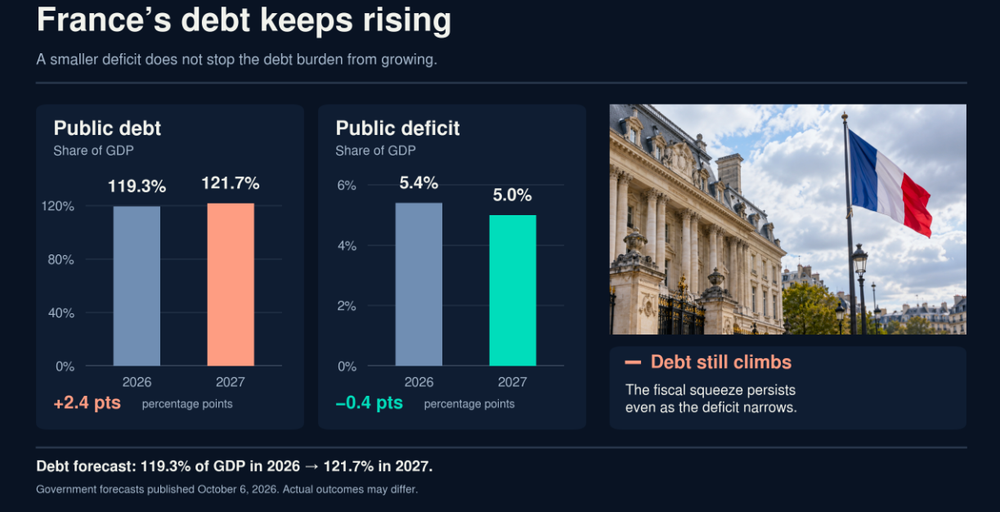
| Public deficit, as a share of GDP | 5.4% | 5.0% |
| Public debt, as a share of GDP | 119.3% | 121.7% |
These forecasts were published on October 6. They depend on the government’s economic assumptions and proposed budget measures.
The deficit is projected to narrow while the debt ratio continues rising.
Slower growth limits the expansion of tax receipts. Spending restraint can help repair the budget, while also weakening demand. France therefore faces a difficult balance between supporting activity and rebuilding confidence in its public finances.
Bond investors are demanding more compensation
France’s ten-year bond yield rose 70 basis points during September. That equals a 0.70-percentage-point increase.
Its yield premium over German ten-year bonds approached 160 basis points last week. Reuters reported that this was the widest gap since 2012. A widening gap with Germany signals additional concern about France itself. It helps distinguish French fiscal anxiety from a general increase in European interest rates. France plans €340 billion of medium- and long-term bond issuance in 2027, net of buybacks.
Those sales finance the government and replace maturing debt. Refinancing progressively exposes older borrowing to today’s financing conditions. The proposed budget puts state debt costs at €72.9 billion for 2027. Higher borrowing costs absorb resources that could otherwise fund services, investment or deficit reduction.
This creates a difficult feedback loop. Fiscal uncertainty raises financing costs, which can make the fiscal adjustment harder.
Europe’s economic picture remains uneven
The wider eurozone still shows resilience.
Eurozone GDP expanded 0.6% in the second quarter, following no growth in the first quarter.
In September, the ECB forecast 0.9% growth for 2026 and 1.4% for 2027. Both estimates were revised upward.
Those figures make a blanket claim of European economic decline difficult to defend.
France’s weakness sits alongside improvement elsewhere. Investors can therefore become more cautious about the euro while parts of the region continue expanding.
Our reading is that fiscal vulnerability is becoming a greater concern for markets.
The issue is how much room governments retain when energy costs rise and financing becomes more expensive.
Higher US rates give the dollar another advantage
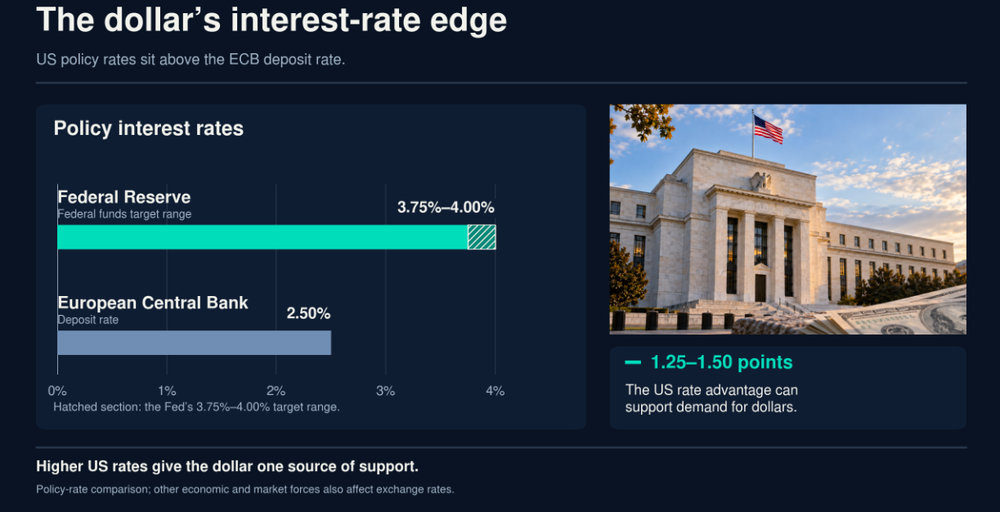
The Federal Reserve raised its policy range to 3.75%–4.00% on September 16. The ECB also raised rates in September, taking its deposit rate to 2.50%.
The US policy range therefore sits 1.25–1.50 percentage points above the ECB deposit rate. This gap can make dollar assets more attractive to investors accepting currency exposure. Exchange-rate movements can still outweigh the additional interest. Markets also price the expected path of rates.
Reuters reported that European bond turmoil had reduced expectations for further ECB increases. Our interpretation is that weaker European rate expectations add another source of support for the dollar. Energy pressure adds to the strain. Brent crude traded above $100 a barrel on October 7 amid renewed Middle East tensions. For European energy importers, expensive oil and a weaker euro can compound cost increases. That can erode purchasing power and squeeze company margins. It also leaves the ECB balancing inflation pressure against risks to economic activity.
Currency moves can change an investor’s return
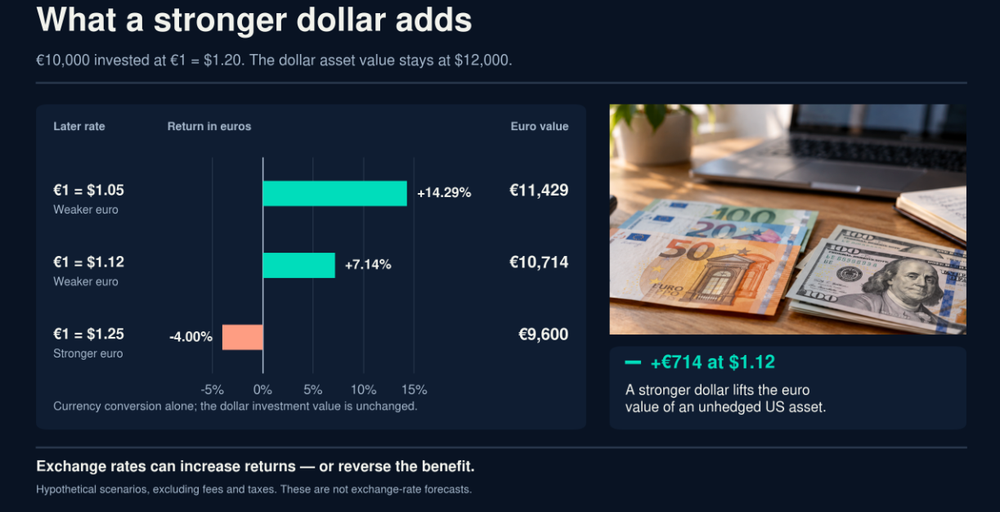
Consider a hypothetical €10,000 investment made when one euro buys $1.20. The investor receives $12,000 before fees.
Assume the investment’s dollar value remains unchanged.
| Later exchange rate | Investment value in euros | Currency-driven return |
|---|---|---|
| €1 = $1.12 | €10,714 | +7.14% |
| €1 = $1.05 | €11,429 | +14.29% |
| €1 = $1.25 | €9,600 | −4.00% |
These are illustrations, excluding fees and taxes. They are not exchange-rate forecasts. At $1.12, currency conversion alone adds approximately €714. A stock loss can still overwhelm that benefit. If the investment falls 15% in dollars, its euro value becomes approximately €9,107 at $1.12. The investor remains down about 8.9%.
An existing US holding and a new purchase face different starting exchange rates.
An investor buying today receives fewer dollars per euro than someone buying at the hypothetical $1.20 rate. Future performance depends on the next currency movement.
Company exposure matters more than its listing location
The implications for companies also vary. An exporter receiving dollars while paying many costs in euros may benefit from euro weakness. An importer paying dollar invoices while selling mainly in France may face additional pressure. Currency hedges, pricing power and customer demand can change either outcome. For investors assessing European companies, the useful questions concern revenue currencies, cost currencies and refinancing needs.
A French listing alone reveals little about those exposures. For US investments, compare the return in dollars with the return in euros. That separates the company’s performance from the contribution of the exchange rate.
Bottom Line
- France’s weak growth and rising debt are increasing pressure on European bond markets and the euro.
- Higher US rates and energy tensions reinforce the dollar’s current advantage.
- For euro-based investors, the practical step is to review existing currency exposure before adding more.
- Watch France’s yield gap with Germany, budget execution and changing expectations for ECB and Fed rates.
The investment decision should reflect earnings, valuation and currency exposure together.
This article is for information only and does not constitute investment advice.

Marc has been involved in the Stock Market Media Industry for the last +5 years. After obtaining a college degree in engineering in France, he moved to Canada, where he created Money,eh?, a personal finance website.